
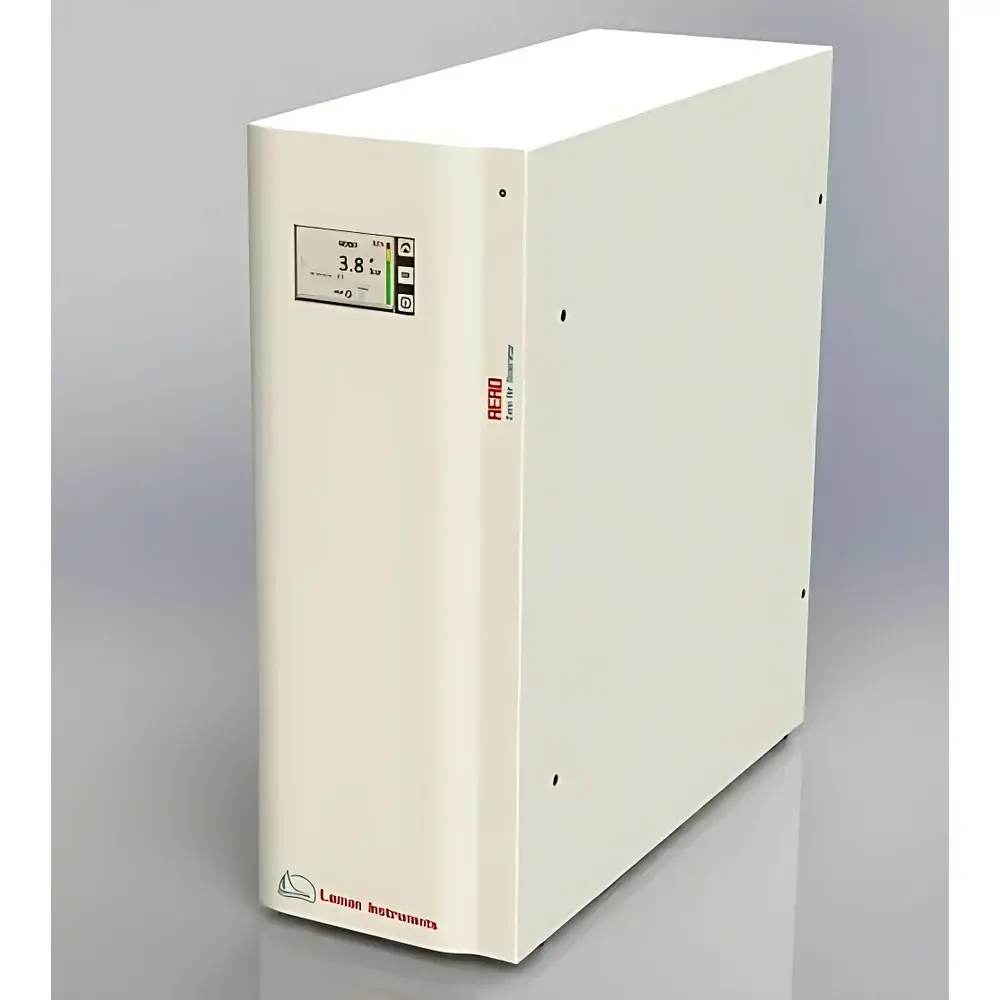
Leman Instruments AEROSTATION 50 TOC LC or RC Zero-Air Generator
| Brand | Leman Instruments |
|---|---|
| Origin | France |
| Model | AEROSTATION 50 TOC LC or RC |
| Hydrocarbon Removal Principle | High-Temperature Catalytic Cracking |
| Output Flow Rate | 1.5–3 L/min |
| Maximum Output Pressure | 5 bar |
| Total Hydrocarbon (THC) Content | <0.05 ppm |
| Dew Point | −60 °C (DP) |
| CO₂ Content | <1 ppm |
| Display & Connectivity | Full-color touchscreen interface |
Overview
The Leman Instruments AEROSTATION 50 TOC LC or RC is a laboratory-grade zero-air generator engineered for analytical applications requiring ultra-low hydrocarbon contamination and thermally stable, moisture-controlled air streams. It operates on high-temperature catalytic cracking — a proven, robust method for complete oxidation of volatile organic compounds (VOCs) and residual hydrocarbons in compressed ambient air. Unlike adsorption-based systems, this principle ensures continuous, stable, and maintenance-free removal of THC down to <0.05 ppm (v/v), with no breakthrough risk under varying load conditions. The unit delivers air meeting stringent “zero-air” specifications defined by ASTM D6196, ISO 8573-1 Class 1.1.1 (for particles, water, and oil), and EPA Method TO-14/TO-15 for trace-level VOC analysis. Its integrated refrigerant dryer and dual-stage desiccant polishing stage achieve a consistent dew point of −60 °C, minimizing condensation risks in sensitive detector interfaces and gas chromatography (GC) auxiliary lines.
Key Features
- High-temperature catalytic converter (≥350 °C) for irreversible hydrocarbon oxidation — eliminates need for consumable scrubbers or frequent media replacement
- Stable output flow range of 1.5–3 L/min at up to 5 bar (g) pressure, compatible with both low-flow FID make-up gas and higher-demand LC-MS nebulizer air supply configurations
- Real-time monitoring via full-color capacitive touchscreen with intuitive menu navigation, system status icons, and alarm history log
- Dual communication architecture: native support for RS485 (Modbus RTU), USB (virtual COM port), and Ethernet (TCP/IP) enabling seamless integration into centralized lab gas management systems and SCADA platforms
- Passive thermal design with forced-air convection cooling — no external cooling water required; acoustically optimized for quiet operation (<52 dBA at 1 m)
- Compact footprint (W × D × H: 480 × 520 × 320 mm) and CE-marked construction compliant with IEC 61010-1 for laboratory electrical safety
Sample Compatibility & Compliance
The AEROSTATION 50 TOC LC or RC is validated for use as combustion air in flame ionization detectors (FID), photoionization detectors (PID), and electron capture detectors (ECD); as zero-gas for hydrocarbon calibration standards (e.g., permeation tubes, dynamic dilution systems); and as auxiliary gas for LC-MS interface drying and nebulization. It meets the air purity requirements specified in USP , EP 2.2.46, and ISO/IEC 17025-accredited laboratories for GC method validation. Its firmware supports audit-trail-enabled operation per FDA 21 CFR Part 11 when deployed with compliant LIMS or data acquisition software — including timestamped event logging, user access levels, and configuration change tracking.
Software & Data Management
The embedded controller runs a deterministic real-time OS with configurable alarm thresholds (e.g., pressure drop >0.3 bar across catalyst bed, dew point excursion >−55 °C). All operational parameters — flow rate, outlet pressure, catalyst temperature, dew point, and runtime hours — are logged internally with 30-day circular buffer memory. Data export is supported via USB mass storage mode (CSV format) or network polling using Modbus TCP. Optional OEM SDK enables custom integration with LabVIEW, Python-based monitoring dashboards, or enterprise-wide gas quality dashboards compliant with ISA-88/ISA-95 frameworks.
Applications
- Primary combustion gas source for Agilent, Thermo Fisher, and Bruker GC-FID systems in environmental, petrochemical, and pharmaceutical QC labs
- Zero-air supply for online ambient air monitoring stations (e.g., EPA SLAMS, EMEP networks) requiring certified background gas for automated hydrocarbon analyzers
- Carrier and purge gas in headspace-GC and purge-and-trap (P&T) systems where sub-ppb THC interference must be excluded
- Instrument air for FTIR spectrometers, cavity ring-down spectroscopy (CRDS) platforms, and laser-based trace gas analyzers demanding non-reactive, particle-free airstreams
- Support gas in regulated stability-indicating methods per ICH Q5C, where air purity directly impacts degradation product detection sensitivity
FAQ
What is the expected service life of the catalytic converter?
The high-temperature catalytic module is rated for ≥15,000 operating hours under nominal flow and inlet air quality meeting ISO 8573-1 Class 4 (7 µm particulate, 30 °C DP, 0.1 ppm oil aerosol).
Can the unit be rack-mounted or installed in a ventilated cabinet?
Yes — it features standardized 19-inch rack ears (optional) and rear exhaust ventilation; minimum clearance of 100 mm required at intake and exhaust grilles.
Does the generator require an external air dryer or pre-filtration?
A coalescing filter (0.01 µm) and activated carbon pre-filter are recommended upstream if inlet compressed air exceeds ISO 8573-1 Class 4 specifications; these are available as optional accessories.
Is remote diagnostics supported?
Yes — Ethernet connectivity enables secure remote access via TLS-encrypted web interface (HTTPS) and SNMP v3 traps for predictive maintenance alerts.
How is compliance with GLP/GMP documented?
Factory calibration certificates include uncertainty budgets traceable to NIST SRMs; IQ/OQ documentation packages are available upon request for GxP-regulated installations.



