
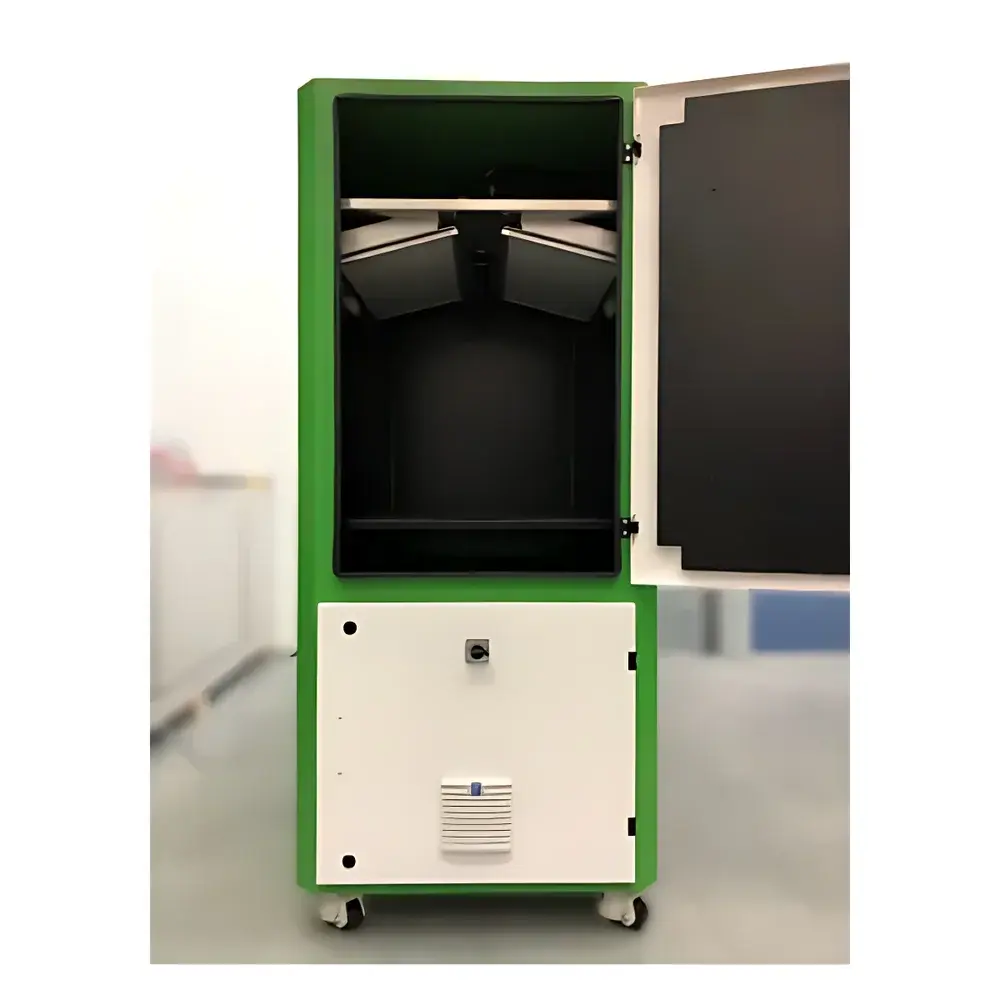
LemnaTec PhenoAIxpert ES High-Sensitivity Bioluminescence Imaging System
| Brand | LemnaTec |
|---|---|
| Origin | Germany |
| Manufacturer Type | Authorized Distributor |
| Origin Category | Imported |
| Model | PhenoAIxpert ES |
| Pricing | Upon Request |
Overview
The LemnaTec PhenoAIxpert ES High-Sensitivity Bioluminescence Imaging System is a laboratory-scale, integrated phenotyping platform engineered for quantitative, non-invasive analysis of plant bioluminescence and morphological traits. Unlike conventional fluorescence imaging systems, the PhenoAIxpert ES employs a scientifically optimized optical architecture centered on low-noise, actively cooled scientific-grade bioluminescence detection—capable of resolving ultra-weak photon emissions from luciferase-expressing transgenic plants, luminescent microbes, or reporter-based metabolic activity. Its dual-sensor design integrates high-resolution RGB top-view imaging with a thermoelectrically cooled back-illuminated EMCCD or sCMOS sensor specifically calibrated for photon-counting in the 400–900 nm spectral range. This enables simultaneous acquisition of structural phenotypes (e.g., leaf area, rosette symmetry, lesion morphology) and functional bioluminescent signals (e.g., promoter activity, pathogen colonization dynamics, stress-induced gene expression), all under controlled, reproducible illumination conditions. The system is designed for compliance with GLP-aligned experimental workflows and supports traceable, audit-ready data capture per ISO/IEC 17025 and FDA 21 CFR Part 11 principles when configured with appropriate software modules.
Key Features
- Top-mounted, uniform diffuse LED illumination system minimizing specular reflection and shadow artifacts across diverse sample geometries—including Petri dishes, multi-well plates, seed trays, and individual pots.
- Industrial-grade, actively cooled bioluminescence imaging sensor with sub-electron read noise and >95% quantum efficiency at peak emission wavelengths (e.g., firefly luciferase: ~560 nm).
- Co-registered high-resolution RGB camera (≥5 MP, global shutter) enabling pixel-accurate overlay of morphological and luminescent datasets.
- Integrated industrial PC with touch-enabled HMI interface; all hardware control, image acquisition, preprocessing, and basic analysis executed locally without external dependencies.
- Modular workflow engine supporting standardized, repeatable protocols—configurable for time-series imaging, dose-response assays, or multi-condition comparative studies.
- Structured image metadata management compliant with MIAPPE (Minimum Information About a Plant Phenotyping Experiment) guidelines.
Sample Compatibility & Compliance
The PhenoAIxpert ES accommodates a broad spectrum of biological samples relevant to plant science and agro-biotechnology research: intact Arabidopsis thaliana or crop seedlings (up to 30 cm height), excised leaf discs, germinating seeds, root segments in transparent containers, fungal-infected tissue explants, and insect–plant interaction models (e.g., aphid-infested leaves, lepidopteran egg clusters). Sample carriers include standard 6–96-well microplates, square Petri dishes (up to 150 mm), custom trays, and individual growth pots (diameter ≤120 mm). All optical components meet CE marking requirements for laboratory instrumentation. The system architecture supports ISO 17025-compliant calibration traceability via optional NIST-traceable photometric standards and routine dark-current/flat-field correction routines embedded in firmware.
Software & Data Management
Acquisition and analysis are managed through LemnaTec’s proprietary Phenolyzer Suite v5.x, a validated desktop application built on Qt and R frameworks. It implements a scriptable workflow editor allowing users to define multi-step pipelines—from auto-focus and exposure optimization to background subtraction, ROI segmentation, intensity normalization, and statistical summarization. Output includes structured CSV/TSV files containing raw pixel intensities, derived phenotypic descriptors (e.g., projected area, convex hull ratio, color histograms), and time-resolved luminescence kinetics. PDF reports are auto-generated using R Markdown templates, embedding ggplot2 visualizations, ANOVA summaries, and raw measurement tables. Optional AI-assisted modules leverage pre-trained CNN models for lesion segmentation, genotype classification, or developmental stage prediction—deployable offline with local inference engines to ensure data sovereignty and regulatory compliance.
Applications
- Quantitative monitoring of luciferase reporter gene expression in transgenic lines under abiotic/biotic stress (e.g., drought, salinity, pathogen challenge).
- Spatiotemporal tracking of bioluminescent bacterial or fungal colonization in planta, including quantification of infection foci and expansion rates.
- High-throughput screening of mutant populations or CRISPR-edited lines for altered promoter activity or signaling pathway activation.
- Seed viability and vigor assessment via ATP-dependent luciferase assays coupled with morphometric scoring.
- Phenotypic integration of bioluminescent biosensors with classical traits (e.g., chlorophyll content, senescence progression, architectural plasticity) for systems-level modeling.
- Regulatory toxicology studies requiring objective, operator-independent endpoints aligned with OECD Test Guidelines 208 and 227.
FAQ
What is the minimum detectable photon flux for bioluminescence imaging?
The system achieves single-photon sensitivity under optimal integration times (≥30 s) and cooling conditions (−60°C sensor temperature), enabling detection of <103 photons/sec/cm2 for firefly luciferase in dark-adapted samples.
Can the system be used for fluorescence imaging?
No—it is purpose-built for bioluminescence and chemiluminescence detection only; no excitation light source is integrated for fluorescence applications.
Is remote operation supported?
Yes, via secure SSH/VNC access to the embedded PC; however, all imaging operations require local initiation to maintain environmental stability and calibration integrity.
How is data provenance ensured for regulatory submissions?
Audit trails log user actions, instrument parameters, and software versions; raw images retain EXIF-style metadata including timestamp, exposure settings, and sensor temperature—fully exportable for 21 CFR Part 11-compliant archives.
Does the system support third-party analysis tools?
Yes—TIFF and HDF5 exports are compatible with ImageJ/Fiji, MATLAB, Python (scikit-image, OpenCV), and commercial platforms such as MATLAB Bioinformatics Toolbox or KNIME Analytics Platform.




