
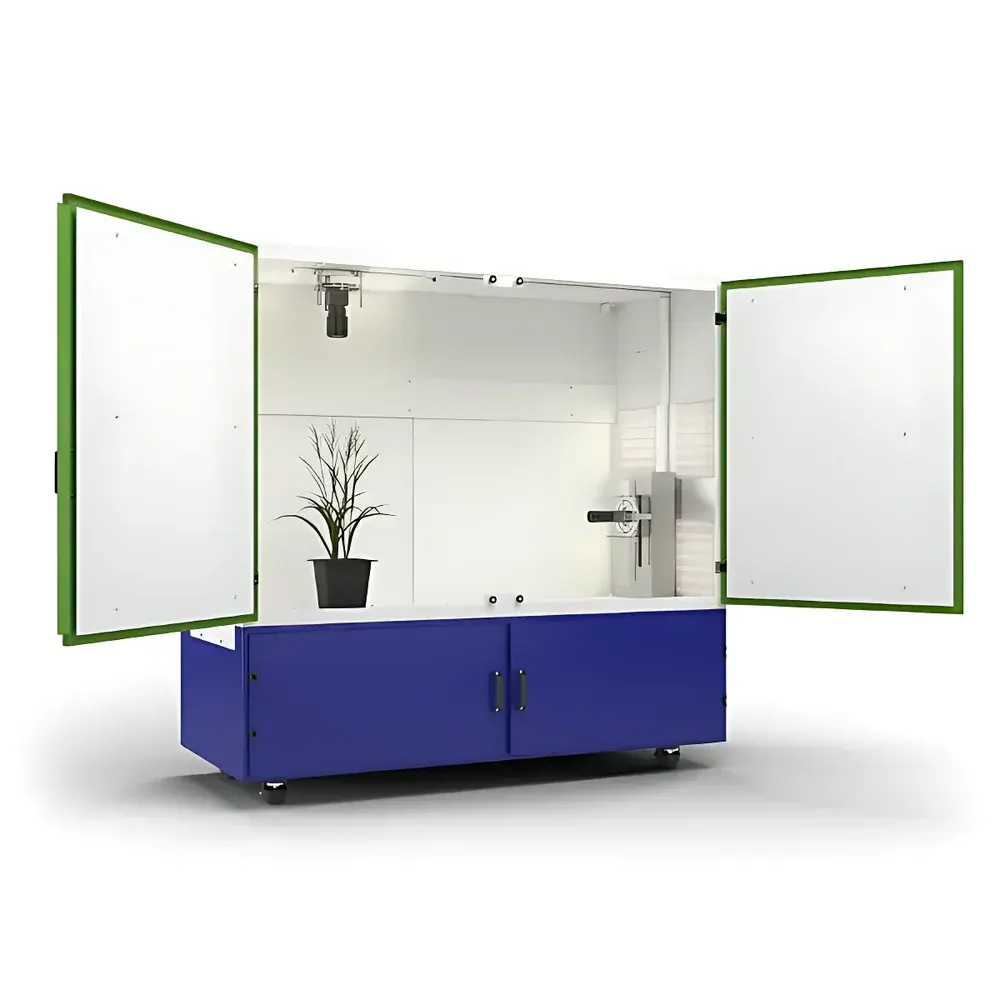
LemnaTec PhenoAIxpert Pro Laboratory Plant Phenotyping Imaging System
| Brand | LemnaTec |
|---|---|
| Origin | Germany |
| Model | PhenoAIxpert Pro |
| Imaging Modalities | Top-view + Side-view Visible-light Imaging |
| Sample Handling | Motorized Rotating Stage (360° continuous positioning) |
| Illumination | Uniform Diffuse LED Lighting (Gloss-reduction optimized) |
| Integrated Control & Analysis | Onboard Industrial PC with Touch Interface |
| Workflow Engine | Modular, Scriptable Image Analysis Pipelines |
| Optional Module | Visible-light Root Imaging (Soil-intact, Non-destructive) |
Overview
The LemnaTec PhenoAIxpert Pro is a high-precision, benchtop-scale plant phenotyping imaging system engineered for controlled-environment laboratories. It operates on the principle of multi-angle visible-light digital imaging combined with automated sample positioning and standardized illumination geometry. Unlike field-based or greenhouse phenotyping platforms, the PhenoAIxpert Pro delivers reproducible, operator-independent acquisition of morphological and chromatic traits under constant environmental conditions—critical for longitudinal studies, mutant screening, and dose–response assays. Its dual-camera architecture captures orthogonal views (0° top-down and 90° lateral) in synchronized acquisition, enabling robust 2.5D reconstruction of plant architecture without reliance on stereo triangulation or structured light. The system is purpose-built for small-scale biological specimens: individual potted seedlings, agar-grown seedlings in Petri dishes, leaf discs in multi-well plates, detached organs, seeds, and even biotic interaction models such as insect herbivory or fungal lesion development on host tissue.
Key Features
- Dual high-resolution visible-light cameras (top and side), independently calibrated for geometric and radiometric consistency
- Motorized rotating stage with sub-degree angular resolution and programmable stop positions (0–360°), enabling full circumferential profiling of rosettes, stems, or asymmetric structures
- Uniform diffuse LED illumination system with spectral stability (CCT ~5000 K, CRI >90), minimizing specular reflection and shadow artifacts across diverse surface textures (waxy leaves, hairy stems, translucent cotyledons)
- Integrated industrial PC with touchscreen interface—hardware control, image acquisition, preprocessing, and quantitative trait extraction are unified within a single software environment
- Modular workflow engine supporting drag-and-drop pipeline construction; preconfigured modules available for leaf area estimation, color histogram analysis (RGB, HSV, CIELab), lesion segmentation, seed counting, and symmetry quantification
- Expandable architecture: optional root imaging module enables non-invasive visible-light capture of root systems in transparent growth media (e.g., gellan gum, agar) or shallow soil substrates, preserving spatial context without staining or excavation
Sample Compatibility & Compliance
The PhenoAIxpert Pro accommodates standardized labware including 6–96-well microtiter plates, Petri dishes (up to 150 mm diameter), 75 × 125 mm growth pouches, and pots up to 12 cm height. It supports live imaging of Arabidopsis thaliana, Brassica species, rice seedlings, tomato cotyledons, Medicago truncatula nodules, and maize coleoptiles under ambient lab lighting or controlled photoperiod cabinets. All imaging protocols adhere to FAIR data principles (Findable, Accessible, Interoperable, Reusable). Metadata—including camera exposure settings, stage position, illumination intensity, and timestamped environmental logs—is embedded in TIFF/OME-TIFF outputs. The system supports audit-trail generation and user-access controls compliant with GLP documentation requirements for academic and regulatory research (e.g., OECD TG 208, ISO 20673:2019).
Software & Data Management
PhenoAIxpert Pro runs LemnaGrid® v4.2 software—a validated, version-controlled platform designed for traceable phenotypic data processing. Each analysis workflow generates a human-readable JSON manifest containing parameter values, algorithm versions, and provenance metadata. Output formats include CSV (trait tables), GeoJSON (spatial feature coordinates), and HDF5 (multi-dimensional image stacks). Batch processing supports scheduled acquisitions across multiple plates or time points. Export modules integrate directly with R/Bioconductor (phenoptr, plantcv), Python (scikit-image, OpenCV), and commercial statistical suites (JMP, SAS). Raw image archives are stored with SHA-256 checksums; database-backed project management enables role-based access and versioned experiment histories.
Applications
- High-throughput mutant and transgenic line screening based on morphometric divergence (e.g., rosette diameter, petiole angle, leaf serration index)
- Quantitative assessment of abiotic stress responses: drought-induced wilting kinetics, salinity-related chlorosis progression, heavy metal phytotoxicity gradients
- Pathogen–host interaction dynamics: temporal mapping of necrotic lesion expansion, sporulation density, and host tissue discoloration in controlled inoculation assays
- Seed quality evaluation: viability scoring via colorimetric clustering, size distribution analysis, and coat integrity metrics
- Root architectural phenotyping in semi-transparent media: primary root length, lateral root density, branching angles, and gravitropic deviation under nutrient gradient treatments
- Developmental staging validation: automated alignment of morphological landmarks against reference ontologies (e.g., Plant Ontology, PO:0009011)
FAQ
Does the PhenoAIxpert Pro require external darkroom conditions?
No—its integrated diffuse LED chamber eliminates dependency on ambient light control. Ambient illumination outside the cabinet does not affect measurement repeatability.
Can I import custom segmentation algorithms into the workflow engine?
Yes. LemnaGrid® supports Python 3.9+ plugin integration via standardized API hooks; users may deploy trained CNN models (e.g., U-Net variants) for specialized tissue classification.
Is root imaging compatible with soil-grown plants?
The optional root module supports shallow-depth (<3 cm) soil imaging using contrast-enhanced visible-light differential absorption; deeper soil penetration requires complementary modalities (e.g., X-ray CT or MRI).
How is calibration maintained across long-term experiments?
The system performs daily auto-calibration using embedded photometric and geometric reference targets; drift compensation is applied retroactively during batch reprocessing.
Does the software comply with FDA 21 CFR Part 11 requirements?
LemnaGrid® v4.2 offers optional 21 CFR Part 11 add-on package—including electronic signatures, audit trail export, and role-based permission tiers—for regulated environments (e.g., agrochemical efficacy trials).



