
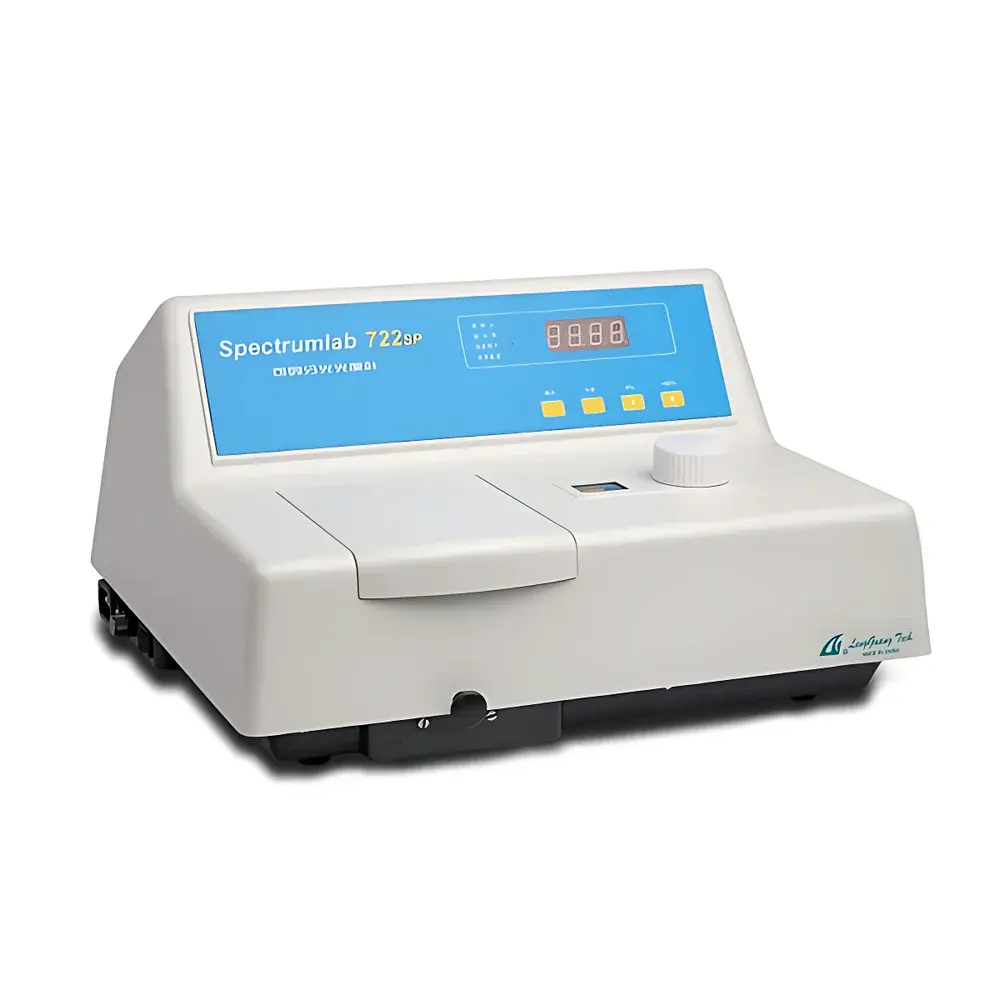
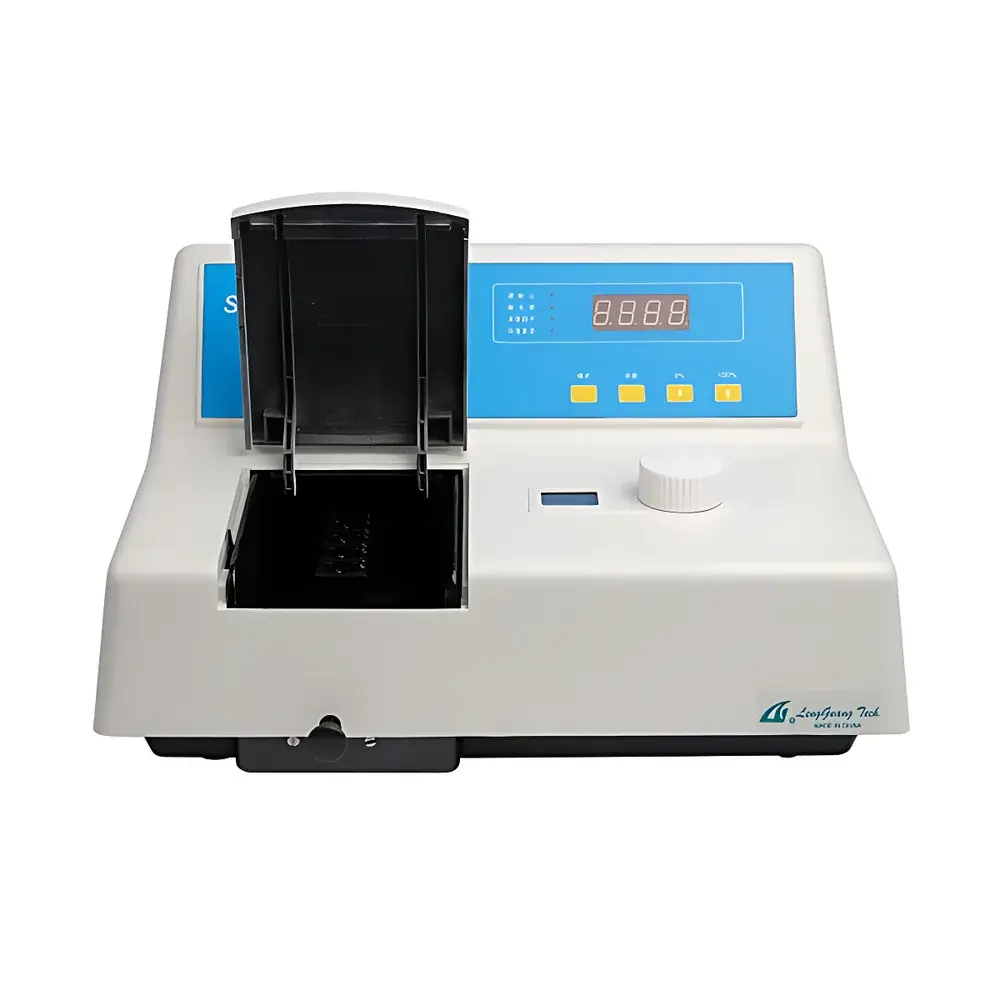
Lengguang Tech. 722SP Visible Spectrophotometer
| Brand | Lengguang Tech. |
|---|---|
| Origin | Shanghai, China |
| Manufacturer Type | Original Equipment Manufacturer (OEM) |
| Product Origin | Domestic (China) |
| Model | 722SP |
| Optical System | Czerny-Turner monochromator with holographic grating |
| Detector Type | Photodiode array |
| Wavelength Range | 325–1000 nm |
| Wavelength Selection | Manual adjustment |
| Spectral Bandwidth | 5 nm |
| Wavelength Accuracy | ±2.0 nm |
| Wavelength Repeatability | ≤1.0 nm |
| Stray Light | ≤0.2% T |
| Photometric Accuracy | ±0.5% T |
| Photometric Repeatability | ≤0.2% T |
| Absorbance Range | –0.3 to 2.999 A |
| Transmittance Range | 0.0–199.9% T |
| Light Source | 20 W / 12 V halogen lamp |
| Dimensions (W×D×H) | 370 × 320 × 190 mm |
| Net Weight | 7 kg |
| Interface | RS-232 serial port |
| Compliance | Meets GB/T 21186–2007 (Chinese national standard for visible spectrophotometers) |
Overview
The Lengguang Tech. 722SP Visible Spectrophotometer is a precision single-beam optical instrument engineered for routine quantitative and qualitative analysis in the visible spectrum (325–1000 nm). It operates on the principle of Beer–Lambert law-based absorbance measurement, utilizing a Czerny–Turner monochromator equipped with a high-efficiency holographic diffraction grating to isolate discrete wavelengths. The optical path incorporates optimized collimating and focusing optics, ensuring consistent spectral resolution and minimal aberration across the operational range. Designed for laboratory environments where reliability, ease of maintenance, and regulatory traceability are essential — including clinical chemistry labs, environmental monitoring stations, pharmaceutical QC units, and academic teaching facilities — the 722SP delivers reproducible photometric performance under standard operating conditions. Its fixed 5 nm spectral bandwidth balances signal-to-noise ratio and resolution for general-purpose applications such as enzyme kinetics, dye concentration assays, and water quality parameter determination (e.g., nitrate, phosphate, COD).
Key Features
- Robust aluminum die-cast chassis providing mechanical stability, thermal inertia, and long-term alignment retention.
- C-T monochromator with pre-aligned holographic grating and precision-machined optical mounts, minimizing wavelength drift during extended operation.
- Pre-calibrated 12 V / 20 W halogen lamp with integrated spectral energy correction algorithm, enabling straightforward lamp replacement without recalibration.
- Dedicated microprocessor-based measurement system supporting real-time transmittance (T%) and absorbance (A) conversion, automatic zeroing (0% T), auto-set 100% T reference, direct concentration readout, and user-definable concentration factors.
- RS-232 serial interface compliant with EIA-232-D specifications, supporting bidirectional communication with external peripherals including serial printers and host PCs.
- Designed and validated per GB/T 21186–2007, the Chinese national standard for visible spectrophotometers, ensuring metrological consistency with internationally recognized photometric test protocols.
Sample Compatibility & Compliance
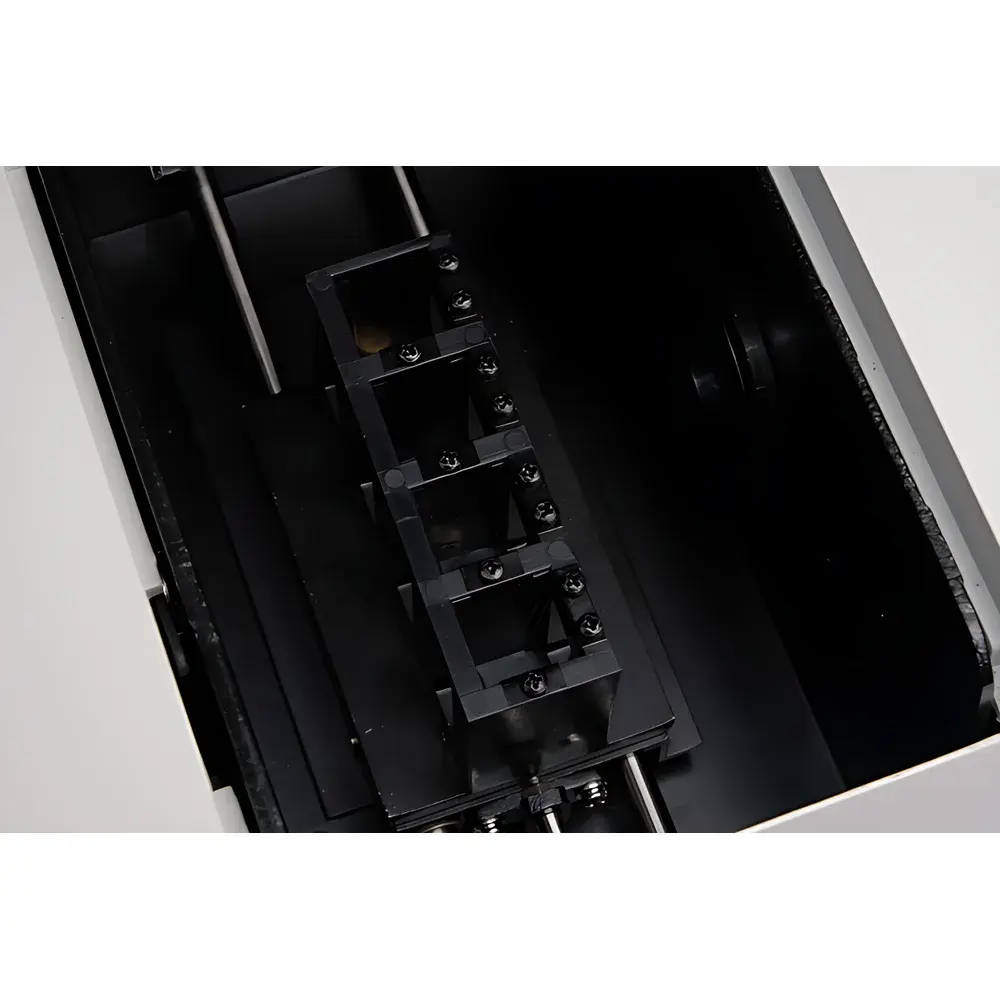
The 722SP accommodates standard 10 mm pathlength cuvettes (glass or quartz) and supports liquid, solution-phase samples compatible with common UV-Vis solvents (e.g., water, ethanol, buffer systems). It does not support solid reflectance or fiber-optic probe configurations. Instrument validation documentation includes factory-verified wavelength accuracy (±2.0 nm at Hg 404.7 nm and 546.1 nm lines), photometric linearity verification across 0–2.999 A, and stray light assessment using sodium nitrite solution at 340 nm. While not certified to ISO/IEC 17025 or FDA 21 CFR Part 11 out-of-the-box, its RS-232 interface and deterministic firmware architecture permit integration into GLP/GMP-compliant workflows when paired with validated third-party data acquisition software featuring audit trail, electronic signature, and version-controlled method storage.
Software & Data Management
The 722SP operates autonomously via front-panel controls but interfaces with optional S22PC data processing software (Windows-compatible) via RS-232. This software enables time-resolved kinetic scan logging, multi-wavelength absorbance tracking, calibration curve generation with linear/nonlinear regression (including 1st–3rd order polynomial fits), and export to CSV or Excel formats. All acquired datasets retain embedded metadata: date/time stamp, operator ID (user-entered), wavelength setting, and instrument serial number. Raw transmission/absorbance values are stored without rounding, preserving full 12-bit ADC resolution for downstream statistical analysis. No cloud connectivity or remote access functionality is implemented — all data remain under local administrative control.
Applications
- Clinical diagnostics: Hemoglobin quantification, bilirubin assay, uric acid determination per standardized colorimetric protocols.
- Environmental testing: Measurement of heavy metal chelates (e.g., Pb–dithizone), nutrient ions (NO₃⁻, PO₄³⁻), and organic pollutants (phenol, formaldehyde) using APHA/Standard Methods-compliant procedures.
- Industrial QC: Color index evaluation in paints, dyes, and food additives; concentration verification of active ingredients in cleaning agents and disinfectants.
- Academic instruction: Teaching fundamental spectroscopic principles, calibration curve construction, molar absorptivity determination, and error propagation analysis in undergraduate analytical chemistry laboratories.
- Pharmaceutical manufacturing: In-process checks of excipient dissolution profiles and API purity screening where GMP-grade instrumentation is not mandated.
FAQ
What is the maximum sample volume required for accurate measurement?
Standard 10 mm pathlength cuvettes require ≥3.5 mL volume for full beam coverage; smaller volumes may be used with micro-cuvettes (not supplied), though pathlength correction must be applied manually.
Does the instrument support wavelength scanning or only fixed-point measurements?
The 722SP is manually tuned — users select discrete wavelengths via the calibrated dial; it does not perform automated spectral scans.
Can the halogen lamp be replaced by the end user?
Yes; the lamp module is tool-free and pre-centered, and the built-in energy correction compensates for spectral output variance between lamps.
Is NIST-traceable calibration available from the manufacturer?
Factory calibration uses internal reference standards traceable to NIM (National Institute of Metrology, China); NIST-traceable certificates require third-party calibration service.
What is the warm-up time required before photometric measurements?
Minimum 20 minutes stabilization recommended after power-on to ensure thermal equilibrium of optical components and lamp output.




