
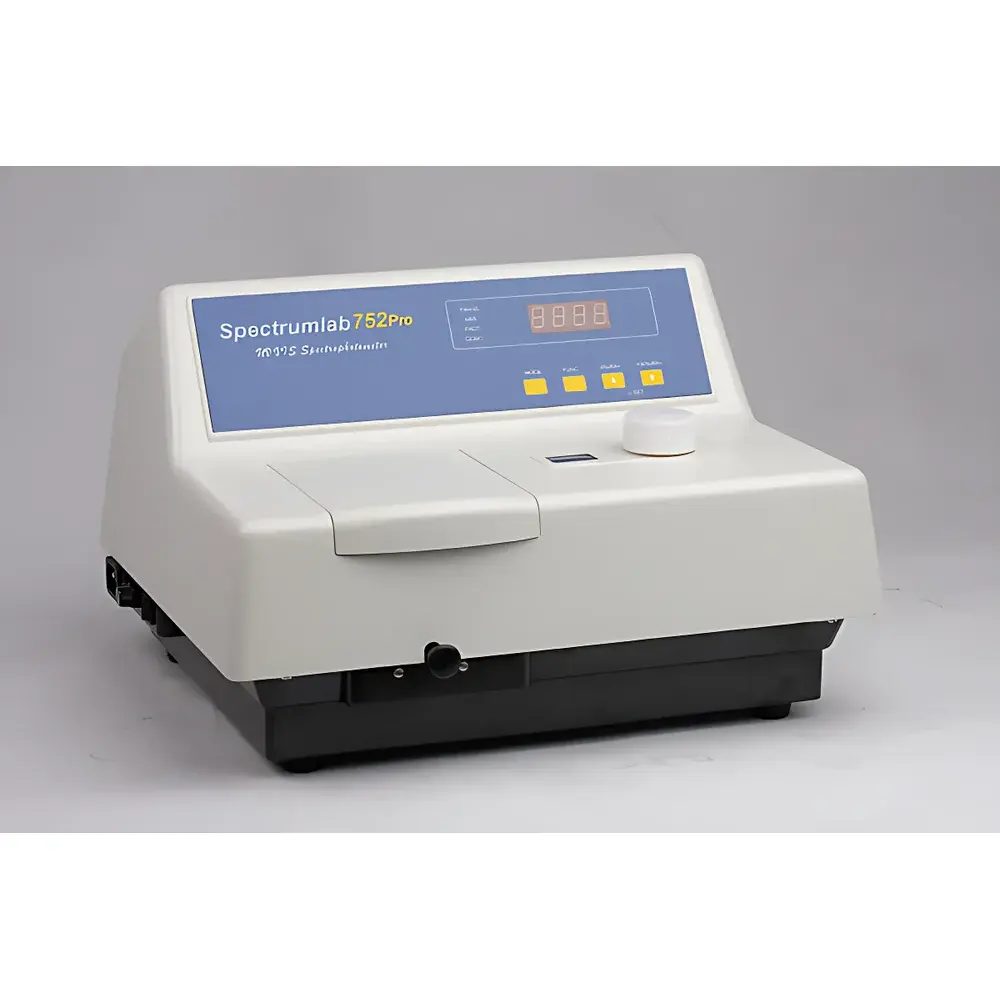
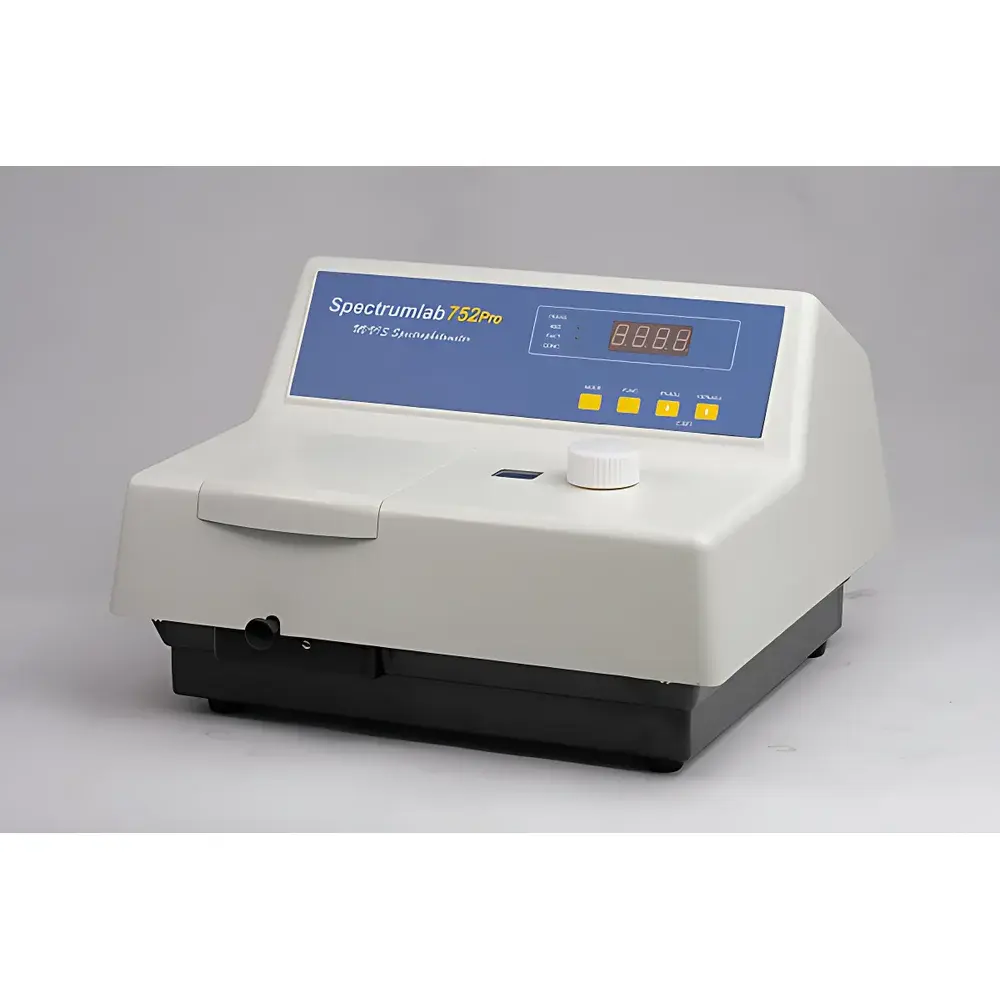
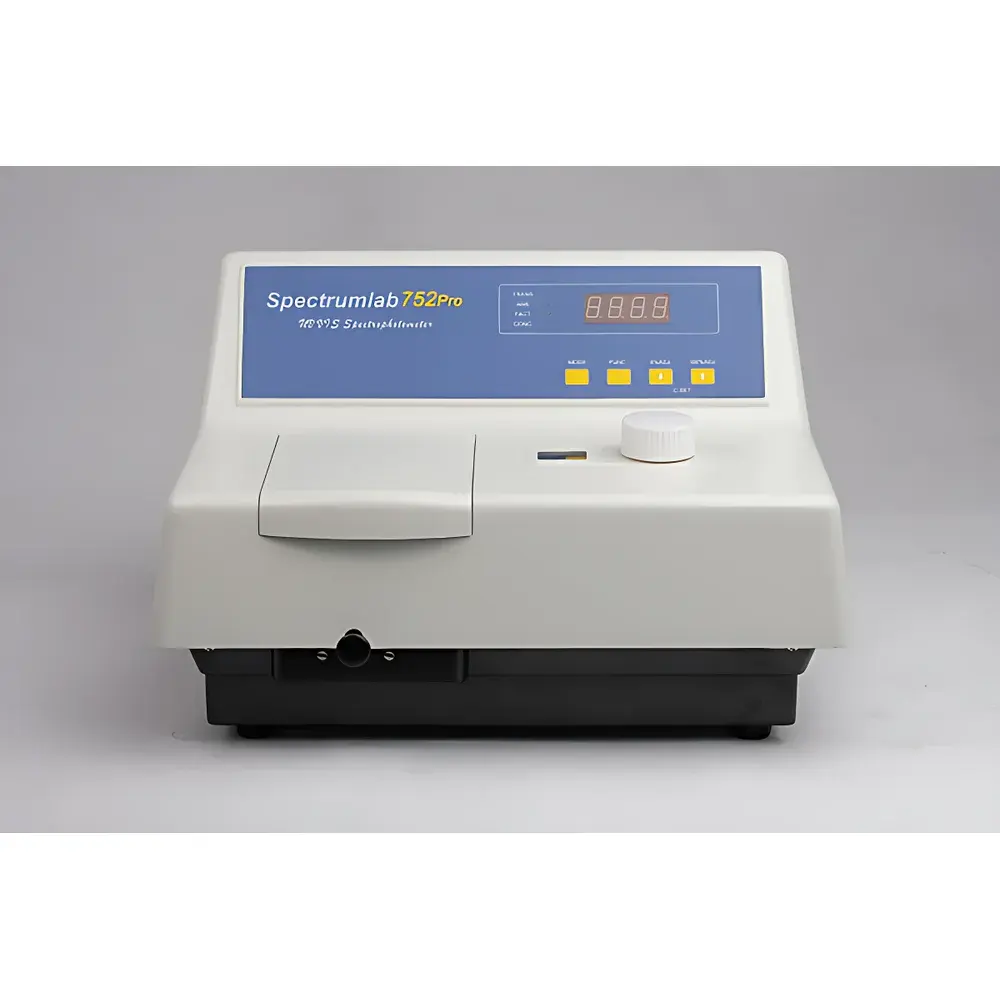
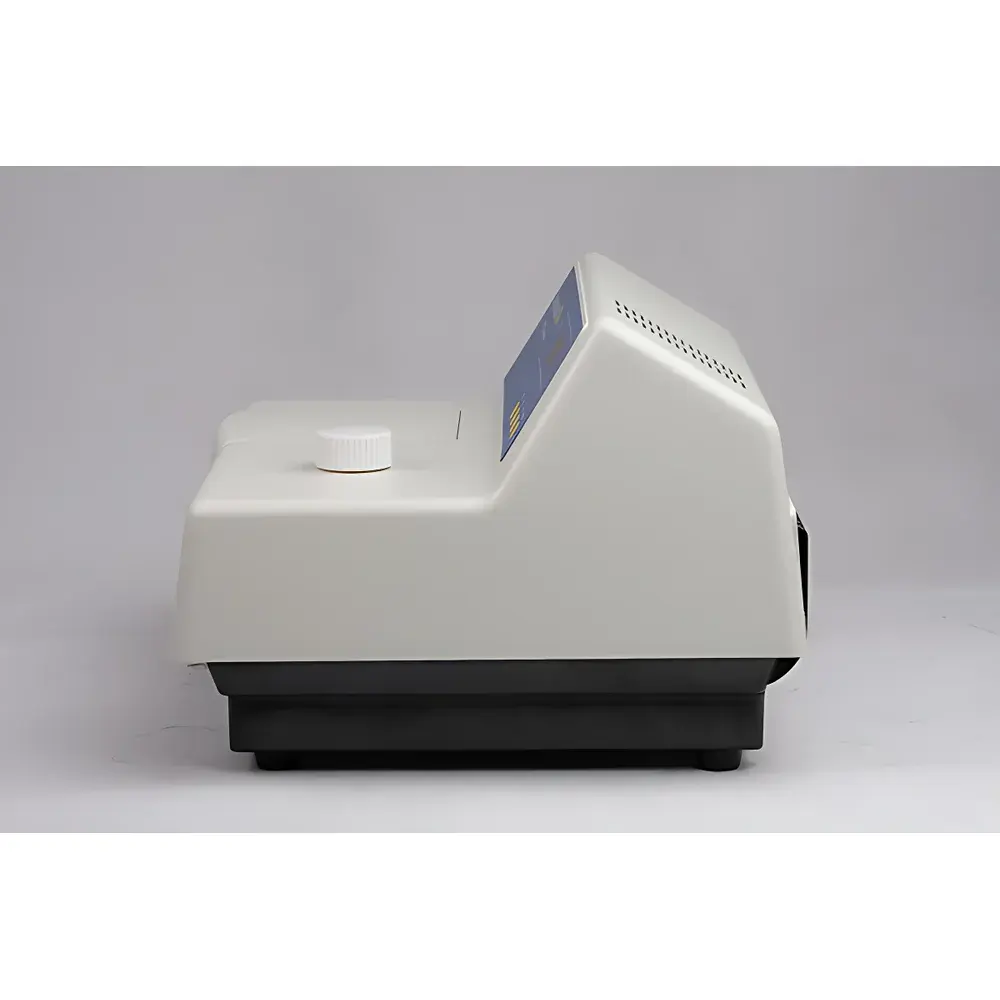
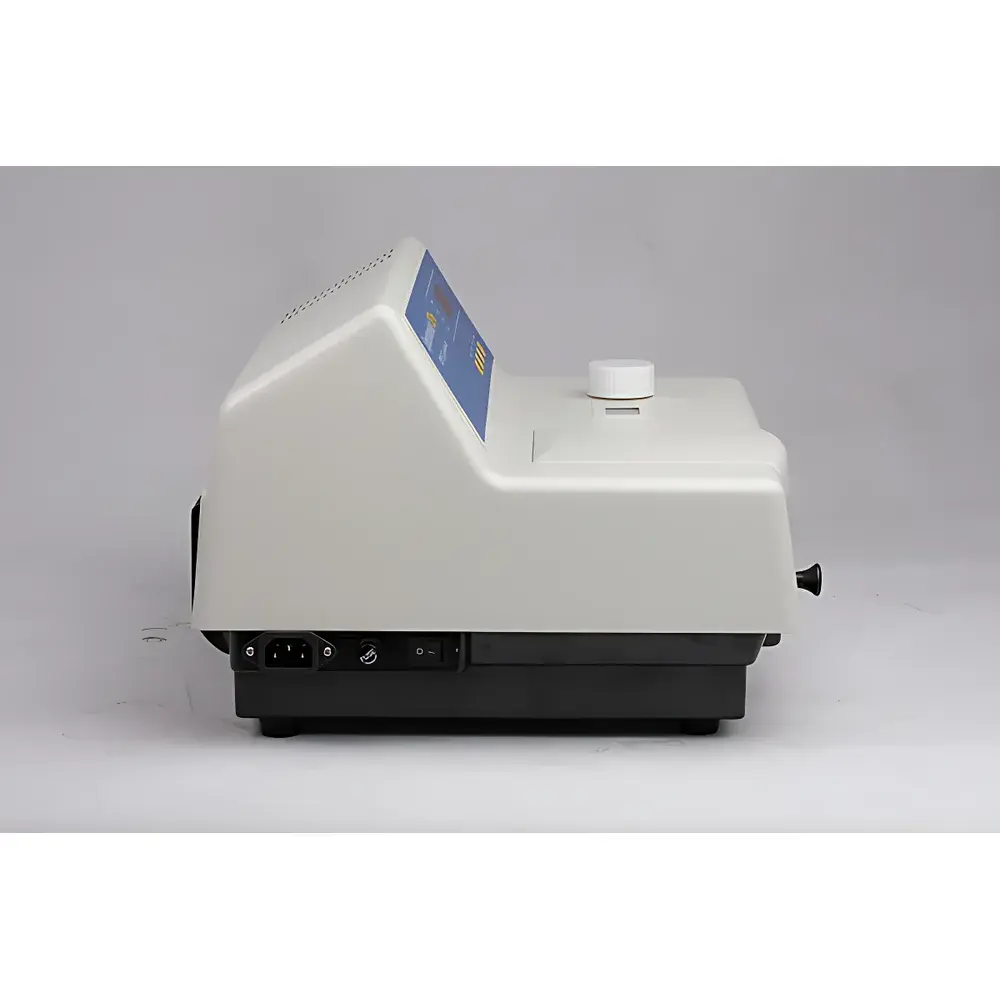
Lengguang Tech. 752Pro Ultraviolet-Visible Spectrophotometer
| Brand | Lengguang Tech. |
|---|---|
| Origin | Shanghai, China |
| Manufacturer Type | Direct Manufacturer |
| Instrument Architecture | Single-Beam |
| Detector Type | Photocell |
| Wavelength Range | 190–1100 nm |
| Wavelength Adjustment | Manual |
| Spectral Bandwidth | 2 nm |
| Wavelength Accuracy | ±2 nm |
| Wavelength Repeatability | ≤0.5 nm |
| Stray Light | ≤0.2% T |
| Photometric Accuracy | ±0.5% T |
| Photometric Repeatability | ≤0.2% T |
| Noise Level | ≤0.2% T (0% line), ≤0.5% T (100% line) |
| Absorbance Range | –0.3 to 2.999 A |
| Transmittance Range | 0.0–199.9% T |
| Dimensions | 370 × 320 × 240 mm |
| Net Weight | 7.5 kg |
| Light Source | Deuterium Lamp (≥500 h lifetime) + Tungsten-Halogen Lamp |
| Optical System | Czerny-Turner Monochromator with Holographic Grating |
| Interface | RS232 (optional software integration) |
Overview
The Lengguang Tech. 752Pro Ultraviolet-Visible Spectrophotometer is a single-beam, manually operated analytical instrument engineered for routine quantitative and qualitative analysis in laboratory environments where cost-efficiency, operational simplicity, and long-term reliability are prioritized. Based on the Czerny-Turner optical configuration, it employs a holographic diffraction grating monochromator coupled with aspheric mirrors and precision-aligned optical components to deliver consistent spectral resolution across its full 190–1100 nm wavelength range. The dual-light-source design—comprising a deuterium lamp for UV performance (rated ≥500 hours) and a tungsten-halogen lamp for visible-NIR stability—ensures broad spectral coverage without manual lamp switching during measurement. Its 2 nm spectral bandwidth satisfies standard method requirements for general-purpose UV-Vis applications, including those referenced in ISO 6425, ASTM E275, and USP , while the ≤0.2% T stray light specification supports reliable low-transmittance measurements in turbid or highly absorbing samples.
Key Features
- Robust aluminum die-cast chassis providing mechanical stability and thermal inertia for improved baseline consistency during extended operation.
- Czerny-Turner monochromator with high-efficiency holographic grating and optimized non-spherical optics for enhanced throughput and reduced aberration.
- Pre-calibrated light source assembly and built-in spectral energy correction system—enabling straightforward lamp replacement and field recalibration without optical realignment.
- Photocell-based detection system with low-noise analog signal conditioning; noise specifications meet ≤0.2% T at 0% transmittance and ≤0.5% T at 100% transmittance per ICH Q2(R2) guidance for instrument verification.
- Manual wavelength selection via calibrated dial—designed for intuitive operation in teaching labs, QC environments, and resource-constrained facilities where automation is not required.
- RS232 serial interface supporting optional PC-based data acquisition and processing software compliant with basic GLP documentation requirements (audit trail, user login, and data export in CSV/ASCII).
Sample Compatibility & Compliance
The 752Pro accommodates standard 10 mm pathlength cuvettes (glass, quartz, or plastic) and is compatible with liquid, solution-phase, and transparent solid samples. It meets fundamental performance criteria outlined in ISO 17025 for equipment suitability in accredited testing laboratories when operated within specified environmental conditions (20–25 °C, ≤65% RH). While not inherently 21 CFR Part 11–compliant due to its manual interface and lack of electronic signature capability, the instrument may be integrated into validated workflows where paper-based records or supplementary electronic logs fulfill ALCOA+ principles. Its photometric accuracy (±0.5% T) and repeatability (≤0.2% T) align with typical acceptance thresholds for in-process controls in pharmaceutical excipient testing, water quality monitoring (EPA Method 365.3), and enzyme kinetics assays.
Software & Data Management
An optional Windows-compatible data processing package is available via RS232 connection, enabling absorbance/transmittance plotting, concentration calculation using Beer-Lambert regression, kinetic time-scan export, and multi-point calibration curve generation. All raw and processed data are stored in plain-text formats (CSV, TXT) to ensure long-term readability and compatibility with LIMS or ELN systems. Software-generated reports include timestamped metadata (date/time, operator ID if entered manually), instrument ID, and measurement parameters—supporting traceability under ISO/IEC 17025 Clause 7.7. No proprietary binary file formats are used, eliminating vendor lock-in risks.
Applications
- Clinical chemistry: Serum bilirubin, uric acid, and total protein quantification using standardized colorimetric protocols.
- Environmental analysis: Nitrate/nitrite determination in surface water per APHA Standard Methods 4500-NO2− and 4500-NO3−.
- Pharmaceutical QA/QC: Assay of active pharmaceutical ingredients (APIs) in tablet extracts against pharmacopoeial monographs (e.g., USP ).
- Biochemical research: DNA/RNA purity assessment (A260/A280 ratio), Bradford/Lowry protein assays, and enzyme activity monitoring at fixed wavelengths.
- Industrial quality control: Dye concentration verification in textile effluents, catalyst loading analysis in petrochemical feedstocks, and polymer additive screening.
FAQ
Is the 752Pro suitable for GMP-regulated environments?
It can be deployed in GMP settings for non-critical testing when supported by documented SOPs, periodic verification (e.g., NIST-traceable filters for wavelength and photometric accuracy), and controlled record-keeping—but lacks native electronic audit trail functionality.
Can quartz cuvettes be used below 220 nm?
Yes—quartz cells are required for measurements below 350 nm; the 752Pro’s 190 nm lower limit necessitates fused silica optics and quartz sample holders for UV-C region work.
What maintenance is required beyond lamp replacement?
Annual verification of wavelength accuracy (using holmium oxide or didymium filters) and photometric linearity (neutral density filters) is recommended; optical alignment is factory-set and not user-serviceable.
Does the instrument support kinetic or scanning modes?
No—this is a fixed-wavelength or manually stepped instrument; continuous spectral scanning requires a different platform (e.g., diode-array or double-beam spectrophotometer).
Is firmware upgrade capability available?
Firmware is embedded and non-upgradable; functional enhancements are implemented only through hardware revision cycles per model generation.
Related Products





