
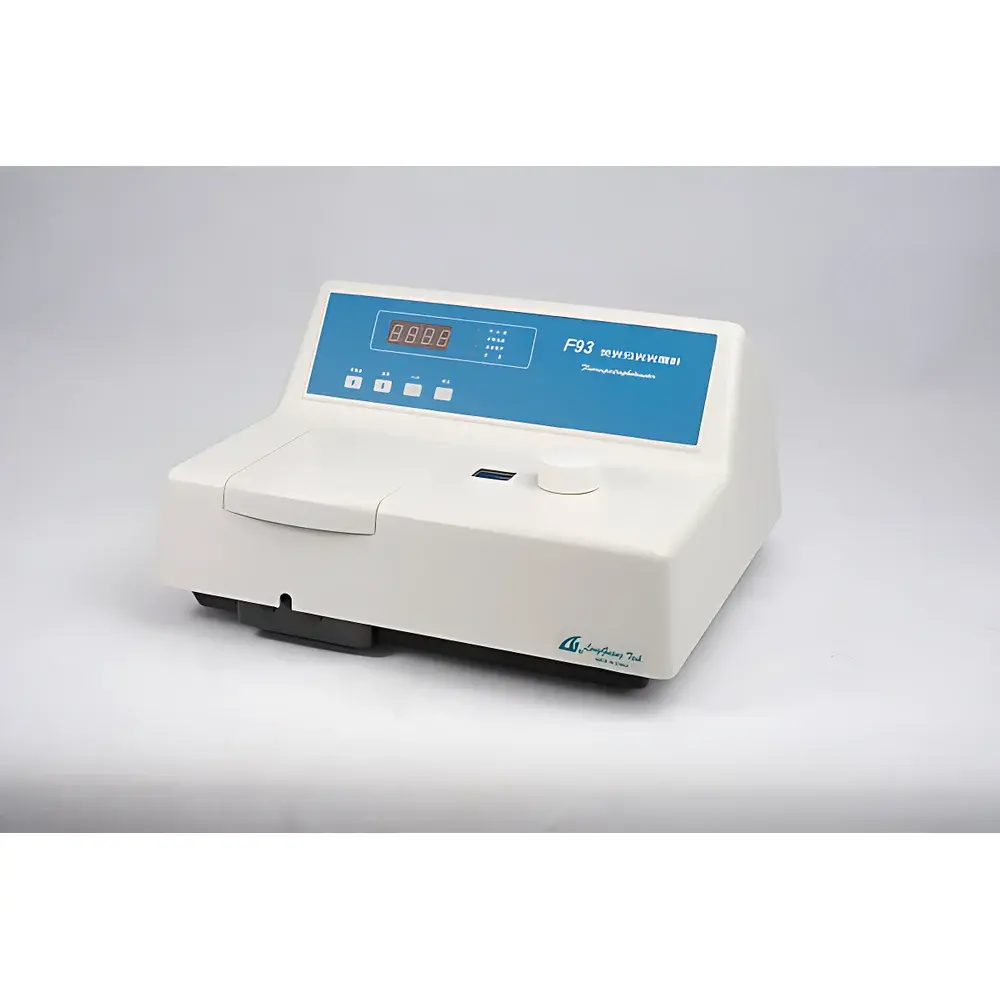
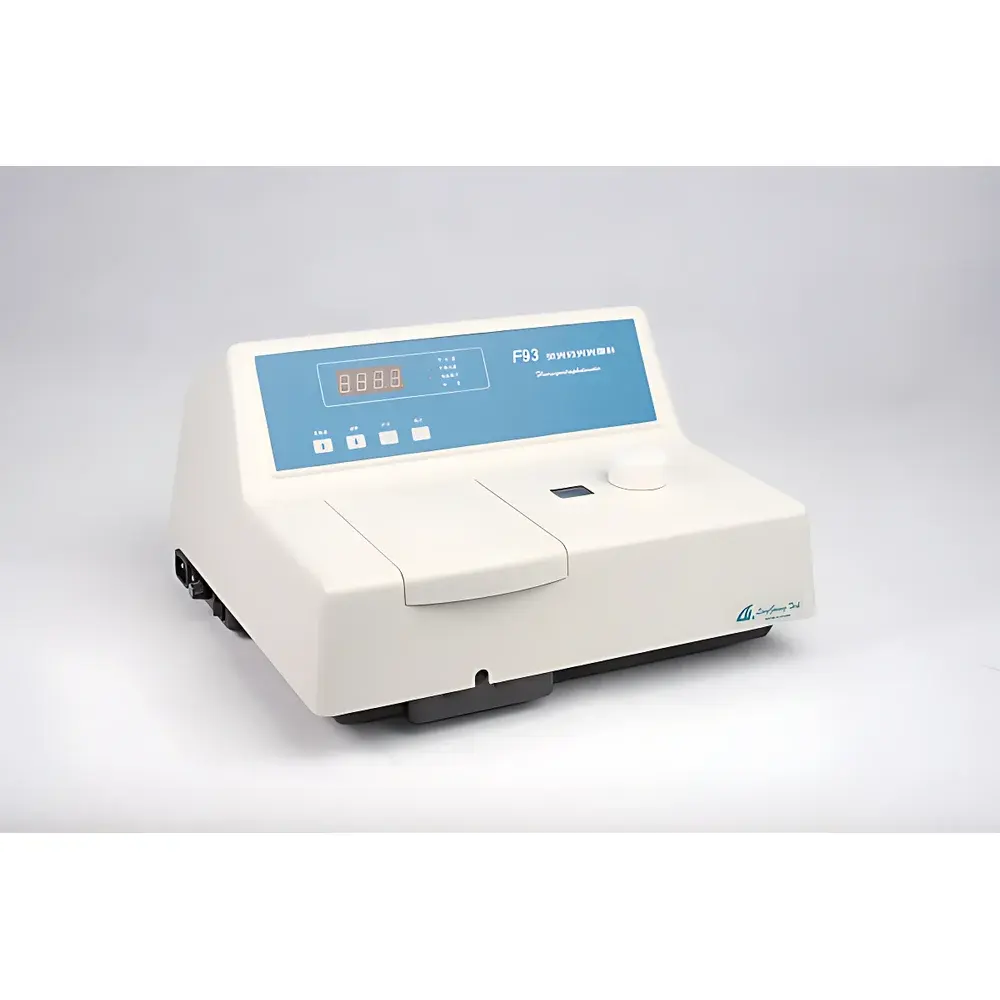
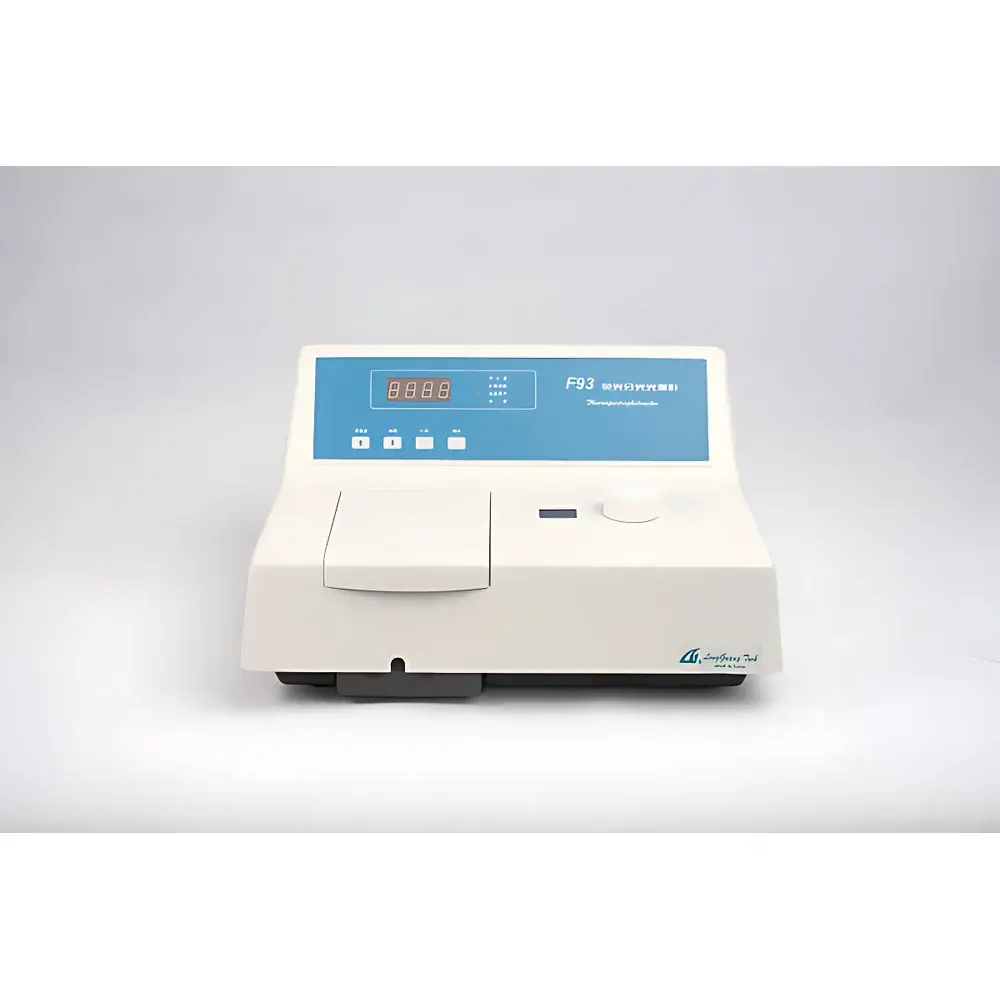
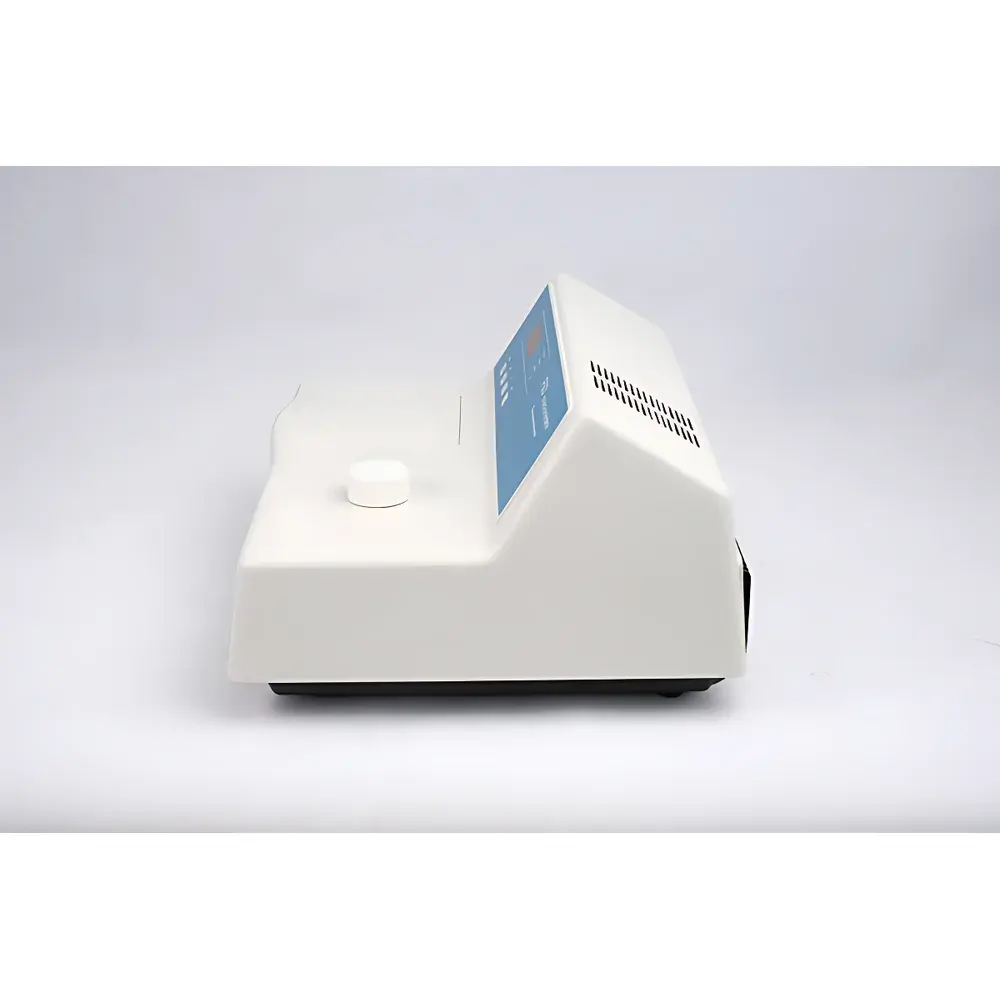
Lengguang Tech F93 Steady-State Molecular Fluorescence Spectrometer
| Brand | Lengguang Tech |
|---|---|
| Origin | Shanghai, China |
| Manufacturer Type | Original Equipment Manufacturer (OEM) |
| Product Category | Domestic |
| Model | F93 |
| Price Range | USD 1,400 – 7,000 |
| Dispersive Element | Holographic Grating |
| Instrument Type | Steady-State Fluorescence Spectrometer |
| Slit Width (Spectral Bandpass) | 12 nm |
| Spectral Resolution | 12 nm |
| Sensitivity | ≤1 × 10⁻⁹ mol/L (Quinine Sulfate in 0.1 M H₂SO₄) |
| Wavelength Accuracy | ±2.0 nm |
| Excitation Source | High-Stability LED |
Overview
The Lengguang Tech F93 is a compact, entry-level steady-state molecular fluorescence spectrometer engineered for reliable quantitative and qualitative fluorescence analysis in academic teaching laboratories, QC environments, and routine analytical workflows. It operates on the principle of photoluminescence detection: a monochromatic excitation beam—generated by solid-state LED sources—is directed onto a sample; emitted photons are collected at right angles, dispersed via a Czerny–Turner (C-T) monochromator equipped with a holographic grating, and detected using a low-noise photomultiplier tube (PMT) or silicon photodiode detector (model-dependent configuration). Unlike conventional tungsten-halogen or xenon arc lamp-based systems, the F93 employs cold LED excitation sources (365 nm standard; optional multi-LED module up to 405 nm in F93A variant), minimizing thermal background, reducing sample photobleaching risk, and enhancing signal-to-noise ratio across the 360–650 nm emission range. Its fixed 12 nm spectral bandwidth ensures consistent resolution suitable for comparative measurements and educational demonstrations where high spectral fidelity is secondary to operational robustness and cost-efficiency.
Key Features
- Steady-state fluorescence intensity measurement with direct concentration readout and auto-zero calibration in standalone mode
- Dual-operation architecture: self-contained microprocessor-controlled operation (no PC required) + USB/RS-232 interface for PC-based data acquisition and advanced processing
- Modular LED excitation system—F93 ships with 365 nm LED; F93A includes four discrete LEDs (365, 376, 392, and 405 nm) enabling multi-wavelength excitation screening without mechanical filter wheels
- C-T monochromator with holographic grating delivers stable wavelength selection and minimal stray light (<0.1% at 435 nm / 365 nm)
- Integrated thermal management ensures LED output stability over extended measurement sessions (typical drift <0.5% per hour at 25°C ambient)
- Front-panel navigation with LCD display supports real-time spectrum preview, peak identification, and arithmetic functions (subtraction, ratio, normalization)
- Support for external serial printers (ESC/P-compatible) for hardcopy report generation compliant with GLP documentation requirements
Sample Compatibility & Compliance
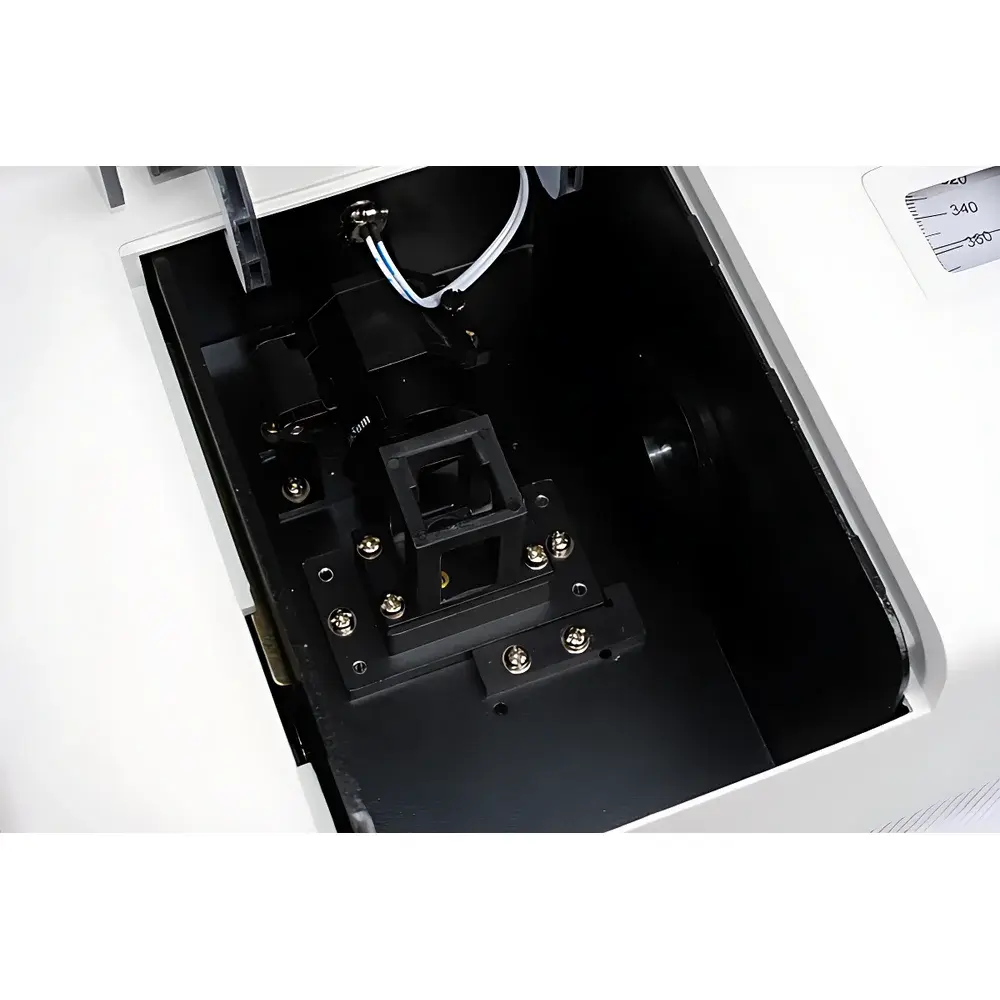
The F93 accommodates standard 10 mm pathlength quartz or UV-grade plastic cuvettes (1.0 mL minimum volume) and is compatible with liquid-phase samples in aqueous or organic solvents (e.g., methanol, acetonitrile, DMSO). Optional accessories include solid-sample holders, temperature-controlled cuvette racks (±0.1°C stability), and fiber-optic probes for remote or in-situ measurements. The instrument meets IEC 61010-1:2010 safety standards for laboratory electrical equipment and complies with electromagnetic compatibility (EMC) requirements per EN 61326-1:2013. While not validated for GMP-regulated production environments, its data integrity features—including time-stamped measurement logs, user-accessible audit trails (in PC-linked mode), and exportable CSV/Excel-compatible datasets—support adherence to basic GLP principles and internal QA/QC protocols aligned with ISO/IEC 17025 clause 7.7.
Software & Data Management
In standalone mode, the embedded firmware provides real-time fluorescence intensity plotting, peak search, integration, and basic statistical reporting (mean, SD, CV%). When connected to a Windows PC (Windows 7–11, 64-bit), the optional Lengguang DataPro software suite enables advanced functionalities: multi-curve overlay, excitation-emission matrix (EEM) mapping (via sequential scan mode), baseline correction algorithms (Rubberband, Asymmetric Least Squares), and calibration curve fitting (linear, quadratic, logarithmic) with residual analysis. All exported datasets include metadata headers (instrument ID, date/time stamp, operator ID, excitation/emission settings), satisfying traceability needs for undergraduate lab reports or preliminary research documentation. Software-generated reports can be exported in PDF, PNG, or XML formats, and support configurable templates for institutional branding.
Applications
- Quantitative analysis of fluorophores including quinine sulfate, riboflavin, fluorescein, and dansyl chloride in pharmaceutical excipient testing
- Environmental monitoring of polycyclic aromatic hydrocarbons (PAHs) in water extracts following EPA Method 8310
- Biochemical assays such as protein conformation studies (intrinsic tryptophan fluorescence), enzyme kinetics (NADH/NADPH detection), and DNA intercalation binding assays
- Quality control of fluorescent dyes, pigments, and optical brighteners in textile and polymer industries
- Undergraduate chemistry and biochemistry laboratory instruction: Beer–Lambert law verification, Stern–Volmer quenching experiments, and solvent polarity effects on emission maxima
FAQ
What is the typical detection limit for quinine sulfate under standard operating conditions?
The instrument achieves a signal-to-noise ratio ≥3 for 1 × 10⁻⁹ mol/L quinine sulfate in 0.1 M sulfuric acid, measured at λex = 350 nm and λem = 450 nm with 12 nm slits.
Can the F93 perform synchronous or time-resolved fluorescence measurements?
No—the F93 is designed exclusively for steady-state intensity measurements. Synchronous scanning requires variable slit coupling; time-resolved detection necessitates pulsed excitation and TCSPC electronics, neither of which are supported.
Is FDA 21 CFR Part 11 compliance available?
The base firmware does not include electronic signature, role-based access control, or immutable audit trails required for Part 11. However, raw data files generated via DataPro software may be archived within a validated LIMS environment meeting those requirements.
What maintenance is required for long-term LED source stability?
LED modules are rated for >10,000 hours of continuous operation. No alignment or recalibration is needed during service life; periodic verification using NIST-traceable fluorescence standards (e.g., quinine sulfate reference solution) is recommended annually.
Does the instrument support custom excitation wavelengths beyond the included LED set?
No—excitation is limited to the installed LED wavelengths. External laser or lamp-based excitation sources cannot be integrated due to optical path constraints and lack of coupling interfaces.
Related Products





