
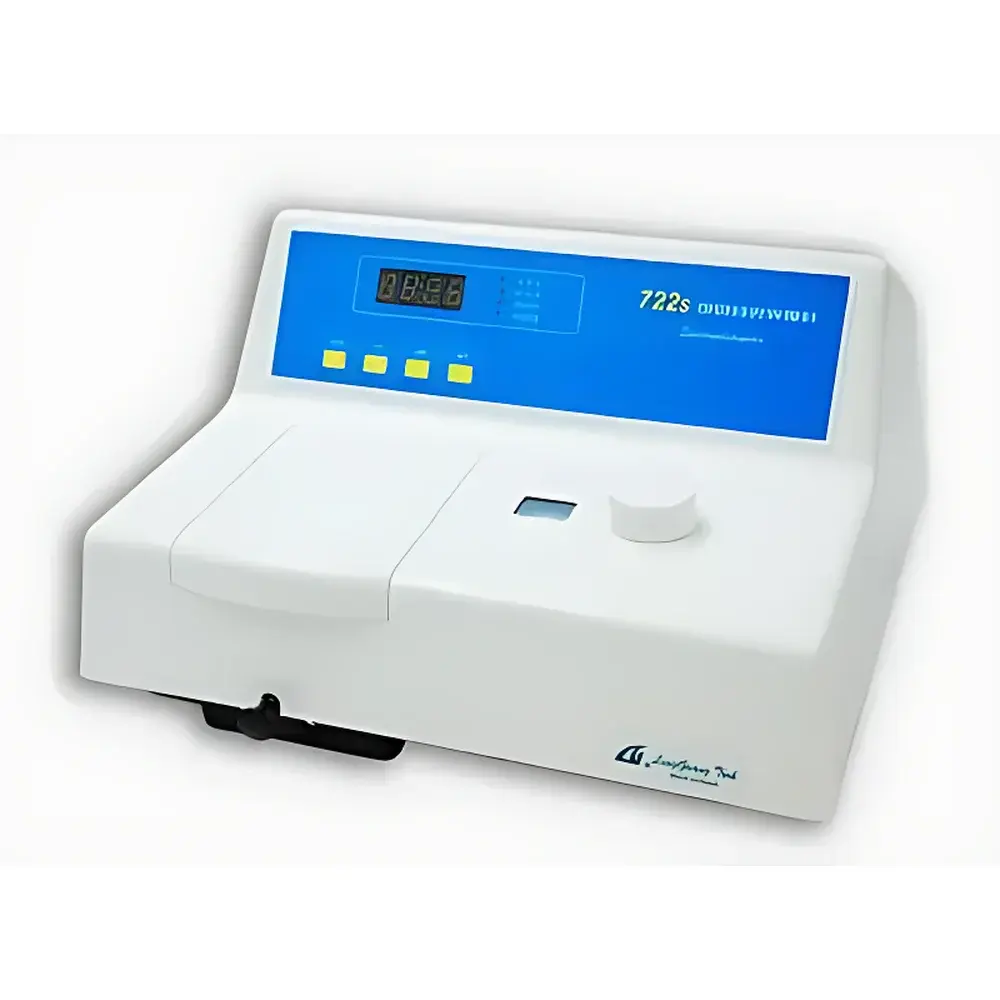
Lengguang Tech S22/S22PC Visible Spectrophotometer
| Brand | Lengguang Tech |
|---|---|
| Origin | Shanghai, China |
| Manufacturer | Yes |
| Product Type | Domestic |
| Model | S22 / S22PC |
| Price Range | USD 420–690 (est.) |
| Optical Design | Single-beam |
| Detector | Silicon Photocell |
| Wavelength Range | 340–1000 nm |
| Wavelength Adjustment | Manual |
| Spectral Bandwidth | 6 nm |
| Wavelength Accuracy | ±2.0 nm |
| Wavelength Repeatability | ≤1.0 nm |
| Stray Light | ≤0.2% T |
| Photometric Accuracy | ±0.5% T |
| Photometric Repeatability | ≤0.2% T |
| Absorbance Range | –0.3 to 2.999 A |
| Transmittance Range | 0.0–199.9% T |
| Dimensions | 370 × 320 × 190 mm |
| Net Weight | 7 kg |
Overview
The Lengguang Tech S22/S22PC Visible Spectrophotometer is a single-beam, manually operated analytical instrument engineered for routine quantitative and qualitative absorbance measurements in the visible spectral region (340–1000 nm). It employs a Czerny-Turner (C-T) monochromator architecture with a high-quality diffraction grating and precision optical components to deliver stable photometric performance under standard laboratory conditions. Designed for robustness and long-term operational reliability, its aluminum die-cast chassis provides mechanical stability and thermal inertia critical for minimizing baseline drift during extended measurement sessions. The system utilizes a 12 V / 20 W halogen lamp as its broadband source, coupled with pre-calibrated spectral energy correction to maintain consistent radiant output across the operating range. As a domestically developed instrument certified as a Shanghai Municipal Innovation Product, the S22PC builds upon the legacy of the 722S platform—introducing improved stray light suppression (<0.2% T), parallel printer interface support, and enhanced firmware logic for direct concentration calculation.
Key Features
- Aluminum die-cast mainframe ensuring structural rigidity, vibration resistance, and thermal stability
- C-T monochromator with optimized diffraction grating and high-precision optical alignment for consistent spectral resolution (6 nm bandwidth)
- Pre-aligned, user-replaceable halogen lamp with integrated spectral energy calibration for simplified maintenance and traceable intensity reproducibility
- Dedicated microprocessor-based measurement system supporting automatic zero adjustment (0% T), full-scale calibration (100% T), linear T/A conversion, and direct concentration readout with programmable factor scaling
- RS-232 serial interface compliant with EIA/TIA-232 standards for bidirectional communication with external peripherals or PCs
- Optional parallel printer port (Centronics-compatible) for real-time hardcopy output of transmittance/absorbance values and concentration results
- Firmware-level compliance with basic GLP documentation requirements—including timestamped measurement logs and operator-defined sample IDs when used with optional PC software
Sample Compatibility & Compliance
The S22/S22PC accommodates standard 10 mm pathlength cuvettes (glass or plastic) and supports both transmission and reflectance mode configurations via optional accessories. Its optical design conforms to fundamental principles outlined in ISO 6223 (spectrophotometers — general requirements) and aligns with performance expectations referenced in ASTM E275 (standard practices for describing and measuring performance of ultraviolet, visible, and near-infrared spectrophotometers). While not designed for regulated GMP environments requiring 21 CFR Part 11-compliant audit trails, the instrument’s firmware and optional PC software provide sufficient data integrity features—including non-erasable session logs, manual operator annotation fields, and CSV export capabilities—for use in QC laboratories operating under ISO/IEC 17025 or internal quality management systems.
Software & Data Management
When connected to a Windows-based host computer via RS-232, the S22PC supports proprietary data acquisition and analysis software that enables full spectral scanning (point-by-point wavelength entry), multi-sample batch reporting, linear regression for calibration curve generation (up to five standards), and export to common spreadsheet formats (CSV, TXT). All acquired data retain embedded metadata including date/time stamps, instrument model and serial identification, user-entered sample labels, and measurement mode (T or A). Software-generated reports may be printed directly or archived for internal review; no cloud synchronization or remote access functionality is implemented, preserving data sovereignty in on-premise workflows.
Applications
This instrument serves as a foundational tool for colorimetric and photometric assays across diverse sectors: clinical chemistry labs utilize it for enzyme activity assays (e.g., ALT, AST), serum protein quantification (Biuret/Lowry), and hemoglobin determination; environmental monitoring programs apply it to nitrate/nitrite, phosphate, and heavy metal (e.g., Cr(VI), Cu²⁺) analysis using standardized APHA or EPA-approved colorimetric methods; industrial QA/QC departments deploy it for dye concentration verification in textile effluents, catalyst loading assessment in petrochemical feedstocks, and purity checks of food-grade additives. Its 340–1000 nm range covers key absorption bands for conjugated organic chromophores, transition metal complexes, and biological macromolecules without UV vacuum requirements.
FAQ
Is the S22PC suitable for regulatory submissions under FDA or ISO 17025?
It meets core photometric performance criteria cited in ISO 6223 and ASTM E275 but lacks hardware-enforced electronic signatures, automated audit trail generation, or password-protected method locking required for formal 21 CFR Part 11 or ISO/IEC 17025 accreditation.
Can I upgrade the S22 to S22PC functionality?
No—the S22PC incorporates revised firmware, additional I/O circuitry (parallel port), and calibrated optical enhancements not retrofittable to the base S22 unit.
What cuvette materials are supported?
Standard 10 mm square quartz, glass, or disposable plastic cuvettes; note that glass absorbs below ~340 nm, limiting effective lower-wavelength usability.
Does the instrument support kinetic or scanning modes?
No—it operates in fixed-wavelength, single-point measurement mode only; spectral scanning requires manual wavelength stepping and discrete data capture.
Is NIST-traceable calibration available?
Yes—optional NIST-traceable neutral density filters and holmium oxide reference standards (for wavelength verification at 361, 419, 536, and 638 nm) are supplied separately and compatible with the S22PC’s optical geometry.
Related Products






