
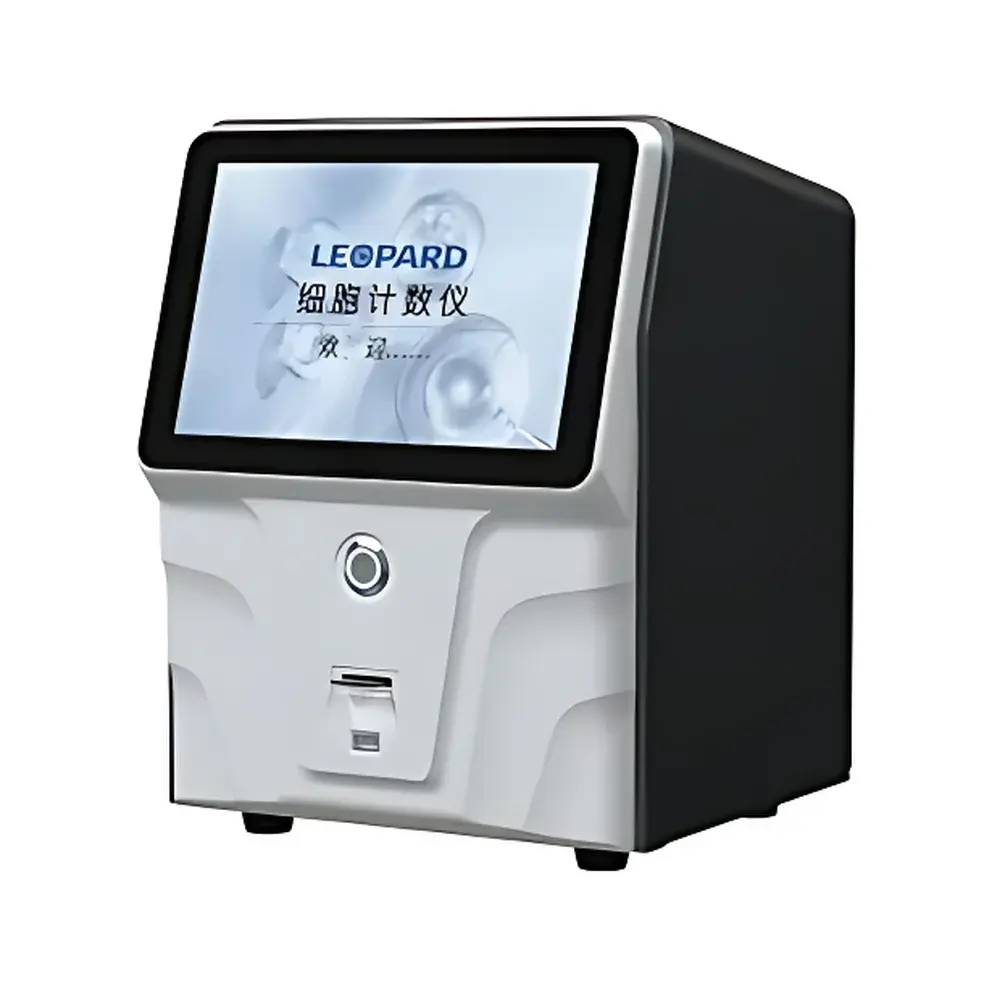
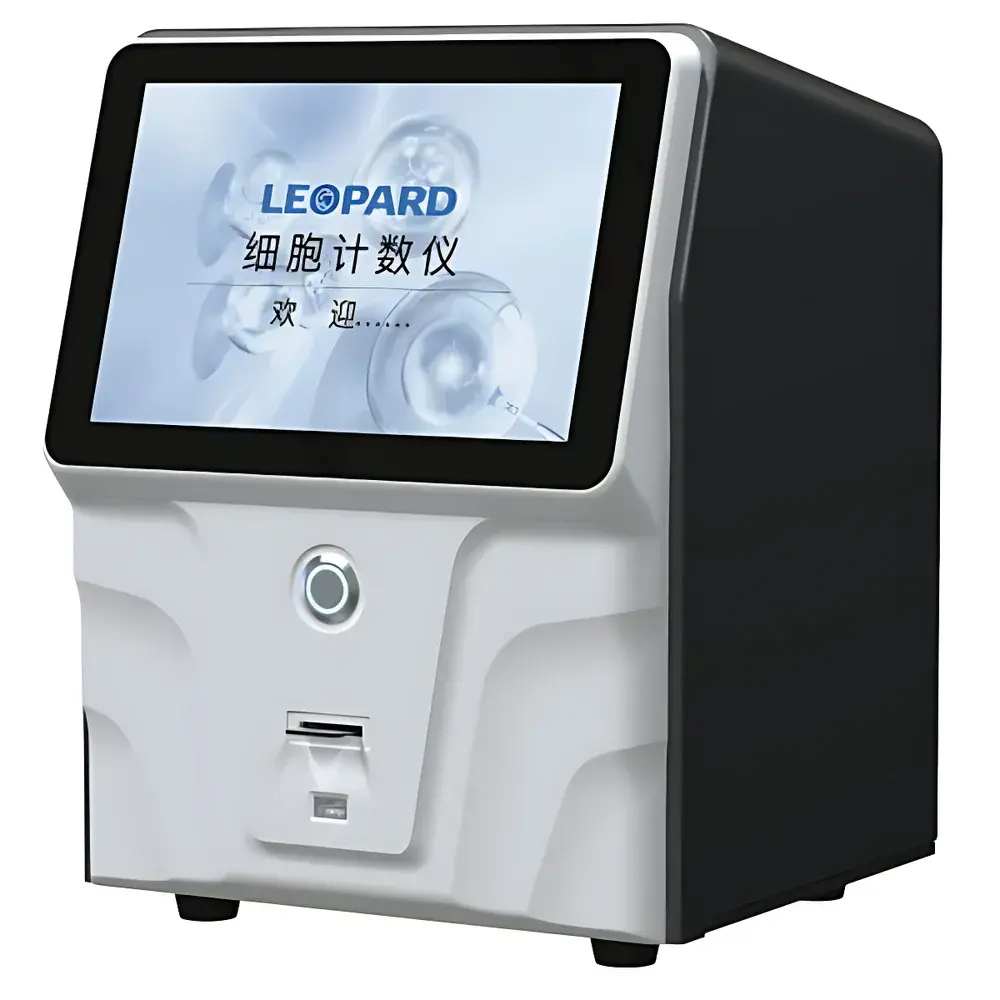
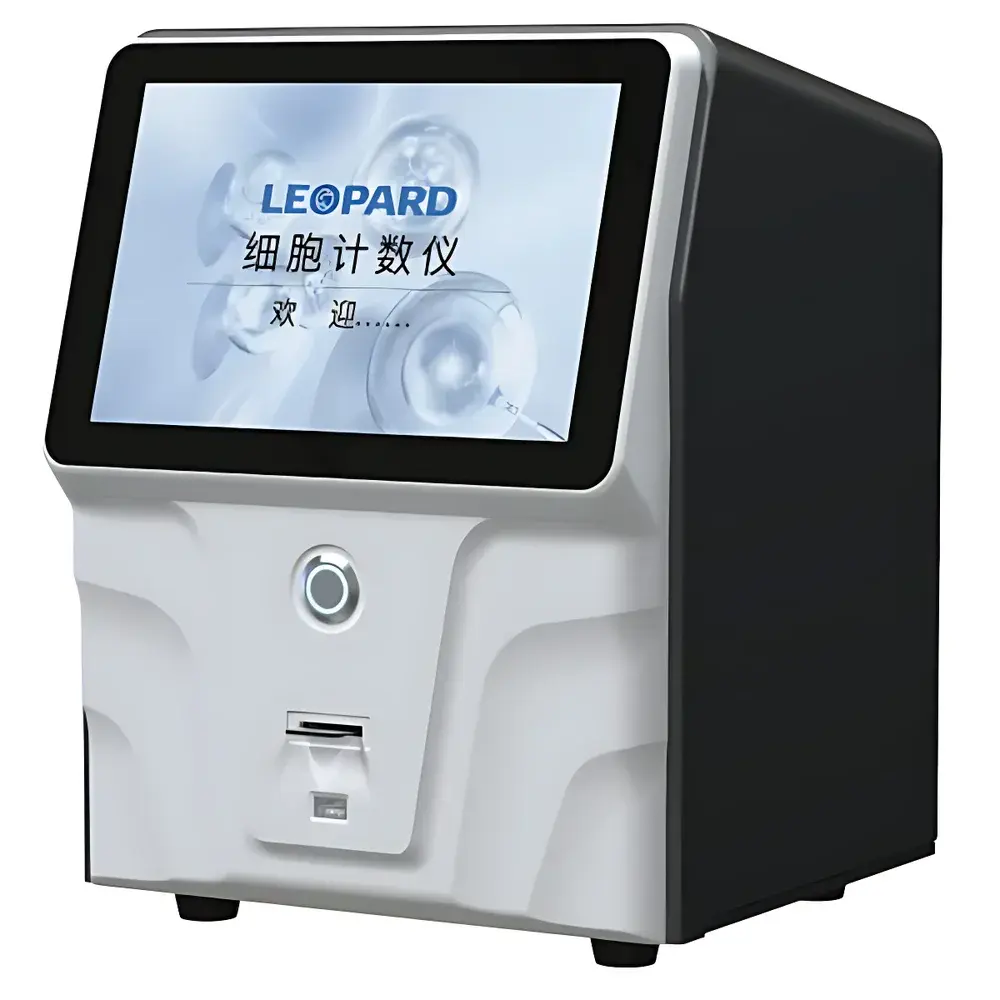
Leopard BFCC-8 Brightfield Cell Counter
| Brand | Leopard |
|---|---|
| Origin | Beijing, China |
| Manufacturer Type | Original Equipment Manufacturer (OEM) |
| Product Category | Domestic |
| Model | BFCC-8 |
| Detection Time | <10 s |
| Cell Concentration Range | 2×10³–3×10⁷ cells/mL |
| Sample Volume | 10 µL |
| Sample Throughput | 1–200 µm (particle size range) |
| Detectable Cell Diameter | 1–200 µm |
| Ambient Operating Temperature | 4–32 °C |
| Relative Humidity | <80% (non-condensing) |
| Objective Lens | 10× |
| Imaging Sensor | 12 MP (12 million pixel) CMOS camera |
| Onboard Storage | 500 GB |
| Interfaces | HDMI ×1, USB ×2, RJ45 ×1 |
| Power Input | AC 110/220 V, 50/60 Hz |
| Dimensions (W×D×H) | 280 × 280 × 370 mm |
| Weight | 8.2 kg |
Overview
The Leopard BFCC-8 Brightfield Cell Counter is a fully integrated, benchtop cell analysis system engineered for rapid, label-free quantification and morphometric characterization of suspension-cultured mammalian, insect, yeast, and bacterial cells. Utilizing high-resolution brightfield microscopy coupled with real-time video-streaming acquisition and AI-enhanced image segmentation algorithms, the BFCC-8 delivers objective, operator-independent measurements of cell concentration, viability (via trypan blue or AO/PI exclusion), mean diameter, circularity, and aggregation index—all within a single 10-second assay cycle. Unlike flow-based cytometers or hemocytometer-dependent manual counting, the BFCC-8 employs static field-of-view imaging on disposable 8-well counting chambers, eliminating fluidic complexity, calibration drift, and carryover risk. Its optical architecture—featuring a 10× achromatic objective, 12 MP CMOS sensor, and 4K oversampling—ensures consistent resolution across the full 1–200 µm detection range, supporting applications from primary T-cell suspensions to large adherent cell aggregates dissociated for passaging.
Key Features
- Integrated 10.1-inch capacitive touchscreen interface with intuitive, icon-driven workflow navigation—no external PC required
- Patented auto-focus algorithm optimized for heterogeneous cell populations, dynamically adjusting focal plane across varying cell thicknesses and settling behaviors
- Real-time video streaming mode enables live morphological assessment, including motility observation, clump dynamics, and debris discrimination
- 8-well disposable counting chamber design supports parallel analysis of up to eight independent samples—or technical triplicates per sample—for statistical robustness
- AI-powered image processing engine trained on >15,000 annotated cell images improves segmentation accuracy for irregular, elongated, or partially overlapping cells
- Zero-maintenance optical path: no moving parts in illumination or detection train; no fluidic lines, valves, or syringes to service or clog
- On-device data management with encrypted 500 GB SSD storage, audit-ready timestamped logs, and GLP-compliant metadata tagging (user ID, protocol ID, chamber lot)
Sample Compatibility & Compliance
The BFCC-8 is validated for use with standard trypan blue, acridine orange/propidium iodide (AO/PI), and unstained suspensions across common bioprocessing cell types—including CHO, HEK293, Jurkat, Vero, Sf9, and Saccharomyces cerevisiae. Its 1–200 µm particle sizing range accommodates both single-cell suspensions and controlled aggregates relevant to suspension-adapted processes. The instrument complies with IEC 61010-1:2010 for laboratory equipment safety and meets electromagnetic compatibility requirements per EN 61326-1:2013. While not FDA 21 CFR Part 11-certified out-of-the-box, its software architecture supports optional configuration for electronic signature, audit trail, and role-based access control—enabling alignment with GMP/GLP environments upon customer-defined validation protocols.
Software & Data Management
The embedded firmware (v3.2+) includes native report generation in PDF, CSV, and XLSX formats, with customizable templates for QC release documentation. All raw image stacks and processed masks are retained alongside numerical outputs, supporting retrospective reanalysis without re-acquisition. Data export supports network transfer via Ethernet (RJ45) or local backup via USB 3.0. Optional Leopard Cloud Connect module enables secure, TLS-encrypted synchronization with LIMS or ELN platforms using RESTful API endpoints. Software update packages are digitally signed and verified at boot time to ensure integrity and traceability.
Applications
- Bioreactor inoculum preparation and harvest titer verification in upstream process development
- Cell line stability monitoring during master/working cell bank expansion
- Transfection efficiency assessment via post-nucleofection viability and size distribution shifts
- Stem cell differentiation endpoint evaluation using morphology-driven clustering metrics
- QC release testing of cryopreserved vials per USP <1043> guidelines for cellular therapies
- Yeast fermentation monitoring in academic and industrial brewing labs
FAQ
Does the BFCC-8 require daily calibration or routine maintenance?
No. The optical path is factory-aligned and sealed; only periodic verification using NIST-traceable polystyrene microsphere standards (10 µm and 50 µm) is recommended every 90 days.
Can the BFCC-8 distinguish between live/dead cells without fluorescent dyes?
Yes—using high-contrast brightfield imaging and membrane integrity inference, but trypan blue remains the reference method for viability determination per ISO 20391-1.
Is the 8-well counting chamber compatible with third-party slides?
No. Chamber geometry, meniscus control, and optical flatness are proprietary; only Leopard-certified disposable plates (Cat. No. BFC-PLATE-8) ensure metrological validity.
How does the BFCC-8 handle highly aggregated or viscous samples?
The system applies adaptive thresholding and multi-scale blob analysis to resolve individual nuclei within loose clusters; samples exceeding 15% aggregate area fraction should be gently vortexed or filtered prior to loading.
What data security measures are implemented in onboard storage?
Full-disk encryption (AES-256), user-authenticated login, and immutable log files prevent unauthorized access or tampering—meeting baseline requirements for ISO/IEC 27001 Annex A.8.2.3.




