
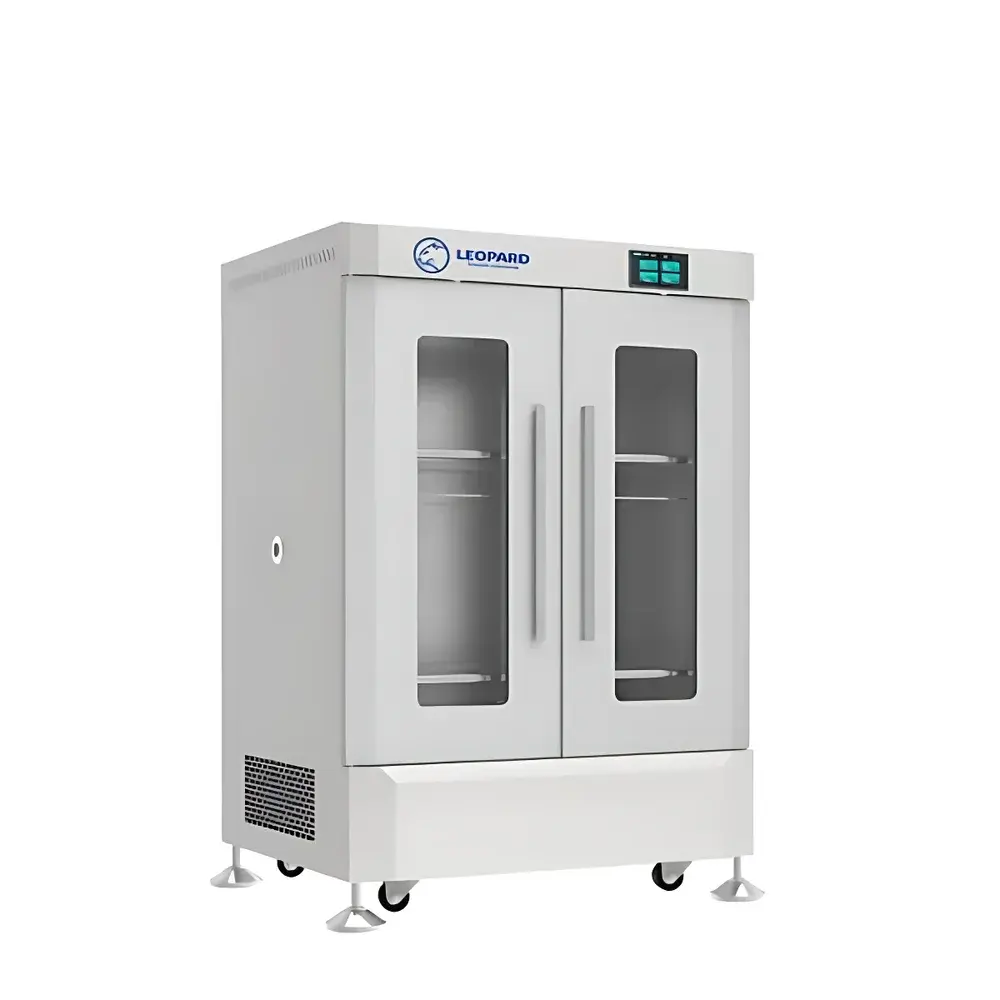
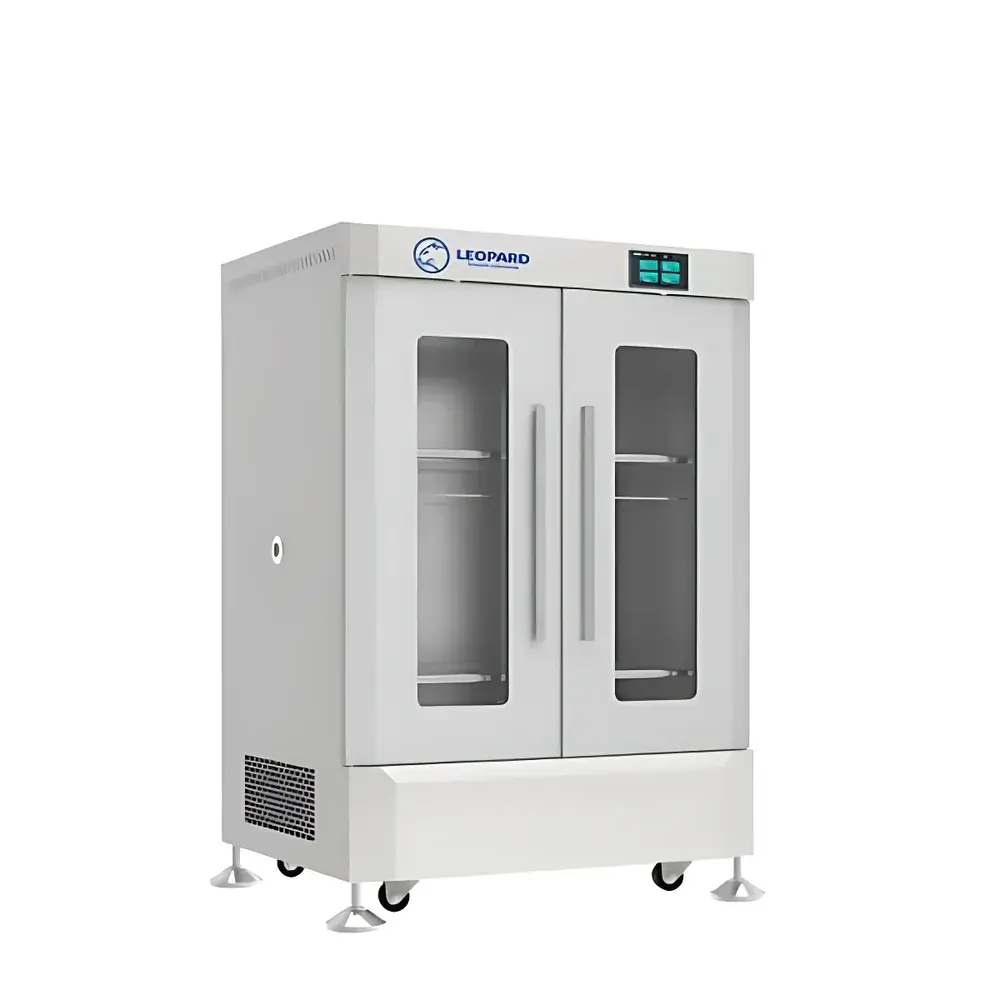
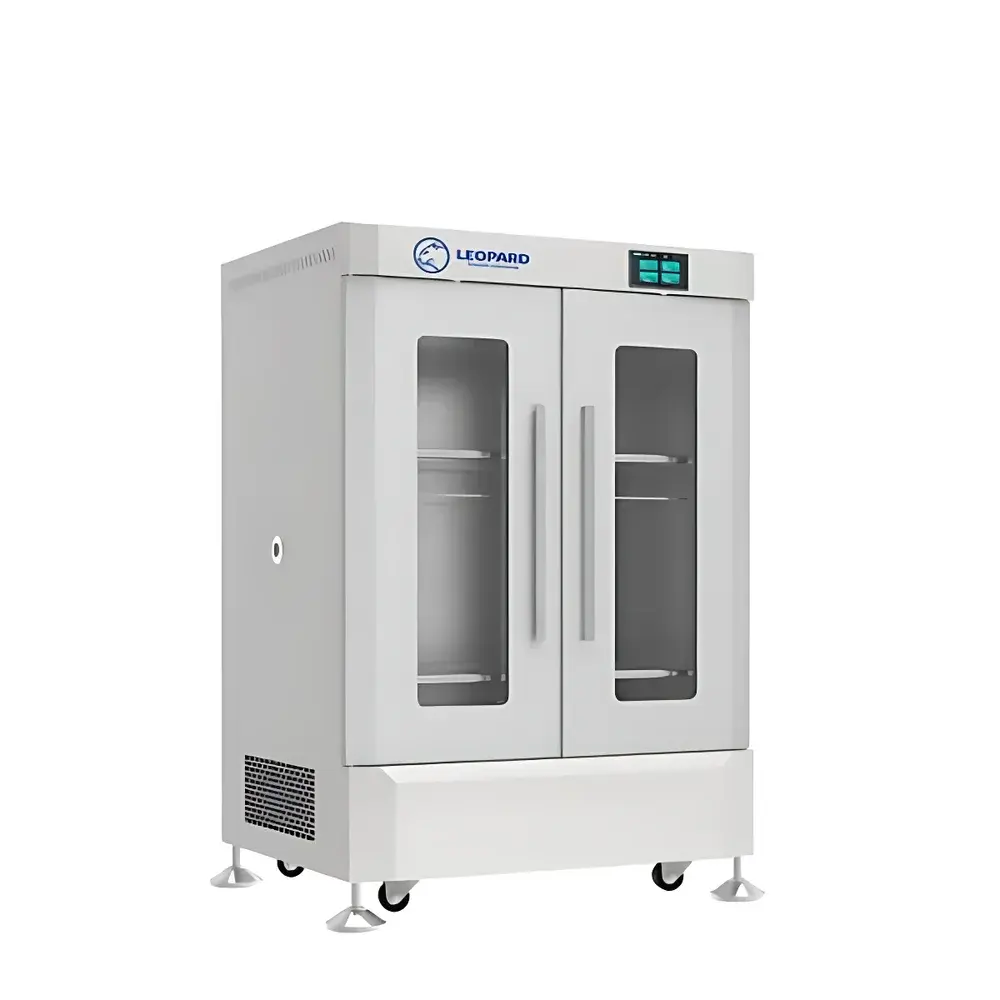
Leopard NBS-500 Vertical Dual-Door Temperature-Controlled Orbital Shaking Incubator
| Brand | Leopard |
|---|---|
| Origin | Beijing, China |
| Manufacturer Type | Direct Manufacturer |
| Instrument Type | Temperature-Controlled Orbital Shaking Incubator |
| Drive Mechanism | DC Servo Motor |
| Speed Range | 10–300 rpm |
| Speed Accuracy | ±1 rpm |
| Orbit Diameter | 26 mm (standard), 50 mm (optional) |
| Temperature Range | 4–65 °C |
| Temperature Fluctuation | ±0.1 °C |
| Temperature Uniformity | ±0.5 °C (at 37 °C) |
| Internal Chamber Dimensions | 1075 mm × 860 mm × 1450 mm (W×D×H) |
| Net Internal Volume | 475 L |
| Dual-Shelf Tray Size | 800 mm × 500 mm per shelf |
| Max Load per Shelf | 20 kg |
| Flask Capacity (per shelf) | 250 mL × 48, 500 mL × 33, 1000 mL × 20, or 2000 mL × 12 |
| Power Supply | AC 220 V ±10%, 50 Hz |
| Rated Power | ≤1600 W |
| Control Interface | 5-inch resistive LED touchscreen |
| Cooling System | Eco-friendly R134a refrigerant with imported compressor |
| Air Circulation | Cross-flow drum-type fan |
| Safety Features | Door-open stop, over-temperature alarm, auto power cutoff, UV sterilization lamp, password-protected operation lock |
Overview
The Leopard NBS-500 Vertical Dual-Door Temperature-Controlled Orbital Shaking Incubator is an engineered platform for precise, reproducible cultivation of microbial, mammalian, and insect cell cultures under controlled thermal and mechanical agitation conditions. It integrates orbital shaking motion—generated via a five-axis eccentric drive system—with high-fidelity temperature regulation in a vertically oriented, dual-access chamber. This configuration supports simultaneous incubation and agitation across two independently accessible shelves, making it suitable for high-throughput applications in bioprocess development, fermentation optimization, enzyme kinetics, and recombinant protein expression. The unit operates on the principle of constant-orbit orbital shaking (26 mm standard orbit), which induces gentle yet effective mixing while minimizing shear stress on sensitive biological samples—critical for maintaining viability in suspension cultures and aerobic bioreactions.
Key Features
- Robust dual-shelf design with 800 mm × 500 mm stainless steel trays (304 grade, mirror finish, R-cornered), enabling efficient vertical space utilization and simplified cleaning between runs.
- Precision servo-driven orbital motion system delivering stable speed control from 10 to 300 rpm with ±1 rpm accuracy; optional 50 mm orbit available for higher-mixing-demand protocols.
- Intelligent dual-loop PID temperature control architecture ensuring ±0.1 °C fluctuation and ±0.5 °C uniformity at setpoint (validated at 37 °C), supported by an eco-friendly R134a refrigeration system with imported compressor and near-silent operation.
- Cross-flow drum-type blower system providing wide-angle, laminar airflow—enhancing thermal homogeneity and reducing localized heat buildup at rear panel surfaces.
- 5-inch resistive LED touchscreen interface with encrypted operation lock, real-time display of temperature, speed, elapsed time, and program segment status; supports up to 30-step programmable cycles with time resolution down to 1 minute.
- Integrated safety systems including door-open immediate stop, over-temperature cut-off, fault-triggered power disengagement, and built-in UV-C germicidal lamp (254 nm) for routine chamber decontamination.
Sample Compatibility & Compliance
The NBS-500 accommodates standard laboratory glassware and plastic vessels—including Erlenmeyer flasks (250–2000 mL), culture bottles, and multi-well plates—across both shelves simultaneously. Its 475 L internal volume and dual-tray load capacity (20 kg per shelf) support scalable cultivation workflows aligned with common upstream bioprocessing practices. The unit complies with general laboratory equipment safety standards (IEC 61010-1) and is designed for use in environments meeting ISO 14644 Class 8 cleanroom specifications when installed with appropriate HVAC support. While not certified for GMP manufacturing, its programmable logging, password protection, and operational traceability features facilitate alignment with GLP documentation requirements and internal QA/QC procedures.
Software & Data Management
Data recording is performed locally via non-volatile memory with timestamped storage of all setpoints, actual values, alarms, and runtime events. The touch interface enables manual parameter entry and review without external software dependency. For integration into networked lab environments, optional RS-485 or Ethernet modules (sold separately) allow remote monitoring and data export in CSV format—supporting audit trail generation compatible with FDA 21 CFR Part 11–aligned record-keeping frameworks when paired with validated third-party LIMS or ELN platforms.
Applications
- Microbial growth studies (E. coli, yeast, Bacillus spp.) under aerobic conditions with defined oxygen transfer rates.
- Mammalian and insect cell line expansion in suspension culture formats requiring low-shear agitation.
- Enzyme activity assays and metabolic pathway analysis where temperature-stable oscillation improves reaction kinetics reproducibility.
- Antibiotic susceptibility testing and pharmacokinetic modeling using broth microdilution methods.
- Vaccine antigen production, plasmid DNA amplification, and recombinant protein expression in shake-flask bioreactors.
- Environmental microbiology sampling incubation and biodegradation rate assessments under controlled thermal-agitation profiles.
FAQ
What is the maximum flask size supported per shelf?
Each shelf accommodates up to twelve 2000 mL Erlenmeyer flasks, thirty-three 500 mL flasks, or forty-eight 250 mL flasks—configured to maintain balanced center-of-mass during orbital motion.
Is the unit suitable for cold room installation?
Ambient operating conditions are specified at 20–30 °C and ≤80% RH; operation below 20 °C may impair refrigeration efficiency and compromise temperature stability at lower setpoints (e.g., 4–10 °C).
Can the UV lamp be scheduled independently of incubation cycles?
Yes—the UV sterilization function operates manually or can be triggered post-cycle via the touchscreen interface, with user-defined exposure duration (default: 30 min).
Does the system support validation documentation (IQ/OQ)?
Factory calibration certificates are provided; full IQ/OQ protocol execution requires site-specific qualification using NIST-traceable thermocouples and tachometers—templates available upon request.
What maintenance intervals are recommended?
Compressor oil and refrigerant integrity should be verified annually; fan filters require quarterly inspection; stainless steel chamber surfaces should be wiped with ethanol or 70% isopropanol after each use.



