
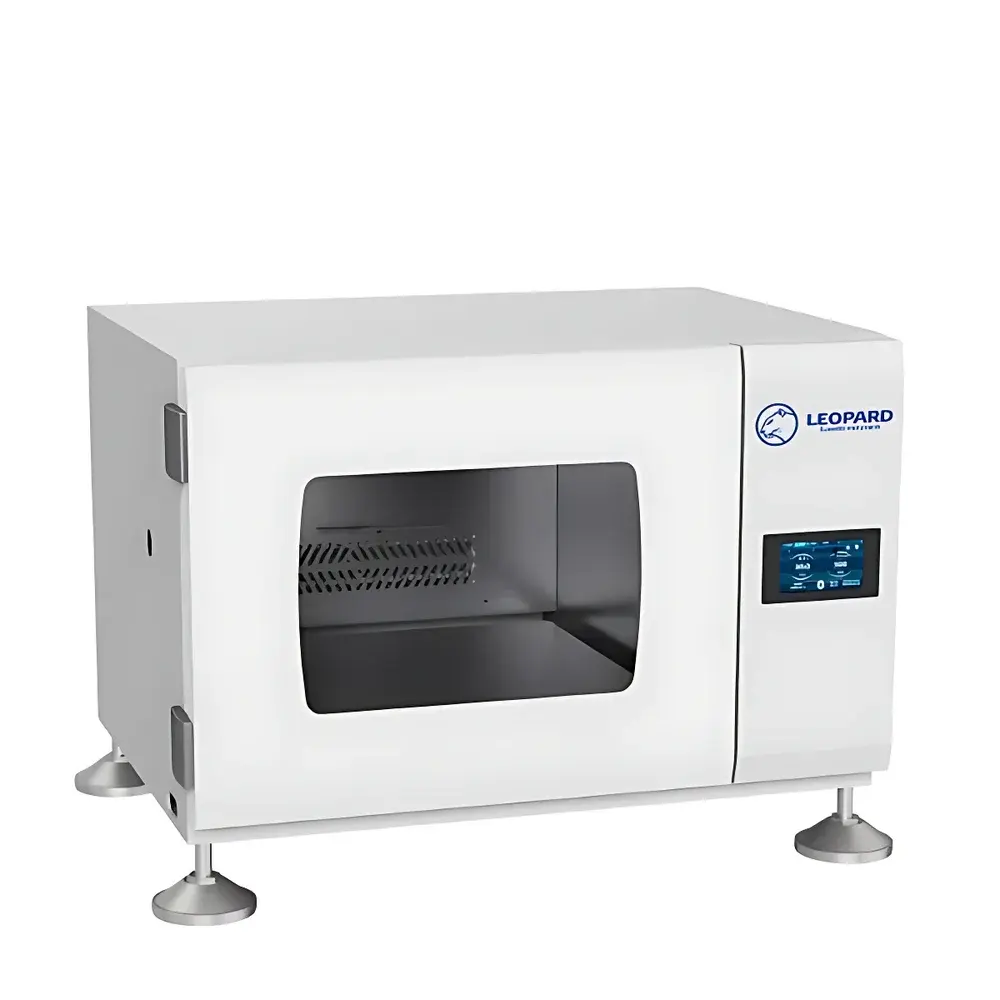
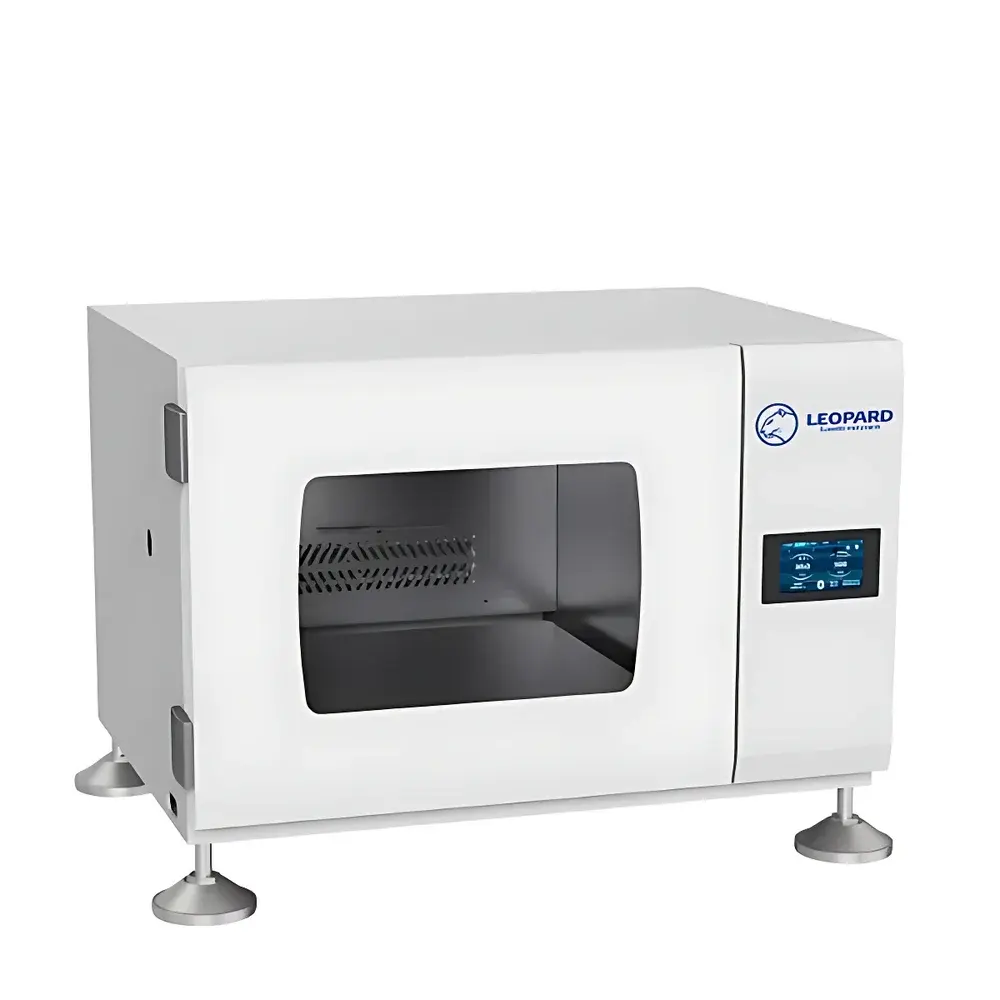
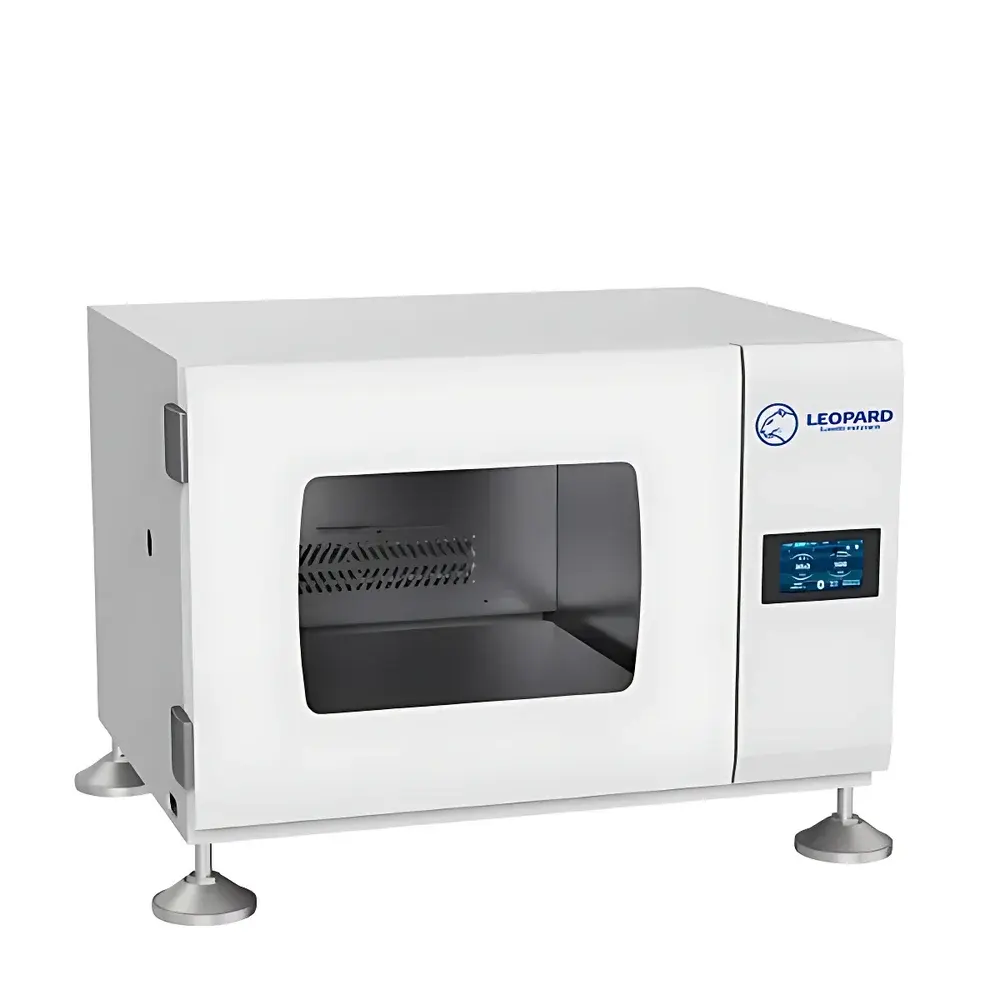
Leopard NBS-80 Stackable Orbital Shaking Incubator
| Brand | Leopard |
|---|---|
| Origin | Beijing, China |
| Manufacturer Type | Direct Manufacturer |
| Instrument Type | Temperature-Controlled Orbital Shaking Incubator |
| Speed Range | 10–300 rpm |
| Speed Accuracy | ±0.3 rpm |
| Orbit Diameter | 26 mm (standard) or 50 mm (optional) |
| Temperature Control Range | 4–60 °C |
| Chamber Volume | 110 L |
| External Dimensions | 1080 mm × 685 mm × 650 mm |
| Temperature Uniformity | ±0.4 °C |
| Display | 5-inch color LCD with PID microprocessor control |
| Power Supply | AC 250 V ±10%, 50–60 Hz |
| Cooling System | Eco-friendly refrigerant with imported compressor |
| Drive System | Five-axis eccentric mechanism with high-precision pulleys and imported timing belt |
| UV Sterilization | Integrated UVC lamp in inner chamber |
| Door Operation | Side-opening with automatic lighting and motion interlock |
| Data Interface | USB port for parameter export/import |
| Operating Modes | Fixed-time mode (0–999 min) and multi-segment mode (up to 30 segments, each 0–9999 min) |
| Sample Capacity (per shelf) | 30 × 250 mL flasks |
| Compliance | Designed to support GLP-compliant workflows |
Overview
The Leopard NBS-80 Stackable Orbital Shaking Incubator is an engineered solution for laboratories requiring simultaneous temperature-controlled incubation and precise orbital agitation across multiple independent layers. It operates on the principle of orbital shaking—where a circular motion (with fixed diameter) imparts uniform mixing energy to liquid cultures—combined with active thermoelectric and compressor-based cooling/heating to maintain stable setpoint temperatures from 4 °C to 60 °C. Its stackable architecture enables vertical expansion of cultivation capacity without increasing footprint, making it especially suitable for space-constrained core facilities, bioprocess development labs, and academic research groups scaling up microbial, mammalian, or hybridoma culture workflows. The system is designed for continuous operation under controlled environmental conditions (ambient 18–25 °C), delivering consistent thermal uniformity (±0.4 °C) and mechanical stability even at maximum speed (300 rpm), supporting reproducible growth kinetics and metabolic profiling.
Key Features
- Modular stackable design with side-access doors—each tier features fully independent PID-controlled temperature and shaking parameters, enabling parallel experiments under distinct conditions.
- High-fidelity servo-driven orbital drive system with five-axis eccentric mechanism and imported timing belt transmission, ensuring long-term mechanical integrity, minimal vibration transfer between layers, and speed accuracy of ±0.3 rpm.
- Integrated UVC germicidal lamp mounted within the stainless-steel chamber interior, providing non-contact sterilization between runs and minimizing cross-contamination risk in sensitive cell or recombinant protein applications.
- 5-inch full-color LCD touchscreen interface with password-protected parameter locking, real-time graphing of temperature and speed profiles, and onboard historical data logging (time-stamped run records).
- Side-hinged tempered glass door with built-in LED illumination activated automatically upon opening—enabling safe, non-intrusive visual monitoring without thermal or mechanical disturbance to ongoing cultures.
- Eco-efficient refrigeration system using R134a-free refrigerant and premium-grade hermetic compressor, optimized for low-noise operation (<55 dB(A)) and stable sub-ambient performance down to 4 °C.
- USB interface for exporting configuration files, runtime logs, and alarm history—facilitating audit-ready documentation and integration into centralized lab data management systems.
Sample Compatibility & Compliance
The NBS-80 accommodates standard Erlenmeyer flasks (250–3000 mL), test tubes, and deep-well plates via interchangeable clamping platforms. Its 550 mm × 460 mm oscillating platform supports up to 30 × 250 mL flasks per layer, with optional 50 mm orbit kits available for high-viscosity or oxygen-demanding cultures. Ventilation slots integrated into the chamber sidewalls ensure passive gas exchange, critical for aerobic microbial fermentations and suspension cell expansions. The unit complies with IEC 61010-1 safety standards for laboratory equipment and incorporates design elements aligned with Good Laboratory Practice (GLP) requirements—including traceable parameter logging, operator authentication, and tamper-evident configuration locks. While not certified for GMP manufacturing environments, its architecture supports 21 CFR Part 11–ready software extensions when paired with validated third-party data acquisition platforms.
Software & Data Management
The embedded PID controller manages dual-loop feedback for both temperature and motor speed, with programmable ramp rates and hold functions. Two operational modes are supported: fixed-duration (0–999 minutes) and multi-segment scheduling (up to 30 segments, each configurable for duration, temperature, and rpm). All settings are stored in non-volatile memory with timestamped change logs. USB data export generates CSV-formatted files containing setpoints, actual readings, alarms, and user actions—compatible with LIMS, ELN, and statistical process control tools. Optional firmware upgrades may extend compatibility with RS-485 Modbus RTU or Ethernet TCP/IP protocols for enterprise-level integration.
Applications
- Microbial fermentation optimization (E. coli, yeast, Bacillus spp.) under varied aeration and thermal regimes.
- Mammalian cell line expansion for monoclonal antibody production and vaccine development.
- Enzyme kinetic assays requiring precise temperature-agitation coupling over extended durations.
- Environmental microbiology studies involving soil slurry enrichment or wastewater bioreactor simulation.
- Pharmaceutical stability testing per ICH Q1 guidelines, particularly for liquid formulations requiring agitation during storage assessment.
- Academic teaching labs performing standardized growth curve analysis and antibiotic susceptibility screening.
FAQ
What is the maximum load capacity per shelf?
Each oscillating platform supports up to 15 kg uniformly distributed, corresponding to configurations such as 30 × 250 mL flasks or 12 × 1000 mL bottles.
Can the unit operate continuously at 4 °C with shaking at 250 rpm?
Yes—the refrigeration system and drive train are rated for uninterrupted operation across the full parameter envelope, including simultaneous low-temperature and high-speed agitation.
Is UV sterilization cycle time programmable?
UV exposure duration is manually initiated and timed externally; no automated timer is built into the UVC subsystem, preserving flexibility for lab-specific decontamination SOPs.
Does the system support remote monitoring or network connectivity?
Native Ethernet or Wi-Fi is not included, but USB-exported logs can be ingested by external SCADA or LabVantage systems via scheduled script-based ingestion.
Are spare parts and service manuals available internationally?
Leopard provides OEM technical documentation, calibration procedures, and authorized distributor networks in North America, EU, and APAC regions—contact regional support for lead times and certification documentation.



