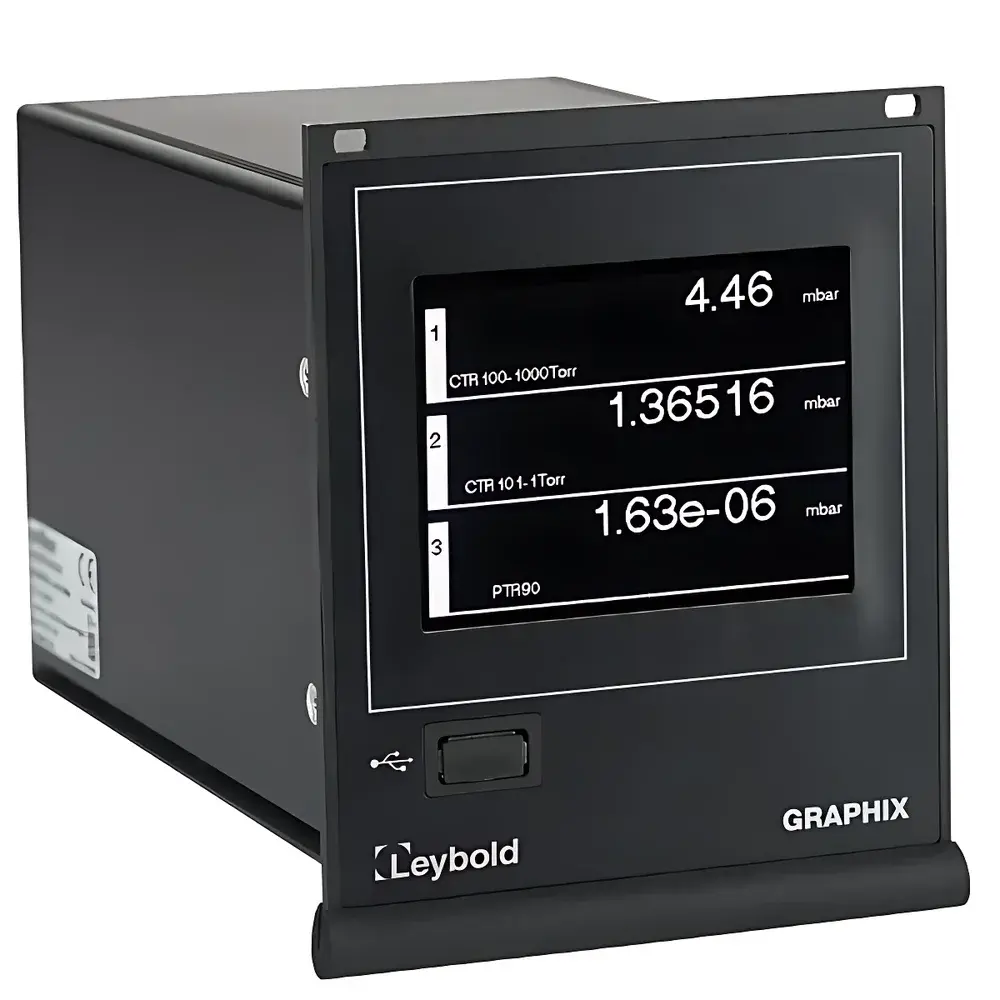
Leybold GRAPHIX Series Vacuum Gauge Controller
| Brand | Leybold |
|---|---|
| Origin | Germany |
| Model | GRAPHIX |
| Channel Options | 1-channel, 2-channel, 3-channel |
| Pressure Range | 1×10⁻¹⁰ mbar to 2000 mbar |
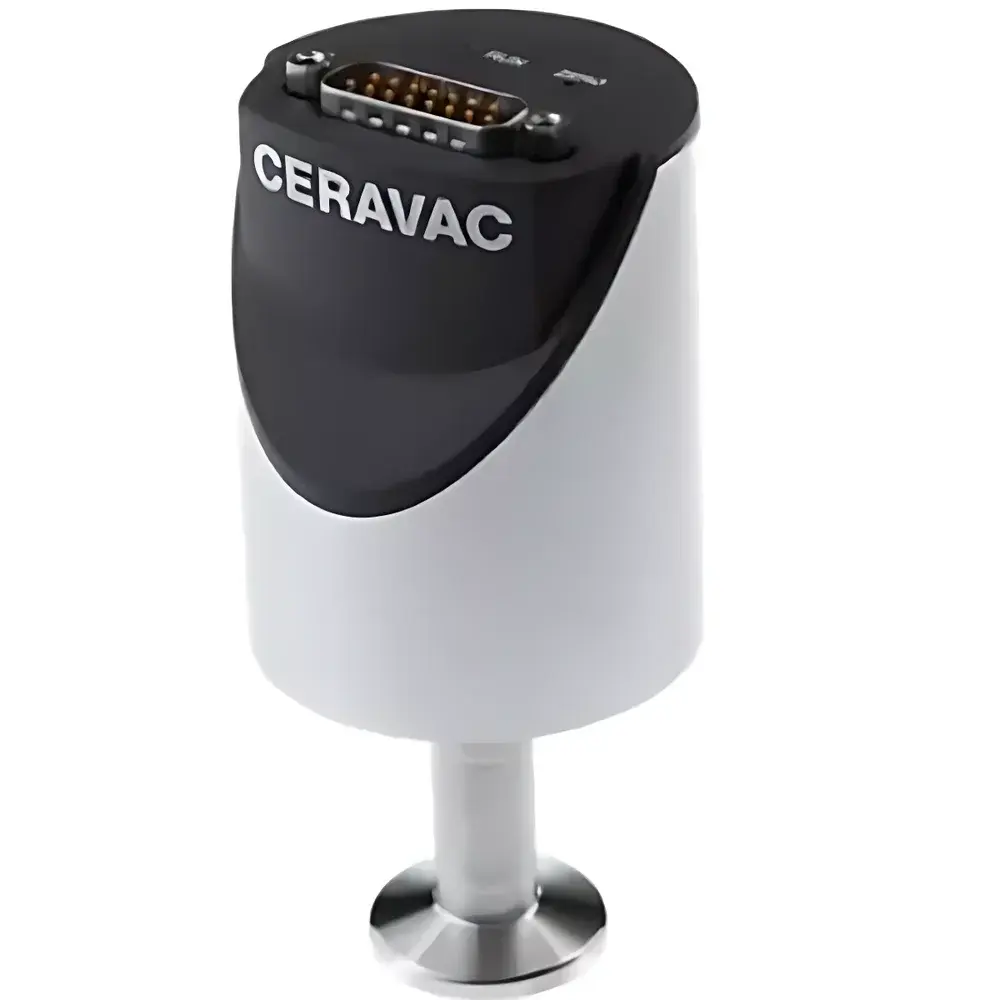
| Sensor Compatibility | THERMOVAC TTR, CERAVAC CTR, DU, PENNINGVAC PTR, IONIVAC ITR series active sensors |
| Operating Principle | Digital signal processing of analog or digital outputs from active vacuum sensors |
Overview
The Leybold GRAPHIX Series Vacuum Gauge Controller is a high-integrity, multi-channel digital control and display unit engineered for precise, real-time pressure monitoring and process integration in industrial vacuum systems. Unlike analog-only controllers, the GRAPHIX platform employs embedded microprocessor-based signal conditioning and digital communication protocols to interface directly with Leybold’s family of active vacuum sensors—including thermocouple (TTR), capacitance diaphragm (CTR/DU), cold cathode (PTR), and hot cathode ionization (ITR) gauges. Its operational range spans 1×10⁻¹⁰ mbar to 2000 mbar—covering ultra-high vacuum (UHV), high vacuum (HV), medium vacuum (MV), and rough vacuum regimes—making it suitable for applications ranging from semiconductor thin-film deposition and vacuum metallurgy to analytical instrumentation and R&D vacuum chambers. The controller does not generate pressure measurements itself; rather, it acquires, linearizes, temperature-compensates, and displays sensor output signals in accordance with manufacturer-calibrated transfer functions traceable to national metrology institutes.
Key Features
- Configurable 1-, 2-, or 3-channel architecture supporting simultaneous acquisition and display of multiple vacuum sensors
- Digital signal processing engine with automatic sensor identification via integrated ID chip recognition (where supported by sensor firmware)
- High-contrast graphical LCD display with intuitive menu navigation and customizable unit selection (mbar, Pa, Torr, psi)
- Real-time analog output (0–10 V or 4–20 mA) per channel for integration into PLCs, SCADA systems, or process controllers
- Digital communication interfaces including RS-485 (Modbus RTU) and optional Ethernet (TCP/IP) for remote monitoring and centralized data logging
- Programmable setpoints with relay outputs (SPDT, 250 VAC/2 A) for vacuum sequencing, interlock activation, and pump staging
- Robust aluminum front panel housing rated IP65 for resistance to dust, condensation, and industrial cleaning agents
Sample Compatibility & Compliance
The GRAPHIX controller is certified for use with all active vacuum sensors bearing the Leybold type designation TTR, CTR, DU, PTR, and ITR. It supports both analog voltage/current inputs and digital sensor interfaces compliant with Leybold’s proprietary serial protocol (Leybold Sensor Bus). All sensor-controller combinations are factory calibrated and documented per ISO/IEC 17025-accredited procedures. The device complies with EU directives including EMC Directive 2014/30/EU and Low Voltage Directive 2014/35/EU. CE marking is affixed, and full Declaration of Conformity documentation is provided with each unit. For regulated environments, the controller supports audit-ready operation: event logs with timestamps, user-access levels (operator/engineer/admin), and password-protected configuration changes—facilitating alignment with GLP and GMP documentation requirements.
Software & Data Management
Leybold provides the free GRAPHIX Configuration Tool—a Windows-based utility enabling offline parameter setup, firmware updates, calibration data import/export, and diagnostic testing. Logged pressure data can be exported in CSV format for post-processing in MATLAB, Excel, or LIMS platforms. When connected via RS-485 or Ethernet, the controller supports OPC UA server functionality (optional license), enabling seamless integration into Industry 4.0 architectures. All configuration changes and alarm events are timestamped and stored in non-volatile memory for ≥10,000 entries, satisfying FDA 21 CFR Part 11 requirements for electronic records when deployed with appropriate system validation protocols.
Applications
- Semiconductor fabrication: Endpoint detection and chamber pressure stabilization during PVD/CVD etch and deposition cycles
- Research vacuum systems: Multi-gauge UHV/HV monitoring in surface science beamlines and cryogenic experiments
- Coating and packaging: Closed-loop control of vacuum levels in roll-to-roll metallization and food vacuum-sealing lines
- Analytical instrumentation: Pressure regulation in mass spectrometers, electron microscopes, and residual gas analyzers
- Energy and fusion research: Redundant pressure monitoring across differential pumping stages in tokamak vacuum vessels
FAQ
Which vacuum sensor types are natively supported without external signal conditioning?
THERMOVAC TTR, CERAVAC CTR, DU, PENNINGVAC PTR, and IONIVAC ITR series sensors—all with active electronics and standard Leybold analog/digital interfaces—are fully supported out-of-the-box.
Can the GRAPHIX controller operate as a standalone vacuum sequencer?
Yes. With up to three programmable relay outputs and configurable delay/timing logic, it can autonomously execute multi-step pump-down or venting sequences without external PLC intervention.
Is firmware update capability available in the field?
Yes. Firmware updates are performed via USB or RS-485 using the official GRAPHIX Configuration Tool; no hardware modification or service visit is required.
Does the controller meet requirements for validated pharmaceutical manufacturing environments?
When implemented with documented change control, access management, and electronic audit trail review, the GRAPHIX satisfies core elements of FDA 21 CFR Part 11 and EU Annex 11 for computerized system validation.
What is the maximum cable length between the controller and an active sensor?
For analog connections, maximum recommended length is 100 m using shielded twisted-pair cable (AWG 22–24); for digital interfaces, refer to specific sensor datasheets—typically ≤30 m for reliable signal integrity without repeaters.