
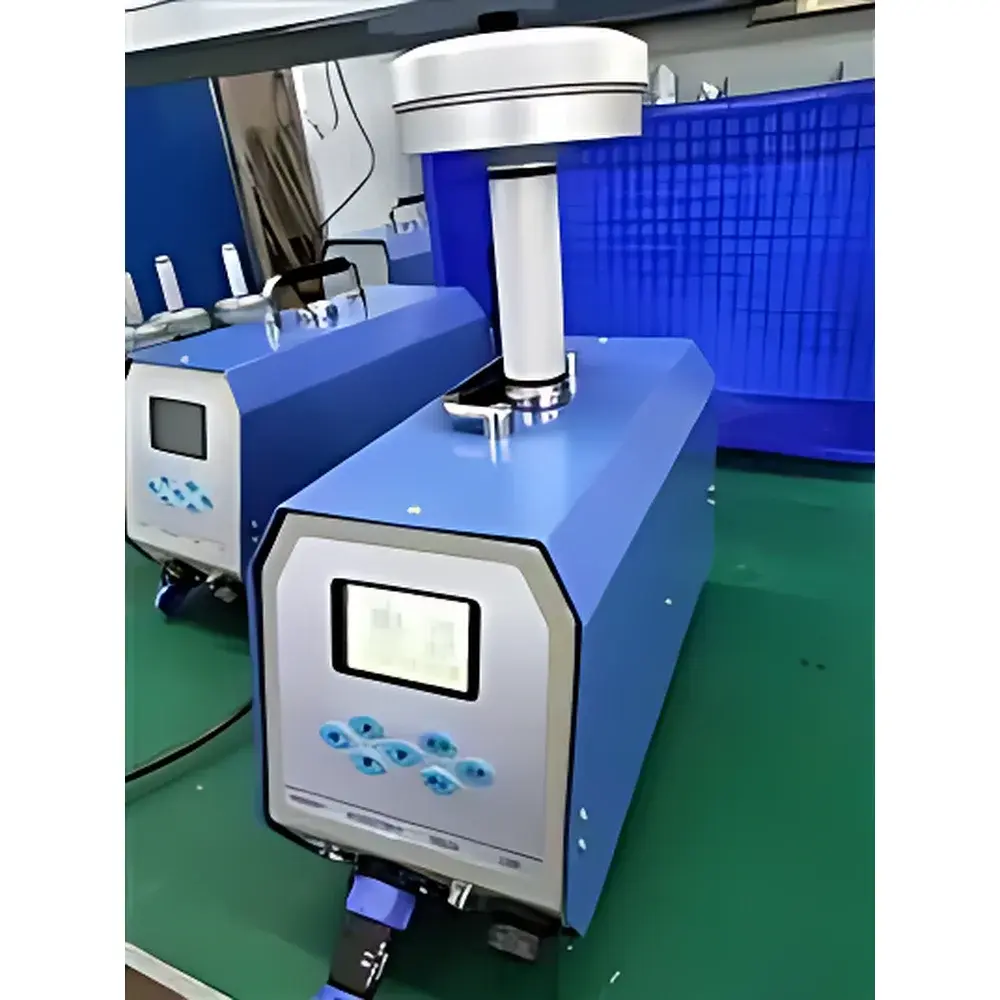
LH-270 Fluoride-Specific Air Sampler
| Origin | Beijing, China |
|---|---|
| Manufacturer Type | Authorized Distributor |
| Origin Category | Domestic (China) |
| Model | LH-270 |
| Pricing | Available Upon Request |
| Dust Sampling Flow Rate | 10–100 L/min (0.1 L/min resolution, ±2% accuracy) |
| Sampling Duration | 00:00–99:59 h:min (1 min resolution, ±1 s deviation within 20 min) |
| Sampling Cycles | 0–99 programmable |
| Pre-sampler Temperature | −30 to 99 °C (0.1 °C resolution, ±1.0 °C accuracy) |
| Pre-sampler Pressure | −30 to 0 kPa (0.01 kPa resolution, ±2.5% accuracy) |
| Ambient Atmospheric Pressure | 50–130 kPa (0.01 kPa resolution, ±500 Pa accuracy) |
| Built-in Heater Range | 15–30 °C (0.1 °C resolution, ±2.0 °C accuracy) |
| Load Capacity | ≥20 kPa at 50 L/min (flow stability ≤2% over 6 h) |
| Inlet Cut-point | Da₅₀ = (100 ± 1) µm, geometric standard deviation δg = 1.5 |
| Inlet Velocity | 0.3 m/s |
| Effective Filter Diameter | Φ80 mm |
| Inlet Thread | M27×1.5 |
| Inlet Width Tolerance | ≤±2.0% |
Overview
The LH-270 Fluoride-Specific Air Sampler is an engineered environmental monitoring instrument designed for the quantitative collection of airborne fluoride-containing particulates and semi-volatile organic compounds (SVOCs) using gravimetric filter-based methodology. It operates on the principle of constant-flow isokinetic sampling, where ambient air is drawn at a precisely controlled volumetric rate through a standardized 80-mm diameter filter medium—typically quartz fiber or polytetrafluoroethylene (PTFE)—to capture total suspended particulates (TSP), including fluorides bound to aerosol surfaces or present as metal-fluoride complexes (e.g., AlF3, CaF2). Its calibrated cut-point (Da50 = 100 ± 1 µm, δg = 1.5) ensures representative TSP capture without size-selective bias, while the integrated heater (15–30 °C) mitigates condensation-induced artifact formation during high-humidity sampling—a critical requirement for accurate fluoride mass recovery in field-deployed regulatory monitoring.
Key Features
- High-stability dual-range mass flow control system (10–100 L/min), validated to ±2% full-scale accuracy per ISO 7709 and EPA Method IO-3.1
- Real-time compensation for temperature, pressure, and humidity via integrated sensors (pre-sampler T/P, ambient barometer, and heated inlet)
- Programmable multi-cycle sampling with up to 99 discrete runs, supporting unattended long-term deployment (up to 99 h 59 min per session)
- Robust mechanical architecture with ≥20 kPa static pressure load capacity at 50 L/min, ensuring consistent flow performance across variable filter resistance (e.g., loaded quartz filters or PTFE membranes)
- ISO-compliant inlet geometry: 0.3 m/s isokinetic velocity, M27×1.5 threaded interface, and tight inlet width tolerance (±2.0%) for reproducible aerosol entry dynamics
- Compliance-ready data logging with timestamped flow, temperature, pressure, and runtime parameters—structured for audit trails under GLP and ISO/IEC 17025 frameworks
Sample Compatibility & Compliance
The LH-270 is compatible with standard 80-mm circular filters used in regulatory-grade analysis, including EPA TO-13A-certified quartz fiber filters for fluoride speciation by ion chromatography (IC) or inductively coupled plasma–mass spectrometry (ICP-MS). Its design conforms to national and international standards governing TSP sampling protocols, including HJ 618–2011 (China), EN 12341:2014 (EU), and ISO 7709:2021 (air quality — determination of mass concentration of total suspended particulates). For fluoride-specific applications, it supports method validation per GB/T 15434–1995 (ambient air — fluoride determination by fluoride ion selective electrode after alkali absorption) and aligns with QA/QC requirements for trace metal and halogen speciation workflows mandated by environmental laboratories accredited to CNAS-CL01 and ILAC-G8.
Software & Data Management
Data acquisition is handled internally via non-volatile memory with automatic time-stamped parameter recording (flow, pre-filter T/P, ambient pressure, heater setpoint, and elapsed time). Export occurs via USB 2.0 interface in CSV format—compatible with laboratory information management systems (LIMS) and statistical process control (SPC) platforms. All logged values include sensor calibration coefficients and uncertainty metadata, satisfying traceability requirements under ISO/IEC 17025 Clause 7.7 and FDA 21 CFR Part 11 (when paired with validated third-party software for electronic signature and audit trail generation). No proprietary cloud service or vendor-hosted platform is required; raw datasets remain fully owned and controllable by the end-user laboratory.
Applications
- Regulatory monitoring of airborne fluoride emissions near aluminum smelters, phosphate fertilizer plants, and ceramic manufacturing facilities
- Source apportionment studies linking atmospheric fluoride concentrations to industrial point sources using receptor modeling (e.g., PMF, CMB)
- Co-sampling of fluorides and SVOCs (e.g., PAHs, PCBs) on dual-bed filter-cartridge configurations for co-exposure risk assessment
- Field validation of dispersion model outputs (e.g., AERMOD, CALPUFF) in compliance with local environmental protection bureau directives
- Long-term trend analysis of particulate-bound fluoride in urban, rural, and background sites under national air quality monitoring networks
FAQ
Is the LH-270 certified for use in official environmental monitoring programs in China?
Yes—the instrument complies with HJ 618–2011 and is widely deployed in provincial ecological environment monitoring centers under the Ministry of Ecology and Environment (MEE) framework.
Can it be used for both fluorides and heavy metals on the same filter?
Yes, provided the filter substrate (e.g., quartz fiber) is suitable for sequential analysis by IC (fluoride) and ICP-MS (Pb, Cd, As, etc.), with documented procedural blanks and spike recoveries per HJ 480–2009.
Does the built-in heater meet ISO 7709 requirements for heated inlets?
Yes—the 15–30 °C adjustable heating range prevents dew-point-related particle loss and maintains inlet wall temperature above ambient dew point by ≥5 °C, satisfying ISO 7709 Annex B recommendations.
What maintenance intervals are recommended for field operation?
Flow sensor calibration every 6 months, pressure transducer verification annually, and routine cleaning of the inlet nozzle and filter holder after each sampling campaign per manufacturer’s technical bulletin TB-LH270-Rev.4.
Is firmware upgrade supported in the field?
Yes—USB-based firmware updates are available from the authorized distributor’s technical support portal, with version-controlled release notes and backward-compatible configuration retention.
Related Products







