
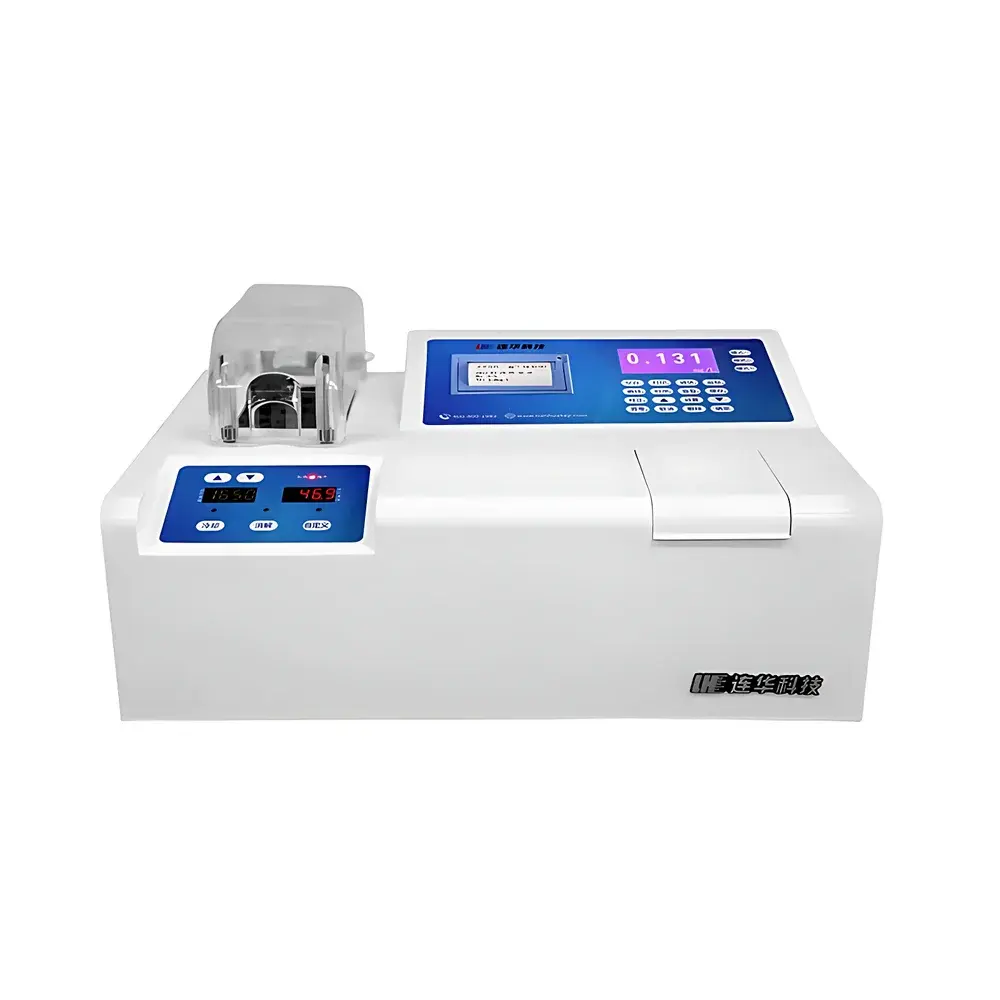
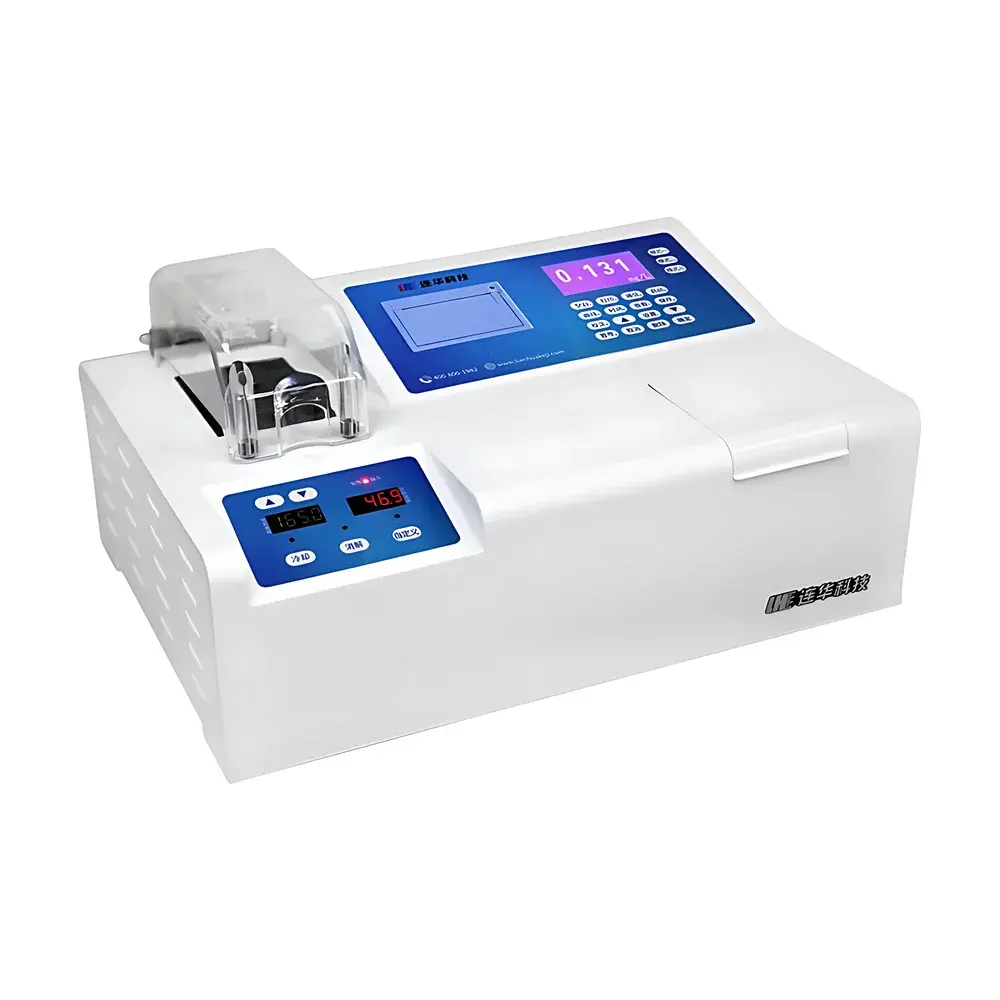
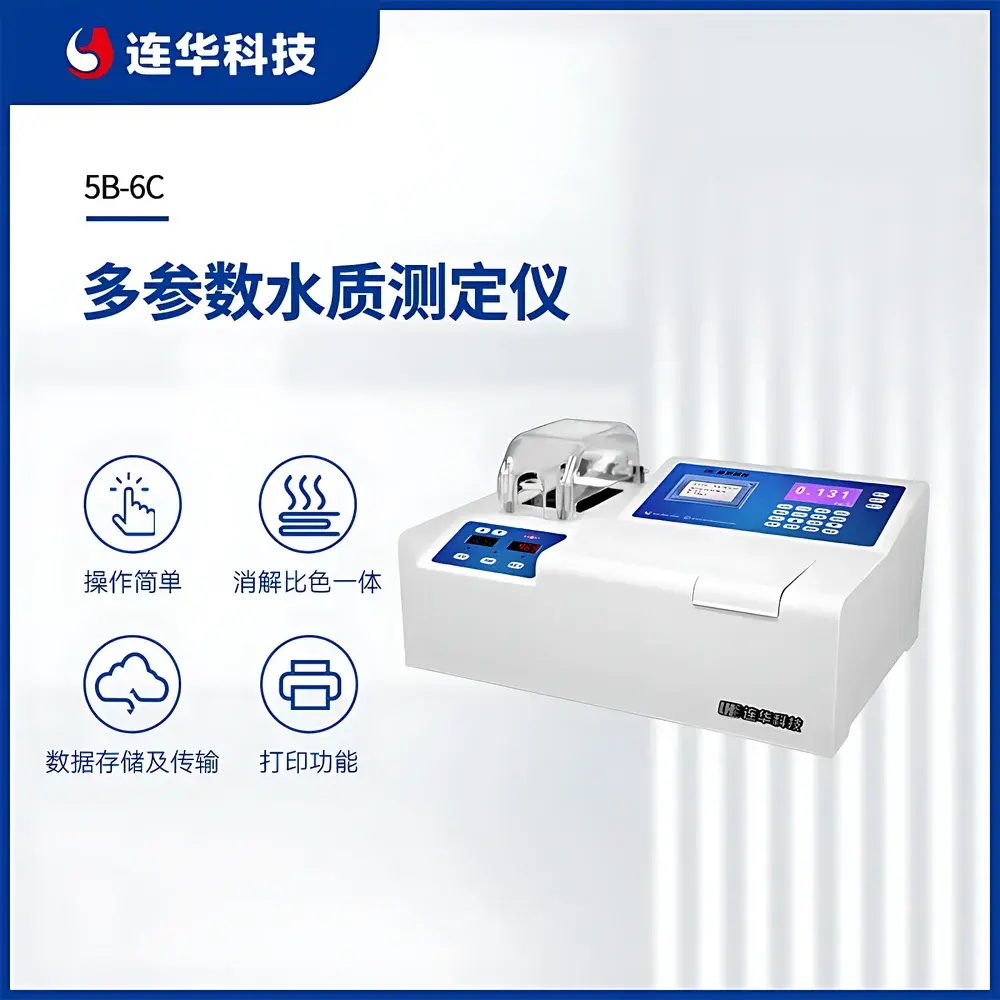
Lianhua Tech 5B-6C Multi-Parameter Water Quality Analyzer
| Brand | Lianhua Tech |
|---|---|
| Origin | Beijing, China |
| Manufacturer Type | Direct Manufacturer |
| Regional Classification | Domestic (China) |
| Model | 5B-6C |
| Instrument Type | Laboratory Water Quality Analyzer |
| Measurable Parameters | COD, Ammonia Nitrogen (NH₃-N), Total Phosphorus (TP) |
| Optical Source | Long-life Cold Light Source with Narrow-band Interference Filter |
| Temperature Control Range | 45–190 °C |
| Timer Range | 1–600 min |
| Calibration Curves Stored | 48 pre-programmed & user-defined curves |
| Data Storage Capacity | 1,000 measurement records |
| Display | Backlit LCD with Chinese UI and bilingual key labeling |
| Cuvette Compatibility | Supports both 10-mm square cuvettes and 16-mm round test tubes |
| Output | Integrated thermal printer for real-time and historical data export |
| Auto-Curve Generation | Capable of automatic calibration curve derivation from standard solutions |
| Interface | Dual-font display mode (large/small), programmable alarm prompts for temperature stabilization and countdown completion |
Overview
The Lianhua Tech 5B-6C Multi-Parameter Water Quality Analyzer is an integrated laboratory instrument engineered for standardized, routine analysis of three critical water quality indicators—Chemical Oxygen Demand (COD), Ammonia Nitrogen (NH₃-N), and Total Phosphorus (TP)—in accordance with national and industry-standard methodologies including HJ 828–2017 (COD), HJ 535–2009 (NH₃-N), and GB/T 11893–1989 (TP). Its design follows the principle of spectrophotometric quantification based on colorimetric reactions: COD is determined via dichromate digestion followed by photometric measurement at 600 nm; NH₃-N employs the Nessler reagent method at 420 nm; and TP is quantified using the ammonium molybdate–ascorbic acid method at 700 nm. The system integrates a precision heating block (45–190 °C) and optical detection unit into a single compact chassis, eliminating inter-unit alignment errors and reducing benchtop footprint—ideal for municipal water labs, environmental monitoring stations, and academic teaching laboratories requiring reproducible, operator-independent results under GLP-aligned workflows.
Key Features
- Integrated dual-function architecture: Combines high-stability digestion block and spectrophotometric detection module in one rigid frame, minimizing thermal drift and mechanical misalignment between steps.
- Triple-parameter simultaneous workflow: Enables sequential or independent measurement of COD, NH₃-N, and TP without hardware reconfiguration—each parameter uses dedicated wavelength channels and optimized reaction protocols.
- Extended thermal control range (45–190 °C): Accommodates diverse digestion requirements—from low-temperature NH₃-N distillation pretreatment to high-temperature COD reflux conditions—without external heating accessories.
- Narrow-band interference cold light source: Provides stable spectral output with 10,000-hour operational lifetime, ensuring long-term photometric repeatability (RSD <1.5% at mid-range concentrations).
- Dual-format sample compatibility: Accepts both 10-mm square quartz/glass cuvettes and 16-mm round glass test tubes, supporting method flexibility across legacy and modern lab protocols.
- Intelligent parameter navigation: Auto-scan function detects inserted sample cell type and selected assay; firmware automatically loads corresponding wavelength, timing, and curve set—reducing manual input errors.
- Configurable user interface: Switchable large/small font modes enhance readability for operators with varying visual acuity; all prompts—including temperature stabilization alerts and countdown notifications—are programmable and retained after power cycle.
Sample Compatibility & Compliance
The 5B-6C supports aqueous samples from surface water, wastewater effluent, drinking water sources, and industrial process streams. Sample volume requirements are consistent with standard methods: 2.5 mL for COD (pre-diluted if necessary), 5–50 mL for NH₃-N (distillate or direct), and 10–25 mL for TP. All internal calibration routines adhere to ISO/IEC 17025 traceability principles through certified reference materials (CRMs) such as NIST SRM 2121a (COD), NIST SRM 2162 (NH₃-N), and NIST SRM 2163 (TP). While not FDA 21 CFR Part 11-certified out-of-the-box, audit trails for calibration events, curve generation, and result exports can be manually archived in CSV format for GMP/GLP documentation compliance.
Software & Data Management
Data handling is performed locally via embedded firmware with no cloud dependency. The device stores up to 1,000 measurement records—including date/time stamp, parameter ID, raw absorbance, calculated concentration, and applied calibration curve ID. Internal memory retains 48 calibration curves: 24 factory-loaded (covering typical environmental concentration ranges) and 24 user-definable via standard solution series. Curve derivation follows linear or polynomial regression (1st–3rd order), with residual error reporting. Thermal printer output includes full metadata: instrument ID, operator code (manually entered), digestion temperature/duration, and pass/fail flags against method-defined blank thresholds. Exported CSV files are compatible with LIMS platforms supporting ASCII-delimited ingestion.
Applications
- Routine regulatory compliance testing for municipal wastewater treatment plants (WWTPs) performing daily COD/NH₃-N/TP checks per local discharge permits.
- Environmental field lab support: Paired with portable filtration and preservation kits, enables same-day analysis of grab samples prior to shipment to central labs.
- Academic instruction: Used in undergraduate environmental chemistry and civil engineering labs to demonstrate EPA-equivalent analytical principles without requiring full spectrophotometer infrastructure.
- Industrial pretreatment verification: Monitors influent and effluent streams in electroplating, food processing, and pharmaceutical manufacturing where phosphorus and nitrogen loadings must remain within pretreatment agreement limits.
- Method validation studies: Serves as a reference platform for cross-checking performance of newer automated analyzers or sensor-based online monitors during commissioning phases.
FAQ
Does the 5B-6C support ASTM or ISO standard methods?
It implements domestic Chinese standards (HJ and GB/T) aligned with equivalent ISO methodologies—e.g., HJ 828–2017 corresponds closely to ISO 6060 for COD, and HJ 535–2009 mirrors ISO 7150-1 for NH₃-N.
Can calibration curves be exported or backed up externally?
Curve parameters (slope, intercept, R², equation type) are printable but not directly exportable via USB or serial port; manual transcription from printed reports is required for archival.
Is the digestion block independently controllable from the photometer?
No—the unit operates as a synchronized system; however, digestion temperature and duration are fully programmable per parameter, and optical measurement initiates only after thermal stabilization confirmation.
What maintenance is required for long-term accuracy?
Annual verification using CRMs and optical path cleaning (cuvette holder, lens surfaces) with ethanol-moistened lint-free wipes is recommended; no lamp replacement is needed within first 5 years under normal use.
Does it meet any cybersecurity or data integrity standards?
It contains no network interface or remote access capability; data integrity relies on local storage redundancy and printed audit trails—suitable for air-gapped lab environments governed by ISO/IEC 27001 physical security controls.







