
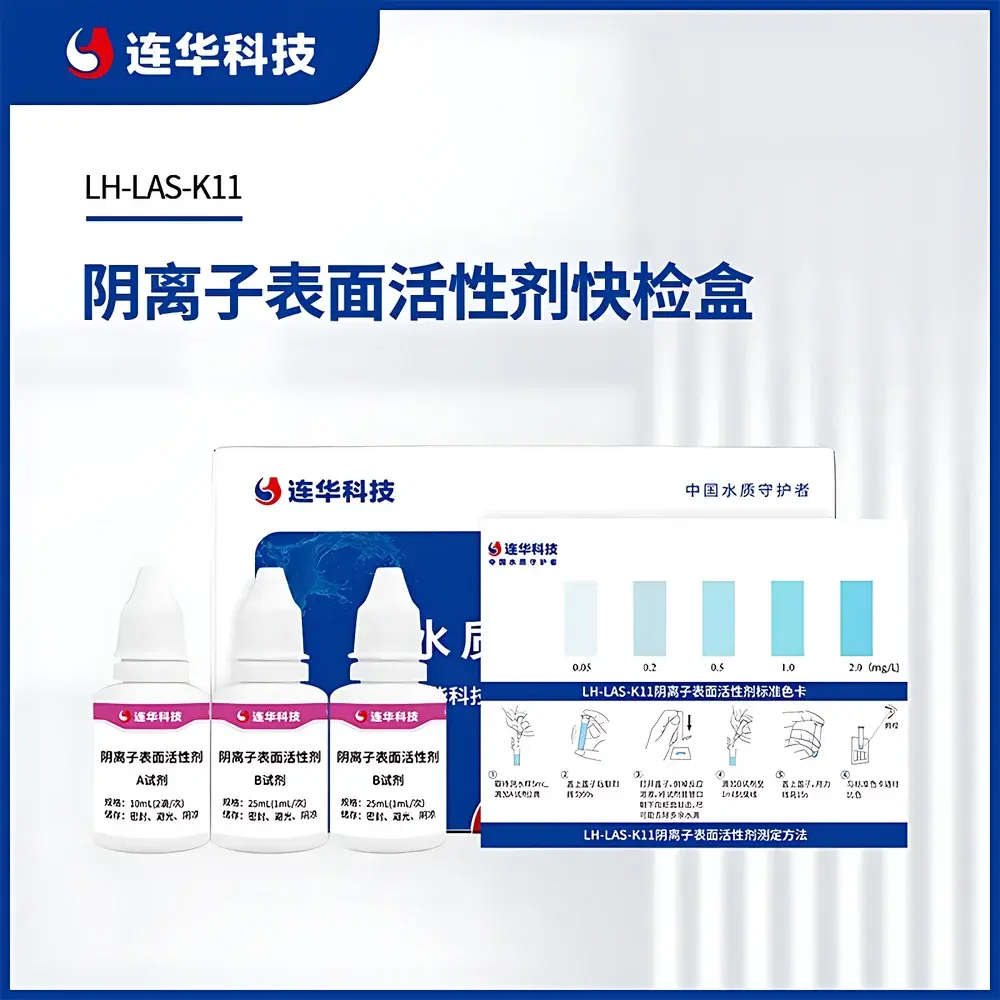
Lianhua Technology LH-LAS-K11 Anionic Surfactant Quick Test Kit
| Brand | Lianhua Technology |
|---|---|
| Origin | Beijing, China |
| Manufacturer Type | Manufacturer |
| Product Origin | Domestic (China) |
| Model | LH-LAS-K11 |
| Pricing | Upon Request |
Overview
The Lianhua Technology LH-LAS-K11 Anionic Surfactant Quick Test Kit is a field-deployable colorimetric assay system engineered for rapid, on-site quantification of anionic surfactants—primarily linear alkylbenzene sulfonates (LAS) and related compounds—in environmental water samples. It operates on the principle of cationic dye–anion complex formation, where methylene blue reacts selectively with anionic surfactants under controlled pH and ionic strength to generate a stable blue-colored ion-pair extractable into chloroform. The intensity of the resulting color is directly proportional to surfactant concentration and is assessed via visual comparison against a calibrated color scale. Designed for emergency response, routine monitoring, and resource-limited settings, the kit delivers semi-quantitative results within 15 minutes without requiring laboratory infrastructure, power supply, or trained analytical personnel.
Key Features
- Field-Ready Visual Quantification: Integrated color comparator card with 8 standardized chromatic steps (0.1–5.0 mg/L LAS as Na-dodecylbenzenesulfonate), enabling immediate interpretation without instrumentation.
- Optimized Reagent Formulation: Pre-measured, lyophilized reagents in sealed vials ensure consistent reaction kinetics, minimized inter-batch variability, and extended shelf life (≥24 months at 4–30 °C).
- Robust Sample Tolerance: Validated for use with surface water, wastewater effluent, and groundwater; accommodates turbidity up to 50 NTU and chloride concentrations ≤500 mg/L without pretreatment.
- Minimal Operational Burden: Three-step protocol—sample acidification, dye addition, and organic phase extraction—requires only a calibrated dropper, vortex mixer (optional), and basic PPE.
- Stable Packaging Architecture: Individually foil-laminated reagent pouches and UV-protected comparator cards maintain reagent integrity during transport and storage across diverse climatic conditions (−10 °C to 45 °C).
Sample Compatibility & Compliance
The LH-LAS-K11 is validated per Chinese Environmental Monitoring Standard HJ 503–2009 (Determination of Anionic Surfactants in Water by Methylene Blue Spectrophotometric Method) and aligns with the foundational methodology of ISO 7875–1:1984. It supports compliance-driven workflows in municipal wastewater treatment plants, industrial discharge monitoring, and ecological risk assessment programs. While not intended for regulatory reporting without confirmatory lab analysis (e.g., HPLC or GC-MS), it fulfills Tier-1 screening requirements under China’s “Technical Guidelines for Emergency Environmental Monitoring” (HJ 589–2010). Cross-reactivity is negligible with non-ionic and cationic surfactants; however, high concentrations of humic substances (>20 mg/L DOC) may necessitate sample filtration prior to analysis.
Software & Data Management
As a non-instrumental, analog test kit, the LH-LAS-K11 does not incorporate embedded software or digital connectivity. However, its design supports seamless integration into digital environmental data management ecosystems: users may log results manually into LIMS platforms or mobile field applications (e.g., ESRI Field Maps, Fulcrum) using standardized parameter codes (e.g., “ANIONIC_SURF_LAS_MG_L”). Batch-specific lot numbers and expiration dates are laser-printed on each kit, enabling full traceability for GLP-aligned recordkeeping. Audit trails—including analyst ID, sampling location (GPS-tagged via companion app), time/date stamp, and observed color match—can be captured to satisfy internal QA/QC documentation requirements.
Applications
- Rapid assessment of LAS breakthrough in activated sludge effluent during wastewater treatment process optimization
- On-scene verification of detergent spill contamination in rivers, lakes, or stormwater runoff following industrial accidents
- Pre-screening of bathing waters and aquaculture intake sources for surfactant load prior to regulatory sampling
- Field validation of point-of-use water filters claiming surfactant removal efficacy
- Educational demonstrations of surfactant behavior and environmental fate in university environmental science laboratories
FAQ
What is the detection range and LOD of the LH-LAS-K11?
The visual detection range spans 0.1 to 5.0 mg/L LAS (as sodium dodecylbenzenesulfonate); the practical limit of detection is ~0.15 mg/L under optimal lighting and observer acuity.
Can this kit be used for seawater analysis?
Direct use in undiluted seawater is not recommended due to high chloride-induced color quenching; a 1:5 dilution with deionized water is required for reliable estimation.
How should expired reagents be disposed of?
Discard unused reagents as hazardous chemical waste per local regulations; chloroform-extracted residues must be handled in accordance with EPA Waste Code D001 (ignitable) and D018 (toxicity characteristic for chloroform).
Is training required to achieve reproducible results?
No formal certification is needed; however, a 30-minute competency assessment—comparing blinded reference standards—is advised for new users to ensure inter-observer agreement ≥90% across the mid-range (1.0–3.0 mg/L).
Does the kit include calibration verification standards?
Each kit contains one sealed ampoule of 2.0 mg/L LAS reference standard for daily performance verification prior to field deployment.
Related Products







