
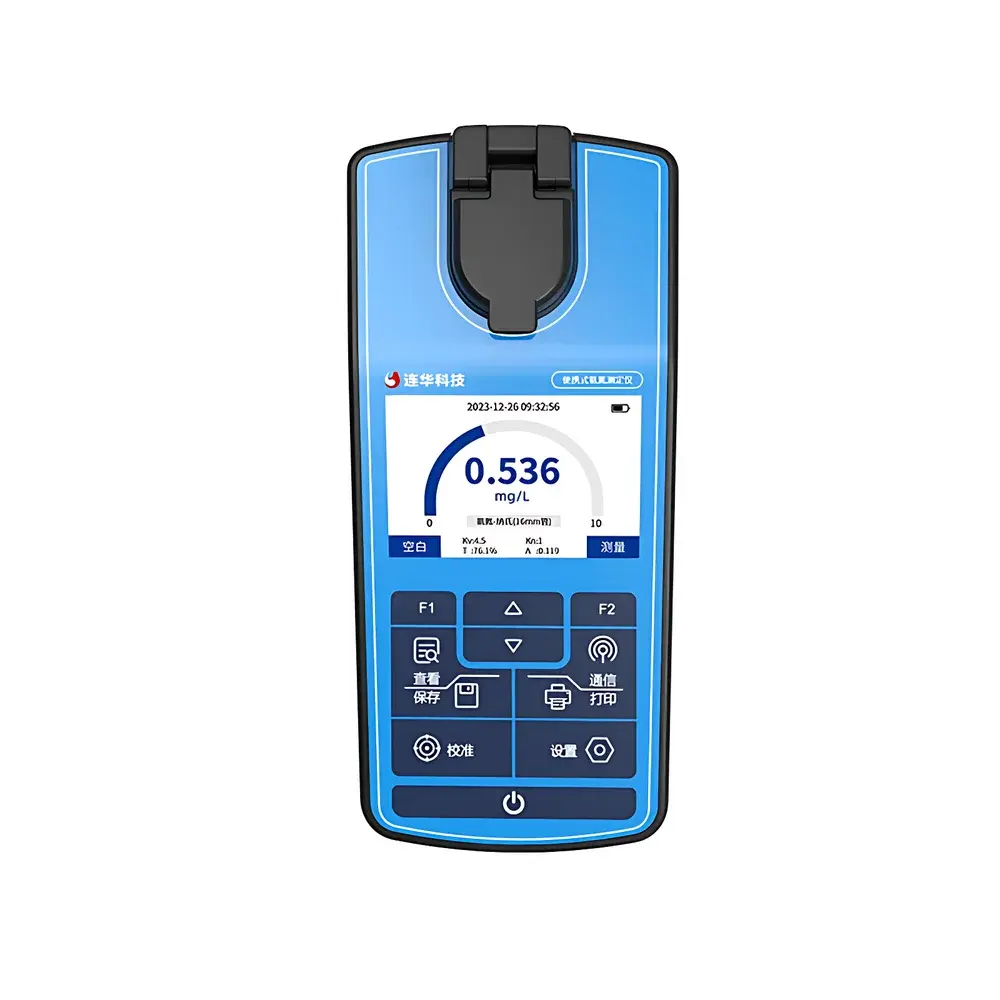
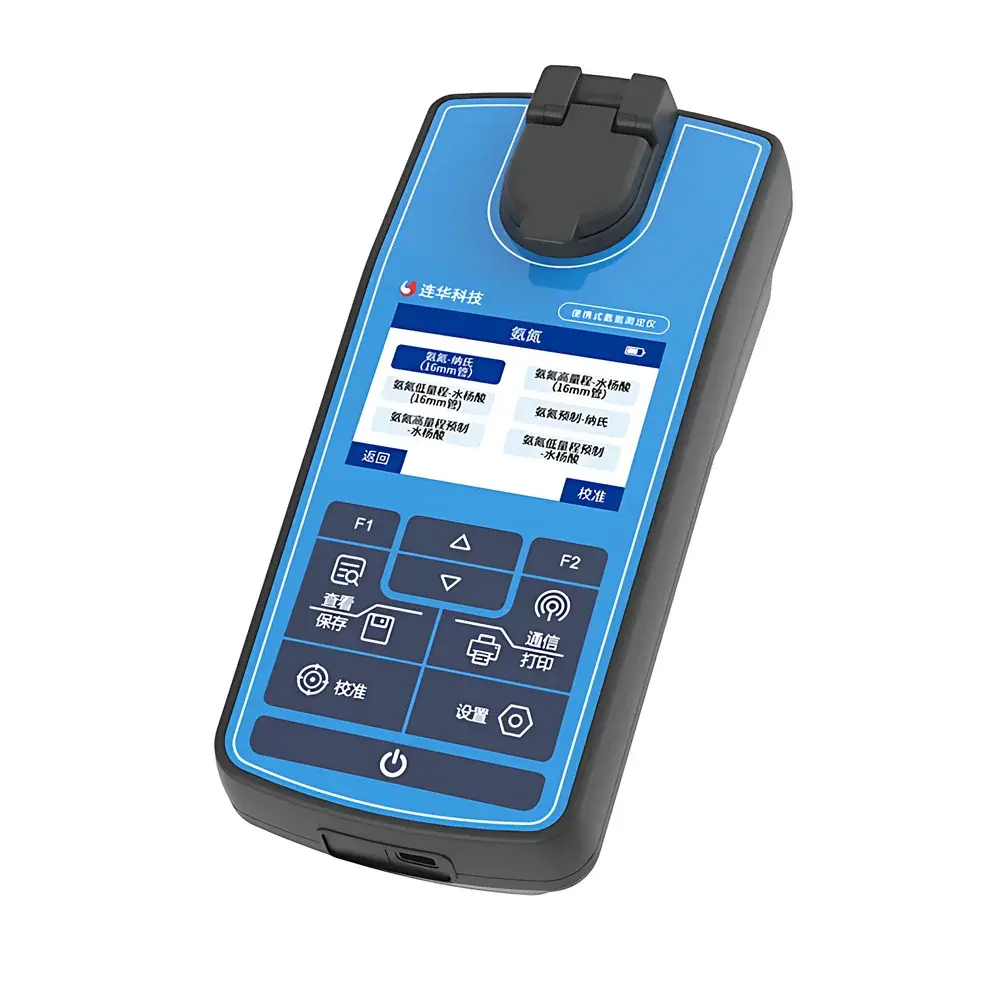
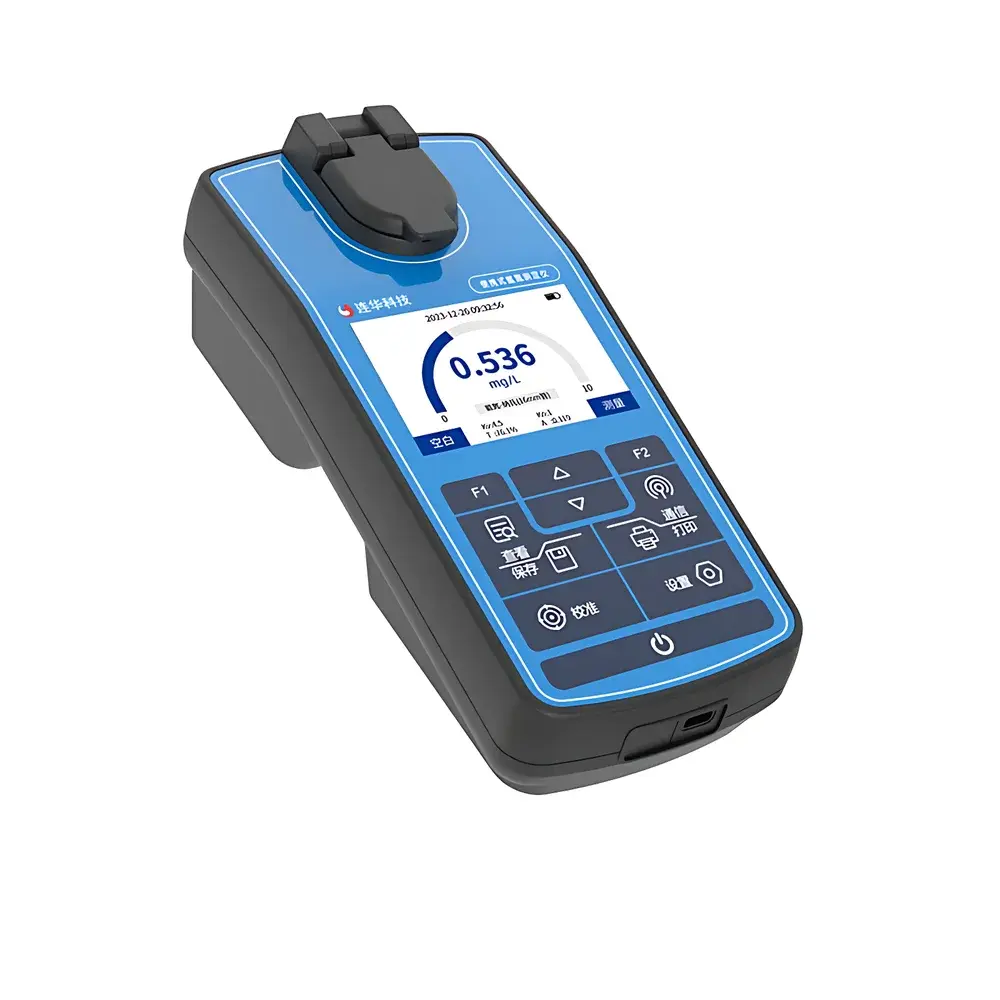
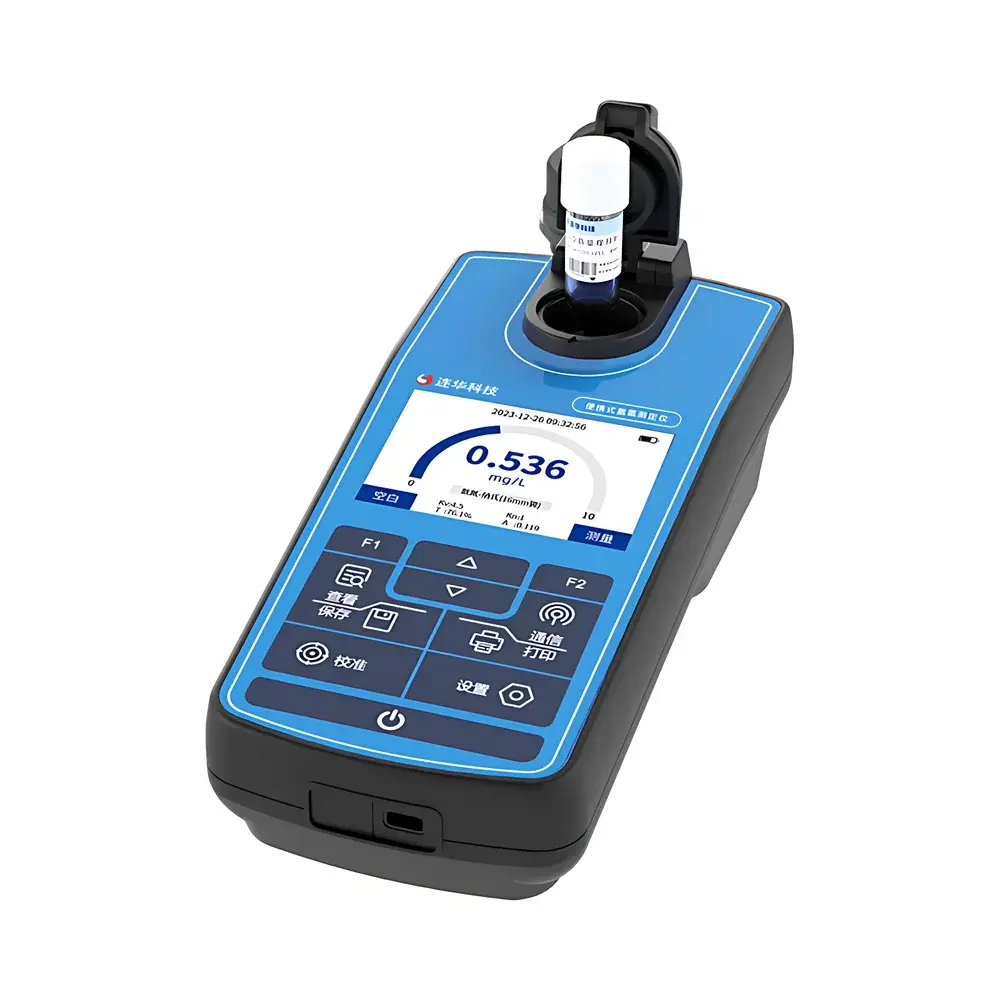
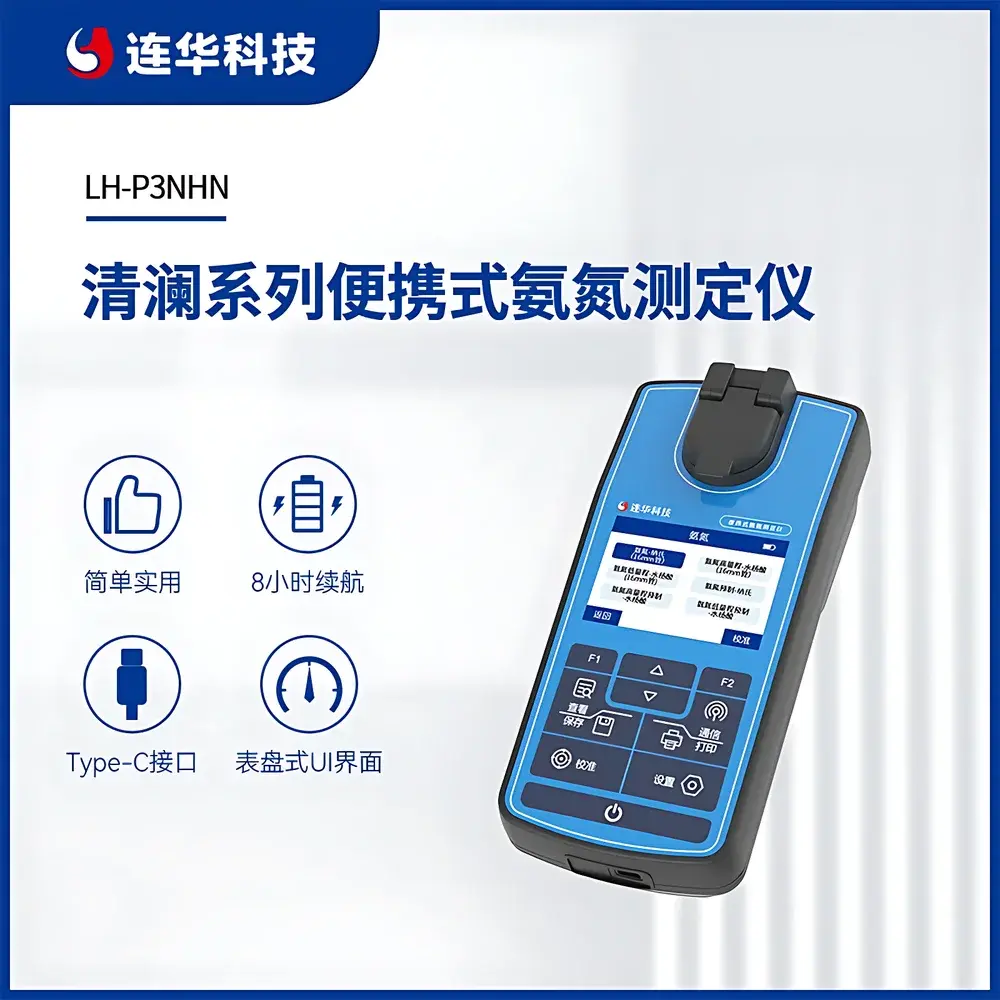
Lianhua Technology Qinglan Series Portable Ammonia Nitrogen Analyzer LH-P3NHN
| Brand | Lianhua Technology |
|---|---|
| Origin | Beijing, China |
| Manufacturer Type | Direct Manufacturer |
| Product Origin | Domestic (China) |
| Model | LH-P3NHN |
| Instrument Type | Portable |
| Measurement Principle | Colorimetric Method (Nesslerization) |
| Measurement Range | 0–200 mg/L NH₃–N (multi-range segmented) |
| Accuracy | ≤ ±10% of reading |
| Compliance Standards | HJ 536–2009, HJ 1535–2009 |
| Display | 3.5-inch color TFT LCD with dial-style UI |
| Calibration | Optical intensity calibration & curve-based calibration |
| Built-in Calibration Curves | 30 preloaded, user-editable and user-calibratable |
| Reagent Compatibility | Pre-formulated reagent kits (LH-series) included |
| Over-range Indication | Visual red alert on dial interface when exceeding upper limit |
Overview
The Lianhua Technology Qinglan Series Portable Ammonia Nitrogen Analyzer LH-P3NHN is a field-deployable, laboratory-grade instrument engineered for rapid, reliable quantification of ammonia nitrogen (NH₃–N) in natural waters, wastewater effluents, and treated drinking water sources. It operates on the standardized colorimetric Nesslerization principle—where ammonia reacts with Nessler’s reagent under controlled alkaline conditions to form a yellow-brown colloidal complex, the absorbance of which is measured spectrophotometrically at 420 nm. This method is fully aligned with Chinese national environmental monitoring standards HJ 536–2009 (Determination of Ammonia Nitrogen in Water Quality—Nessler’s Reagent Spectrophotometric Method) and HJ 1535–2009 (Technical Specifications for Environmental Monitoring Instruments—Ammonia Nitrogen Analyzers), ensuring regulatory traceability for municipal utilities, environmental inspection agencies, and third-party testing laboratories operating within China’s ecological supervision framework.
Key Features
- Portable architecture with integrated power management: battery-operated (rechargeable Li-ion) and AC adapter compatible, enabling continuous operation for >8 hours per charge—ideal for remote sampling sites, emergency response, and mobile lab deployments.
- 3.5-inch high-contrast color TFT display featuring an intuitive dial-style graphical user interface (GUI); concentration values are presented directly in mg/L NH₃–N without manual calculation or unit conversion.
- Pre-formulated, factory-sealed reagent kits (LH-series) eliminate weighing, dilution, and storage variability—ensuring inter-laboratory reproducibility and minimizing analyst error during field use.
- 30 built-in calibration curves—including default curves for common matrices (e.g., surface water, domestic wastewater, industrial discharge)—support both standard addition and multi-point calibration protocols per ISO/IEC 17025 requirements.
- Optical intensity calibration function compensates for LED source drift over time and temperature fluctuations, maintaining photometric stability across extended operational cycles and ambient temperature ranges (5–40 °C).
- Segmented measurement range (0–2, 2–20, 20–200 mg/L NH₃–N) automatically selects optimal optical path and gain settings to preserve signal-to-noise ratio and minimize dilution errors.
Sample Compatibility & Compliance
The LH-P3NHN accepts liquid samples with minimal pretreatment: clarified or filtered (≤0.45 µm) aqueous matrices without significant turbidity (>5 NTU) or interfering ions (e.g., >50 mg/L Ca²⁺/Mg²⁺, >10 mg/L Fe³⁺). It complies with HJ 536–2009 for interference mitigation via masking agents (e.g., tartaric acid, sodium thiosulfate) and optional sample distillation for highly complex matrices. While not certified to ISO 15839 or EPA Method 350.1, its methodology is technically equivalent to these international references and has been validated against NIST-traceable ammonia nitrogen reference materials (SRM 2000 series). The device supports GLP-compliant data logging with timestamp, operator ID, and measurement condition metadata—enabling audit-ready documentation for internal QA/QC programs.
Software & Data Management
Data are stored internally (≥500 test records) with automatic timestamping, batch ID tagging, and pass/fail flagging based on user-defined limits. USB-C interface enables export of CSV-formatted reports to external PCs for integration into LIMS or Excel-based trending analysis. No proprietary software installation is required; exported files conform to ASTM D5116-17 guidelines for environmental data interchange. Firmware updates are delivered via encrypted firmware packages verified with SHA-256 checksums—ensuring integrity and cybersecurity compliance per IEC 62443-4-2 principles.
Applications
- Routine monitoring of influent and effluent streams in municipal wastewater treatment plants (WWTPs)
- Field verification of ammonia removal efficiency in biological nutrient removal (BNR) processes
- Emergency spill response and agricultural runoff assessment in watershed protection zones
- QA/QC validation of online ammonia analyzers (e.g., ion-selective electrode or UV absorption systems)
- Teaching laboratories and vocational training centers requiring pedagogically robust, standards-aligned instrumentation
FAQ
What is the recommended maintenance schedule for optical calibration?
Optical intensity calibration should be performed before each daily use or after every 20 measurements—whichever occurs first—to maintain photometric accuracy within ±10% tolerance.
Can the LH-P3NHN be used for seawater or brackish water analysis?
No—high chloride concentrations (>500 mg/L Cl⁻) interfere with the Nessler reaction; alternative methods such as salinity-corrected ion-selective electrode or distillation-preceded colorimetry are advised.
Is the instrument compliant with FDA 21 CFR Part 11 for electronic records?
It supports ALCOA+ data integrity principles (Attributable, Legible, Contemporaneous, Original, Accurate) but lacks electronic signature capability and audit trail encryption required for full 21 CFR Part 11 compliance.
How are calibration curves validated and documented?
Each curve is traceable to in-house reference standards calibrated against GBW(E) 080292 (Chinese national ammonia nitrogen standard material); validation reports include R² ≥ 0.999, LOD ≤ 0.05 mg/L, and recovery rates of 92–105% across three independent runs.
What reagent shelf life can be expected under field storage conditions?
Unopened LH-series reagent vials retain stability for 18 months at 2–8 °C; once opened, they remain usable for 30 days if stored desiccated and protected from light at ≤25 °C.
Related Products







