
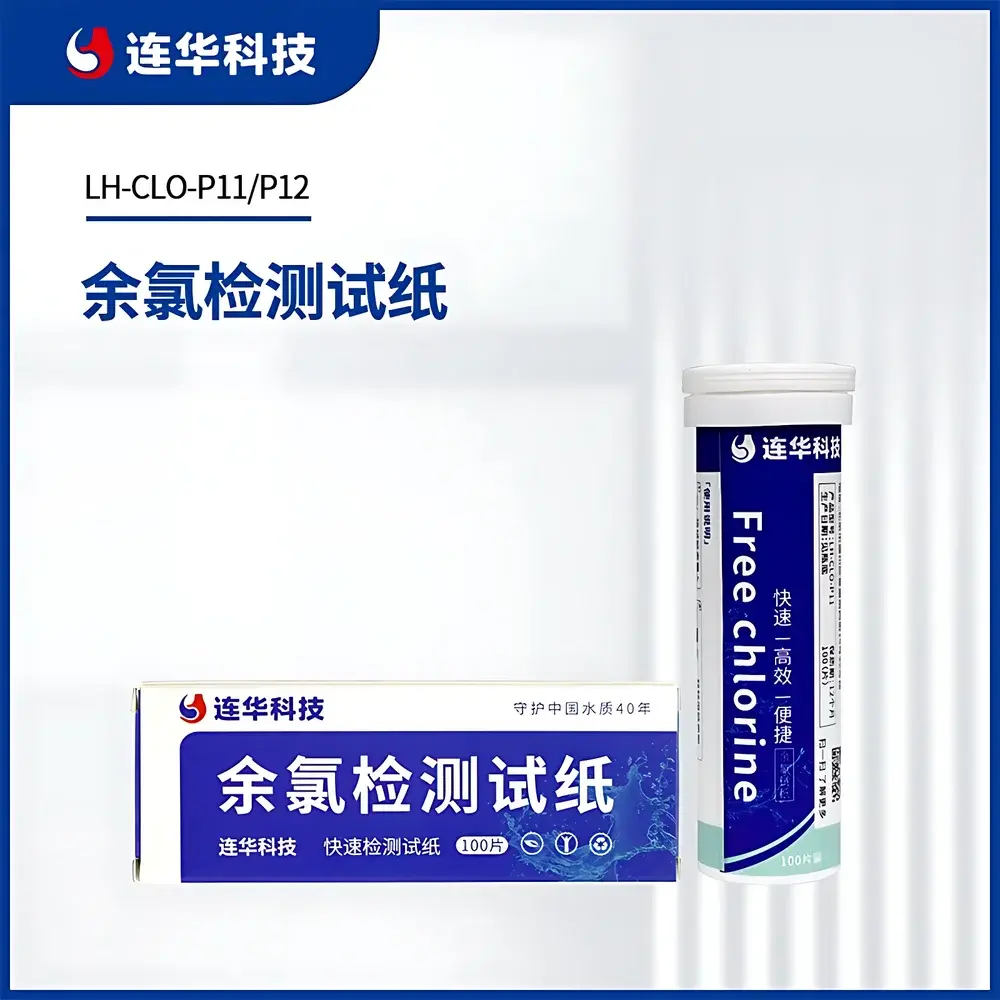
Lianhua Technology Residual Chlorine Test Strips (Dual-Range: LH-CLO-P11 & LH-CLO-P12)
| Brand | Lianhua Technology |
|---|---|
| Origin | Beijing, China |
| Manufacturer Type | Direct Manufacturer |
| Country of Origin | China |
| Model | LH-CLO-P11 / LH-CLO-P12 |
| Pricing | Available Upon Request |
Overview
The Lianhua Technology Residual Chlorine Test Strips (Dual-Range: LH-CLO-P11 & LH-CLO-P12) are calibrated, single-use colorimetric reagent strips engineered for rapid, on-site determination of free residual chlorine concentration in water samples. Designed according to the N,N-diethyl-p-phenylenediamine (DPD) colorimetric method—aligned with ISO 7393-2:2018 and EPA Method 334.0—the strips leverage a stable, immobilized DPD derivative that reacts selectively with free chlorine (HOCl/OCl⁻) to produce a magenta-colored quinoneimine dye. LH-CLO-P11 covers the low-range quantification (0.01–2.00 mg/L Cl₂), optimized for drinking water, swimming pools, and ultrapure process water; LH-CLO-P12 extends detection to the high-range (0.5–10.0 mg/L Cl₂), suitable for disinfection validation in wastewater effluents, cooling towers, and chlorination contact tanks. Both variants employ uniform cellulose acetate substrate impregnation and controlled reagent loading to ensure batch-to-batch reproducibility and minimal interferences from monochloramine or transition metals under standard field conditions.
Key Features
- Dual-range configuration: Two complementary strip formats enable precise quantification across five orders of magnitude without dilution or instrument recalibration.
- Optimized DPD chemistry: Proprietary reagent formulation minimizes oxidation by dissolved oxygen and suppresses false positives from manganese (>0.1 mg/L) and oxidized iron.
- Stable color development: Color intensity reaches maximum within 60 seconds and remains stable for ≥5 minutes—sufficient time for visual comparison under natural or LED white light (CRI >85).
- Calibrated reference chart: Integrated high-resolution, UV-stabilized color comparator card (ISO 12233-compliant grayscale background) provides 12 discrete concentration gradations per range, traceable to NIST-traceable chlorine standards.
- Robust packaging architecture: Individually foil-laminated pouches with desiccant sachets maintain reagent integrity for ≥24 months at 4–30°C; humidity indicator dot confirms seal integrity upon opening.
- No external power or instrumentation required: Fully compliant with ASTM D1293-22 Annex A1 for field-deployable chlorine verification where portable photometers are unavailable or impractical.
Sample Compatibility & Compliance
These test strips are validated for use with potable water, surface water, wastewater effluent, swimming pool water, and recirculated cooling water. Interference testing per ISO 8466-1 confirms acceptable accuracy (±15% bias) in samples containing ≤1.0 mg/L nitrite, ≤0.5 mg/L copper, ≤0.2 mg/L iron, and ≤0.1 mg/L manganese. Performance meets the minimum performance criteria outlined in US EPA’s “Microbiological Methods for Monitoring the Environment” (EPA/600/R-92/135) for rapid screening applications. Each production lot undergoes QC verification against certified reference materials (CRM) traceable to BAM-101 (NIST) and is supplied with Certificate of Analysis (CoA) indicating lot-specific shelf-life, calibration uncertainty (k=2), and stability data.
Software & Data Management
While inherently analog, the LH-CLO-P11/P12 system supports digital integration via Lianhua’s optional LHT-Scan mobile application (iOS/Android). The app uses AI-powered image analysis to capture strip color response under standardized lighting, compare against embedded digital reference spectra, and log results with geotagging, timestamp, operator ID, and photo audit trail. Exported CSV files include metadata compliant with ISO/IEC 17025:2017 documentation requirements and support import into LIMS platforms (e.g., LabWare, STARLIMS) via HL7 or ASTM E1384 interfaces. All data handling conforms to GDPR Article 32 security principles and enables full traceability for GLP/GMP-regulated environments.
Applications
- Field verification of residual chlorine in municipal drinking water distribution systems during routine patrols or emergency response (e.g., post-natural disaster infrastructure assessment).
- Real-time monitoring of chlorine decay kinetics in hospital hot-water loops and pharmaceutical purified water (PW) systems per USP and EU GMP Annex 1.
- Pre-shift validation of disinfectant concentration in food processing plant CIP rinse lines (FSMA §117.130).
- Compliance checks for WHO Guidelines for Drinking-water Quality (4th ed.) and China’s GB 5749-2022 standards.
- Educational laboratory exercises demonstrating redox titration principles and water quality parameter correlation studies.
FAQ
What is the shelf life of unopened LH-CLO-P11/P12 strips?
Unopened foil pouches retain full performance for 24 months when stored at 4–30°C and relative humidity ≤60%. The humidity indicator dot must remain blue; if pink, discard the pouch.
Can these strips measure combined chlorine (chloramines)?
No. LH-CLO-P11/P12 are specific to free residual chlorine only. Combined chlorine requires separate DPD#3 reagent addition per Standard Methods 4500-Cl G.
Are the color charts NIST-traceable?
Yes. Each comparator card is calibrated using spectrophotometrically verified reference standards traceable to NIST SRM 2810 (chlorine gas) and certified by CNAS-accredited metrology lab (Certificate No. CNAS LXXXXX).
Do results comply with regulatory reporting requirements?
Results are valid for screening and operational control per EPA Guidance Document QA/G-5 (2021); however, confirmatory analysis by DPD titration (Standard Methods 4500-Cl B) or online amperometric sensor is required for formal regulatory submission.
Is training required for personnel using these strips?
Minimal training is needed: operators must complete a 15-minute competency assessment covering proper dip time (1 second), vertical blotting technique, and ambient lighting evaluation—documented per ISO/IEC 17025 Clause 6.2.3.







