
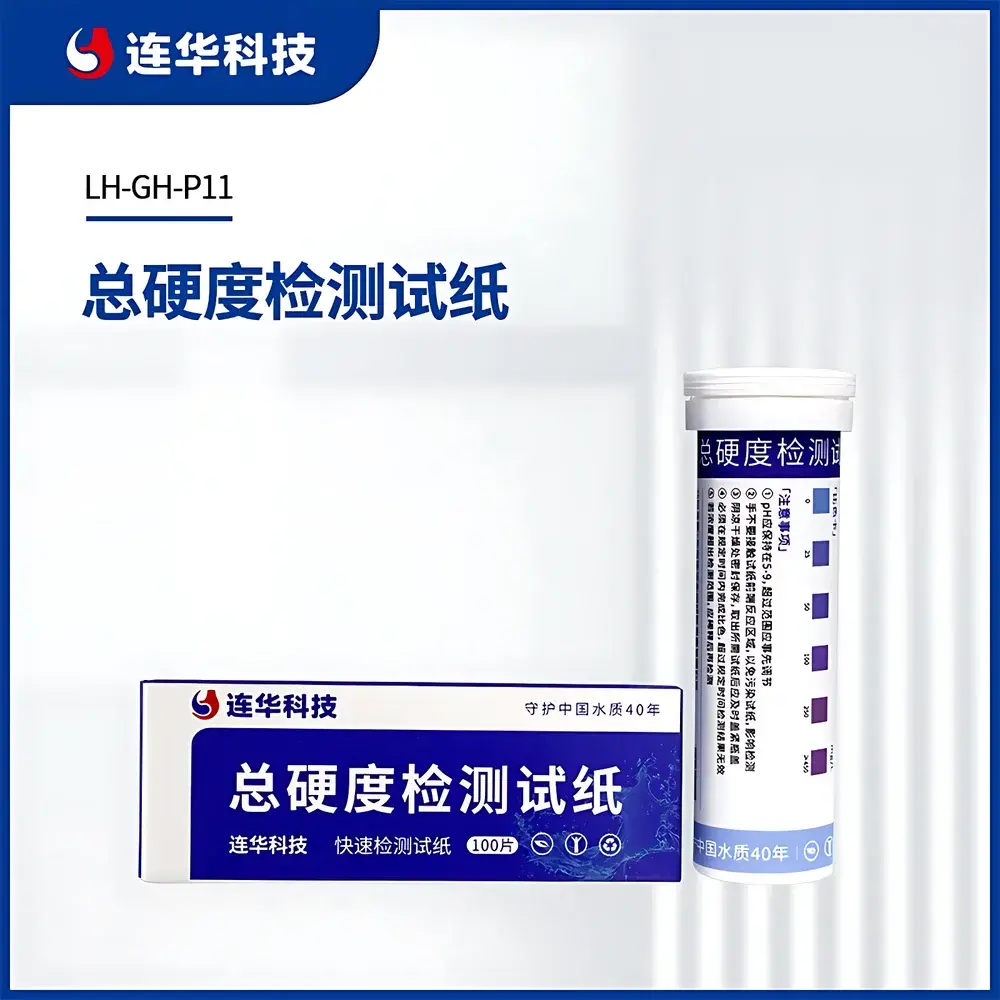
Lianhua Technology Total Hardness Test Strips LH-GH-P11
| Brand | Lianhua Technology |
|---|---|
| Origin | Beijing, China |
| Manufacturer Type | Manufacturer |
| Product Origin | Domestic (China) |
| Model | LH-GH-P11 |
| Pricing | Available Upon Request |
Overview
The Lianhua Technology Total Hardness Test Strips LH-GH-P11 are calibrated, single-use colorimetric reagent strips designed for rapid, on-site quantification of total hardness (as CaCO₃) in water samples. Engineered for field-deployable environmental monitoring, these strips operate on the principle of metal-ion chelation with a proprietary chromogenic agent—specifically optimized for calcium (Ca²⁺) and magnesium (Mg²⁺) ions under buffered pH conditions. The resulting color development is stoichiometrically proportional to total hardness concentration within the defined working range. Unlike instrumental methods requiring power, calibration standards, or sample pretreatment, the LH-GH-P11 delivers semi-quantitative results in under 60 seconds via visual comparison against a high-fidelity, ISO 13694-compliant color chart included with each package. This makes it especially suitable for emergency response teams, municipal water operators conducting routine distribution system checks, and field technicians performing preliminary screening prior to laboratory confirmation.
Key Features
- Rapid Visual Quantification: Delivers results within 30–60 seconds after dip-and-read immersion; no instrumentation, timers, or reagent mixing required.
- Optimized Color Stability: Chromogenic formulation ensures uniform dye development across the strip’s reactive zone, minimizing edge effects and improving inter-observer consistency under varied ambient lighting conditions.
- Controlled Reaction Kinetics: Buffered impregnation matrix maintains optimal pH (7.2–7.6) during reaction, suppressing interference from heavy metals (e.g., Fe³⁺, Cu²⁺) and ensuring specificity for alkaline earth cations.
- Robust Packaging Design: Individually foil-laminated pouches with desiccant provide moisture resistance and extend shelf life to 24 months when stored at 2–30 °C; each pouch includes lot-specific expiration date and batch traceability.
- User-Independent Operation: Requires no formal analytical training; validated per ISO/IEC 17025 competency guidelines for non-laboratory personnel performing Tier-1 field screening.
Sample Compatibility & Compliance
The LH-GH-P11 is validated for use with potable water, surface water, groundwater, and treated wastewater effluents exhibiting turbidity ≤ 5 NTU and residual chlorine ≤ 2 mg/L as Cl₂. Samples with high iron (>0.3 mg/L), manganese (>0.1 mg/L), or suspended solids require pre-filtration (0.45 µm membrane) prior to testing. The test method aligns with the qualitative and semi-quantitative intent of ASTM D1126–22 (Standard Test Method for Hardness in Water) and supports initial compliance assessment under national drinking water regulations (e.g., China’s GB 5749–2022, US EPA 815-B-20-001). While not intended for regulatory reporting in lieu of titrimetric or ICP-OES methods, data generated with LH-GH-P11 satisfies GLP-aligned field documentation requirements when recorded with observer ID, time/date stamp, and reference chart batch number.
Software & Data Management
As a non-instrumented, analog colorimetric tool, the LH-GH-P11 does not interface with digital software platforms or generate electronic data files. However, its design supports structured manual data capture: each package includes a laminated log sheet compliant with ISO/IEC 17025 Annex A.2 for recording sample ID, location coordinates (GPS optional), observer name, ambient temperature, observed color match, and estimated hardness value (mg/L as CaCO₃). For organizations deploying enterprise-level environmental monitoring workflows, scanned log entries can be ingested into LIMS systems (e.g., LabWare, Thermo Fisher SampleManager) via OCR-enabled templates. Audit trails remain fully traceable through printed lot numbers and expiration dates affixed to each foil pouch—meeting minimum documentation criteria under FDA 21 CFR Part 11 for paper-based field records.
Applications
- Emergency response triage following natural disasters (e.g., post-flood well water screening)
- Routine verification of softener performance in commercial HVAC and boiler feedwater systems
- Pre-deployment calibration checks for portable hardness meters (e.g., Hach DR390, Palintest 7500)
- Educational demonstrations of water quality parameters in university environmental science labs
- Field validation of point-of-use filter efficacy in rural water supply programs
FAQ
What is the measurement range of the LH-GH-P11 test strips?
The LH-GH-P11 is calibrated for total hardness quantification between 0 and 500 mg/L as CaCO₃, with color resolution intervals of 25 mg/L in the low range (0–100 mg/L) and 50 mg/L above 100 mg/L.
Can the strips be used in seawater or brackish water samples?
No—high ionic strength and chloride interference suppress chelation kinetics; the strips are validated only for freshwater matrices with TDS < 1,000 mg/L.
How should expired strips be disposed of?
Dispose of used or expired strips as non-hazardous solid waste per local municipal regulations; the reagent matrix contains no regulated heavy metals or organic solvents.
Is there a digital reader compatible with LH-GH-P11?
Lianhua Technology does not manufacture or endorse any dedicated strip readers for this product; visual interpretation using the supplied chart remains the validated method per product specifications.
Does humidity affect strip performance during field use?
Yes—exposure to >80% RH for >5 minutes prior to use may cause premature color development; always open foil pouches immediately before testing and discard unused strips after 10 minutes of ambient exposure.







