
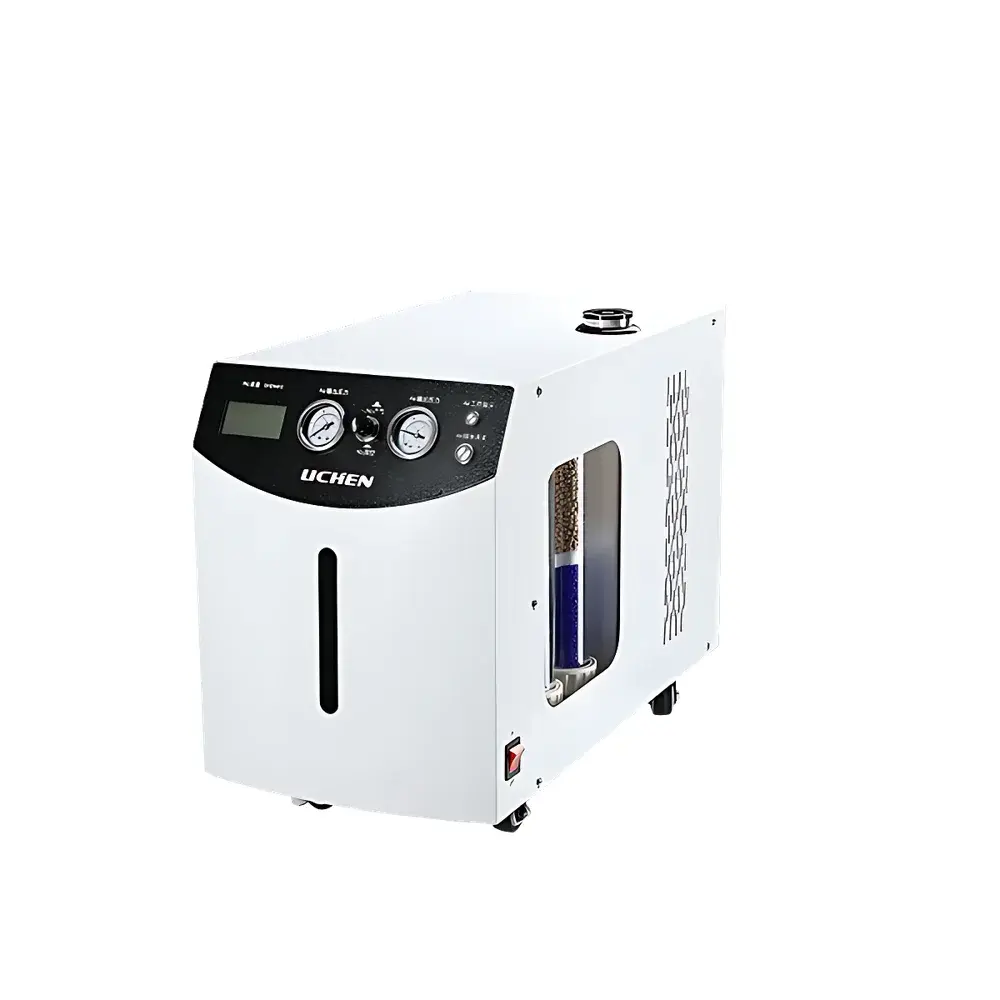
LICHEN LC-NA Series Integrated Nitrogen & Air Generator
| Brand | LICHEN |
|---|---|
| Origin | Shanghai, China |
| Manufacturer Type | Direct Manufacturer |
| Region Classification | Domestic (China) |
| Model | LC-NA Series |
| Price Range | USD 1,560 – 1,880 (FOB Shanghai) |
| Input Power | AC 220 V / 50 Hz |
| Power Consumption | 230 W (LC-NA-300) / 250 W (LC-NA-500) |
| Nitrogen Purity | ≥99.94% |
| Nitrogen Flow Rate | 0–300 mL/min (LC-NA-300) / 0–500 mL/min (LC-NA-500) |
| Air Flow Rate | 0–3 L/min (LC-NA-300) / 0–5 L/min (LC-NA-500) |
| Output Pressure | 0.4 MPa (adjustable, ±0.02 MPa stability) |
| Display | Backlit LCD screen + analog pressure gauges |
| Air Purification Stages | Three-stage filtration (particulate → activated carbon → desiccant) + dual-stage pressure regulation |
| Nitrogen Purification Architecture | Multi-layer plate-type membrane stack with iterative purification cycles |
| Anti-Backflow Protection | Integrated non-return liquid trap in nitrogen generation module |
| Desiccant Columns | Color-indicating silica gel + 5A molecular sieve |
| GC Compatibility | Supports simultaneous connection of up to two gas chromatographs (dual-output configuration) |
| Net Weight | 34 kg |
| Dimensions (L×W×H) | 290 × 580 × 420 mm |
| Maintenance Requirement | Distilled water top-up only (no consumable cartridges or replacement membranes required under normal operation) |
Overview
The LICHEN LC-NA Series Integrated Nitrogen & Air Generator is an engineered solution for laboratories requiring stable, on-demand supplies of high-purity nitrogen and instrument-grade air—without reliance on high-pressure cylinders. Designed specifically for compatibility with gas chromatography (GC) systems, the LC-NA employs a dual-path architecture: a dedicated nitrogen generation path based on selective membrane separation and multi-stage iterative purification, and a parallel air generation path incorporating three-stage physical filtration and dual-stage pressure stabilization. Unlike conventional cylinder-based supply chains, this generator eliminates logistical constraints, safety hazards associated with compressed gas storage, and variability in gas quality across deliveries. Its core function is to deliver nitrogen at ≥99.94% purity (O₂ ≤ 60 ppm, moisture dew point ≤ −40°C) and oil-free, particle-free air meeting ISO 8573-1 Class 2:2:2 specifications—both continuously adjustable within defined flow ranges. The system operates on standard single-phase AC power and requires only periodic replenishment of distilled water for electrolyte maintenance, making it suitable for ISO/IEC 17025-accredited QC labs, pharmaceutical R&D environments, and academic chromatography facilities where long-term operational consistency is critical.
Key Features
- Independent dual-output design: Nitrogen and air streams operate autonomously—each can be activated, deactivated, or flow-adjusted without affecting the other.
- Multi-layer plate-type nitrogen purification module: Utilizes sequential membrane diffusion stages to progressively reduce oxygen, moisture, and trace hydrocarbons—achieving consistent ≥99.94% N₂ purity across full flow range.
- Three-stage air purification train: Comprises sintered stainless-steel particulate filter, activated carbon adsorption bed, and dual-bed desiccant column (color-indicating silica gel + 5A molecular sieve), ensuring removal of oil vapor, CO₂, and humidity to <1 ppmv.
- Integrated anti-backflow protection: A mechanical liquid-trap mechanism prevents condensate migration into the nitrogen membrane stack—eliminating risk of performance degradation or membrane fouling.
- Real-time operational monitoring: Backlit LCD interface displays nitrogen flow rate, output pressure, system status, and desiccant saturation indicators; analog pressure gauges provide redundant verification.
- Energy-efficient architecture: Optimized electrolyzer and compressor duty cycles yield 32–38% lower power draw per liter of gas delivered compared to legacy PSA-based nitrogen generators of equivalent capacity.
- No consumable cartridges: Maintenance limited to distilled water refills and periodic desiccant replacement (typically every 6–12 months depending on ambient humidity).
Sample Compatibility & Compliance
The LC-NA Series meets essential technical prerequisites for integration into regulated analytical workflows. Its nitrogen output complies with ASTM D6349–22 (Standard Practice for Determining Trace Gaseous Impurities in High-Purity Nitrogen) for O₂ and moisture content, and satisfies USP <691> requirements for carrier gas purity in GC applications. Air output conforms to ISO 8573-1:2010 Class 2:2:2 for particles, water, and oil aerosols—validated via independent third-party testing reports available upon request. The unit’s electrical design adheres to IEC 61010-1:2010 for laboratory equipment safety, and its pressure containment system is certified to PED 2014/68/EU Annex I. While not inherently 21 CFR Part 11 compliant, the generator supports audit-ready operation when paired with validated LIMS or chromatography data systems that enforce electronic signature, change control, and audit trail protocols.
Software & Data Management
The LC-NA operates as a standalone hardware platform with no embedded firmware-based data logging or remote connectivity. All operational parameters are displayed locally via the LCD interface and analog gauges. For laboratories requiring traceability, optional analog 0–10 V or 4–20 mA output signals (available on LC-NA-500 variant) enable integration with building management systems (BMS) or PLC-controlled lab infrastructure. Raw pressure and flow data may be recorded externally using calibrated digital transducers interfaced via standard industrial I/O modules. No proprietary software is required or supplied; system diagnostics rely solely on visual status indicators and scheduled preventive maintenance logs maintained per ISO/IEC 17025 Clause 6.4.2.
Applications
- Gas chromatography carrier and detector gases (FID, TCD, ECD) for environmental, petrochemical, and food safety analysis.
- Mobile phase blank gas for headspace GC and purge-and-trap systems.
- Instrument air supply for pneumatic actuators, auto-samplers, and GC oven cooling circuits.
- Zero-air generation when combined with catalytic scrubbers (external) for calibration gas preparation.
- Support gas for FTIR purge lines and mass spectrometer ion source housings.
- Non-critical inerting in sample preparation hoods and glove boxes where ultra-high purity is not mandated.
FAQ
What is the expected service life of the nitrogen membrane stack under continuous operation?
With proper water quality (≥15 MΩ·cm resistivity distilled water) and ambient temperature control (15–30°C), the membrane stack maintains ≥99.94% purity for ≥12,000 hours (approx. 5 years at 24/7 use).
Can the LC-NA supply both nitrogen and air to separate GC instruments simultaneously?
Yes—the unit features two independent outlet ports (one for N₂, one for air), each with dedicated pressure regulators and flowmeters, enabling concurrent connection to two GC systems.
Is external drying or additional filtration required before connecting to a GC?
No—the integrated desiccant columns and final-stage filtration meet GC manufacturer inlet specifications; however, users operating in high-humidity environments (>70% RH) should verify dew point at the outlet using a calibrated hygrometer quarterly.
How frequently must the desiccant be replaced?
Under typical lab conditions (25°C, 50% RH), color-indicating silica gel transitions from blue to pink after 6–9 months; 5A molecular sieve requires replacement every 12 months or after 2,000 hours of continuous air generation.
Does the LC-NA support integration with LabVantage or Thermo Fisher Chromeleon?
It does not feature native API or Ethernet connectivity; however, analog output signals (optional) allow basic status monitoring within these platforms when configured via external DAQ hardware and custom scripting.



