
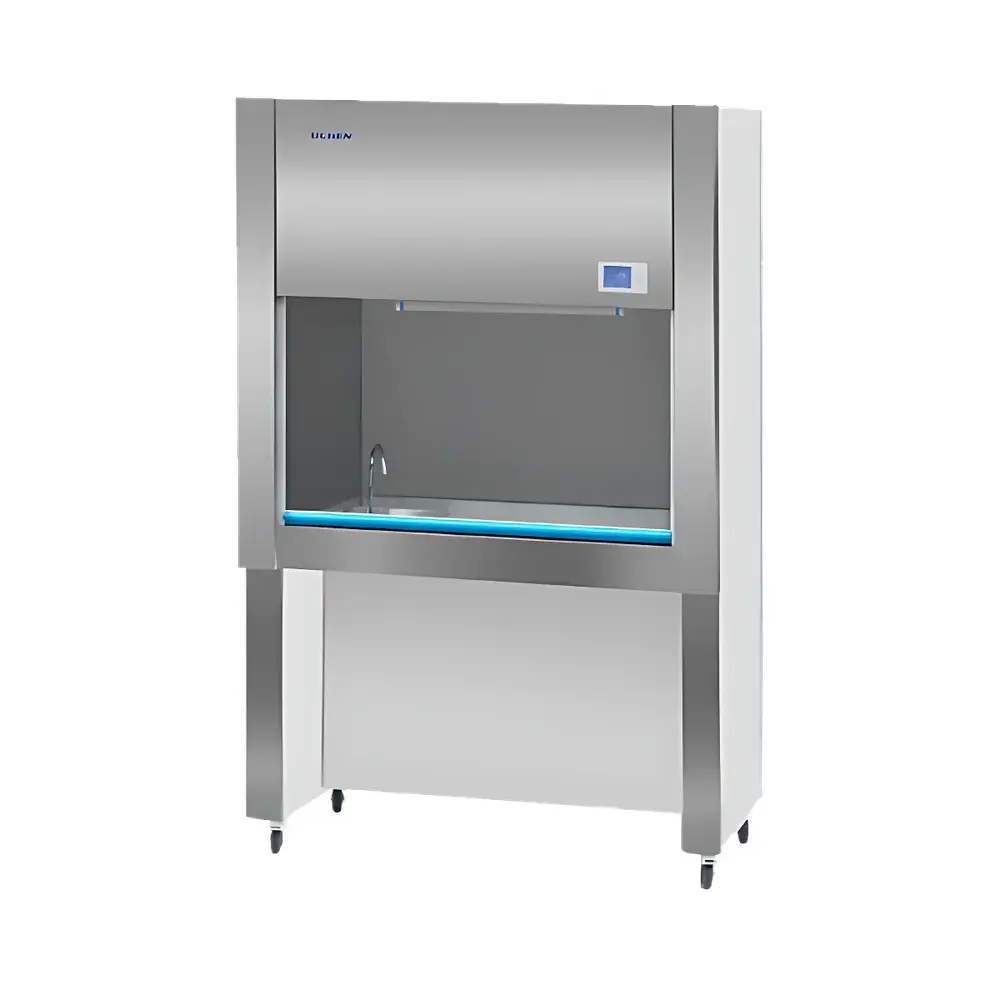
LICHEN TFG Series Fume Hood
| Brand | LICHEN |
|---|---|
| Origin | Shanghai, China |
| Manufacturer Type | Direct Manufacturer |
| Regional Classification | Domestic (China) |
| Model | TFG Series |
| Price Range | USD 920 – 1,500 (FOB Shanghai) |
| Construction Material | Fully Steel Enclosure |
| Configuration | Single-Face Workstation |
| Airflow Control | Variable Air Volume (VAV) System |
| Primary Application Sector | Pharmaceutical R&D and Manufacturing |
| Exhaust Position | Top-Mounted Exhaust |
| Ducting Interface | Standard Round Duct Connection (Ø250 mm) |
| Work Area Dimensions (W×D×H) | 1630 × 700 × 600 mm |
| Overall Dimensions (W×D×H) | 1800 × 750 × 1950 mm |
| Average Face Velocity (at sash opening) | 0.26 ± 0.025 m/s |
| Exhaust Flow Rate | 1080 – 2160 m³/h (calculated from 0.3–0.6 m/s across 1.0 m² nominal face area) |
| Illumination | ≥300 lux (LED, 5000K CCT) |
| Work Surface Height | 760 mm |
| Rated Power Consumption | 800 W |
| Electrical Supply | AC 220 V, 50 Hz |
| Sound Pressure Level | ≤65 dB(A) at 1 m distance |
| Net Weight | 250 kg |
Overview
The LICHEN TFG Series Fume Hood is an engineered safety solution designed for containment of hazardous vapors, particulates, and aerosols generated during laboratory-scale chemical synthesis, formulation, and quality control procedures—particularly within pharmaceutical development and GMP-compliant manufacturing environments. It operates on the principle of directional airflow management: a dedicated exhaust fan creates negative pressure inside the cabinet, inducing room air to flow inward through the sash opening at a controlled, uniform face velocity. This laminar inflow forms a dynamic barrier that prevents escape of contaminants into the operator’s breathing zone. The TFG Series implements a variable air volume (VAV) control strategy, automatically adjusting fan speed in response to sash position changes to maintain consistent face velocity across operational ranges—ensuring compliance with ANSI/ASHRAE 110-2016 and EN 14175-3:2021 performance standards for fume hood containment efficacy.
Key Features
- Fully welded steel enclosure with epoxy-powder-coated finish, providing structural rigidity, corrosion resistance, and cleanroom-compatible non-shedding surfaces.
- Top-mounted exhaust plenum with standardized Ø250 mm duct collar, enabling seamless integration into existing building HVAC infrastructure or dedicated exhaust stacks.
- 4 mm tempered safety glass sash with infinite-position counterbalanced lift mechanism—allowing precise vertical adjustment while maintaining ergonomic access and optimal visibility.
- Dual spring-assisted vertical sliding doors (front and rear), facilitating flexible workflow configurations and secondary containment when required.
- Stainless steel (304 grade) work surface, electropolished and passivated for enhanced chemical resistance, ease of decontamination, and compatibility with USP <800> hazardous drug handling protocols.
- Integrated LED lighting system (≥300 lux at work surface), featuring flicker-free operation, 5000K color temperature, and IP65-rated fixtures for moisture and dust resistance.
- Four heavy-duty locking casters (two with brakes), supporting safe repositioning within lab zones without requiring disassembly or external lifting equipment.
Sample Compatibility & Compliance
The TFG Series accommodates standard benchtop apparatus—including magnetic stirrers, hot plates, vacuum pumps, and small-scale reactors—within its defined work area (1630 × 700 × 600 mm). Its design supports routine use with volatile organic solvents, acids, bases, and low-to-moderate toxicity compounds typical in API synthesis, excipient testing, and stability studies. All units undergo factory verification per ASHRAE 110 tracer gas containment test methodology, with documented face velocity uniformity (±8% across the sash plane) and static pressure differential maintenance (<−5 Pa relative to ambient). Documentation packages include CE-conformity declarations, ISO 9001-certified manufacturing records, and optional IQ/OQ documentation templates aligned with FDA 21 CFR Part 11 and EU Annex 11 requirements for computerized system validation.
Software & Data Management
While the base TFG Series operates as a standalone mechanical system, optional VAV controllers integrate Modbus RTU or BACnet MS/TP communication protocols for centralized building management system (BMS) interfacing. Real-time monitoring includes face velocity feedback, sash position telemetry, fan RPM status, and power consumption logging—enabling automated alarm generation upon deviation from preset thresholds (e.g., face velocity <0.23 m/s or >0.29 m/s). Audit trails are stored locally for ≥30 days and exportable in CSV format for GLP/GMP traceability. Optional touchscreen HMI panels support user-defined setpoints, event history review, and calibration certificate upload—fully compliant with ALCOA+ data integrity principles.
Applications
- Pharmaceutical pre-formulation and analytical method development under cGMP conditions.
- Hazardous drug compounding and cytotoxic agent handling per USP <800> and NIOSH Alert 2016-161 guidelines.
- Inorganic synthesis involving hydrochloric, nitric, or sulfuric acid digestion steps.
- Material safety testing including thermal decomposition analysis and solvent recovery operations.
- University teaching laboratories requiring robust, serviceable containment for undergraduate chemistry curricula.
FAQ
What safety standards does the TFG Series comply with?
It meets ANSI/ASHRAE 110-2016, EN 14175-3:2021, and GB/T 35424-2017 for fume hood performance, airflow containment, and structural integrity.
Is ductless operation supported?
No—the TFG Series is exclusively ducted; it requires connection to an external exhaust system to ensure continuous removal of hazardous effluents.
Can the unit be integrated into a building’s energy management system?
Yes, via optional VAV controllers with Modbus RTU or BACnet MS/TP outputs for real-time parameter exchange and demand-based fan modulation.
What maintenance intervals are recommended?
Sash track lubrication and filter inspection every 6 months; annual verification of face velocity uniformity, sash seal integrity, and electrical grounding resistance per IEC 61000-4-5.
Does the stainless steel work surface resist HF or molten alkali exposure?
304 stainless steel offers moderate resistance to common acids and bases but is not suitable for prolonged contact with hydrofluoric acid or fused sodium/potassium hydroxide—alternative Hastelloy C-276 or polypropylene liners may be specified.



