
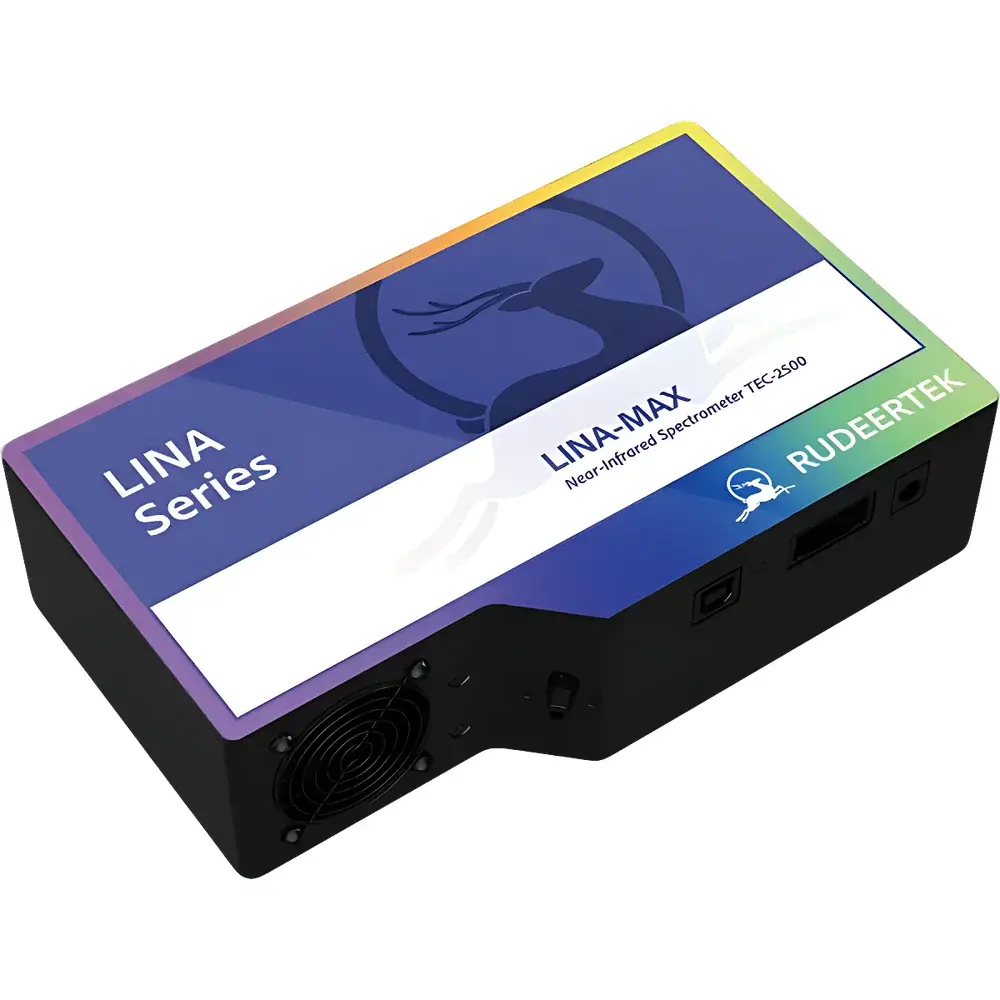
LINA-MAX High-Resolution Cooled Near-Infrared Fiber Optic Spectrometer
| Brand | Luqi Technology |
|---|---|
| Origin | Anhui, China |
| Manufacturer Type | OEM Manufacturer |
| Spectral Range | 900–2500 nm |
| Detector | TE-Cooled InGaAs Linear Array (Two-Stage TEC) |
| Optical Resolution | ~7.6 nm (with 50 µm slit) |
| Signal-to-Noise Ratio | 5500:1 (full signal) |
| Dynamic Range | 8000:1 (single acquisition) |
| Stray Light | <1% |
| Focal Ratio | f/4 |
| Optical Design | Crossed Czerny-Turner |
| A/D Resolution | 16-bit |
| Integration Time | 1 ms – 10 s |
| Linearity | ≥0.998 |
| Weight | 1.25 kg |
| Interface | USB 2.0 Type-B, Digital I/O, SMA905 Fiber Port |
| OS Support | Windows 7/10/11 (32/64-bit) |
Overview
The LINA-MAX High-Resolution Cooled Near-Infrared Fiber Optic Spectrometer is engineered for demanding quantitative and qualitative analysis in the short-wave near-infrared (SWNIR) region. Operating across a broad spectral range of 900–2500 nm, it leverages a two-stage thermoelectrically cooled (TEC) InGaAs linear array detector to suppress dark current and thermal noise—critical for achieving high fidelity in low-light or long-integration applications. Its crossed Czerny-Turner optical architecture, with an f/4 focal ratio and precision-machined optics, ensures high throughput and minimal aberration across the full band. Unlike uncooled or single-stage cooled alternatives, the LINA-MAX’s dual-stage TEC system stabilizes detector temperature up to 40 °C below ambient, enabling consistent spectral baseline stability over extended measurement sessions—a prerequisite for process monitoring, calibration transfer, and regulatory-compliant spectroscopic workflows.
Key Features
- Two-stage TEC cooling for InGaAs detector, delivering stable dark current suppression and enabling integration times up to 10 seconds without thermal drift
- High optical throughput via f/4 crossed Czerny-Turner design with optimized grating efficiency across 900–2500 nm
- Selectable slit widths (10, 25, 50, 75, and 100 µm) to balance resolution (~7.6 nm at 50 µm) and sensitivity per application requirement
- Correlated double sampling (CDS) circuitry integrated at the analog front-end to reject reset noise and 1/f flicker noise—preserving raw data integrity prior to digitization
- 16-bit analog-to-digital conversion with ≥0.998 linearity ensures accurate photometric response across the dynamic range
- Compact, robust aluminum housing (1.25 kg) with SMA905 fiber coupling, USB 2.0 Type-B interface, and TTL-compatible digital I/O for external trigger synchronization
Sample Compatibility & Compliance
The LINA-MAX is compatible with standard 400–600 µm core multimode silica fibers and supports common NIR sampling accessories—including transmission cells, diffuse reflectance probes, and integrating spheres—for solid, liquid, and semi-solid sample interrogation. Its optical performance meets foundational requirements for method validation under ISO/IEC 17025 and supports alignment with ASTM E1655 (standard practices for NIR quantitative analysis) and USP (near-infrared spectroscopy). While not pre-certified for FDA 21 CFR Part 11, its hardware-level timestamping, deterministic trigger handling, and non-volatile configuration storage facilitate implementation within GLP/GMP environments when paired with compliant third-party software platforms supporting audit trails and electronic signatures.
Software & Data Management
The spectrometer operates natively with Luqi’s SDK (C/C++, Python, MATLAB APIs) and includes a vendor-neutral ASCII-based spectral data output format (.csv, .asc), ensuring seamless integration into custom data pipelines or LIMS systems. Raw frame data (including dark reference and lamp reference captures) are accessible at the driver level, permitting full control over background subtraction, normalization, and spectral preprocessing logic. The device supports hardware-triggered acquisition with sub-millisecond jitter, making it suitable for time-resolved measurements in industrial sorting or real-time blending control. All firmware updates are delivered via signed binary packages; configuration parameters—including integration time, ROI selection, and TEC setpoint—are retained in nonvolatile memory across power cycles.
Applications
- Pharmaceutical raw material identification and blend uniformity assessment (e.g., API-excipient ratio monitoring)
- Agricultural commodity grading (moisture, protein, oil content in grains, seeds, and forage)
- Polymer composition analysis and recycling stream verification (e.g., PET vs. PP discrimination)
- Food authenticity testing (adulteration detection in edible oils, honey, and dairy powders)
- Industrial process analytical technology (PAT) deployments requiring ruggedized, fiber-coupled NIR sensing in harsh environments
- Research-grade spectroscopy in academic labs studying vibrational overtones and combination bands in organic functional groups
FAQ
What is the typical cooling temperature delta achieved by the two-stage TEC system?
The detector can be stabilized up to 40 °C below ambient temperature, with thermal equilibrium typically reached within 5 minutes of power-on.
Can the LINA-MAX operate in continuous scanning mode for kinetic studies?
Yes—its hardware trigger input supports externally synchronized acquisition at rates up to 100 Hz (dependent on integration time and host USB bandwidth).
Is spectral calibration traceable to NIST standards?
The instrument ships with factory wavelength calibration using certified rare-earth oxide emission lines; users may perform re-calibration using optional NIST-traceable tungsten-halogen or mercury-argon sources.
Does the device support dark current correction during acquisition?
Yes—correlated double sampling occurs at the analog stage, and user-accessible dark frame capture is supported via SDK for post-processing baseline correction.
Are there options for extended spectral coverage beyond 2500 nm?
No—the InGaAs detector cutoff limits operation to ≤2500 nm; for longer wavelengths (e.g., 2.5–5.0 µm), a separate MCT-based spectrometer platform is recommended.





