
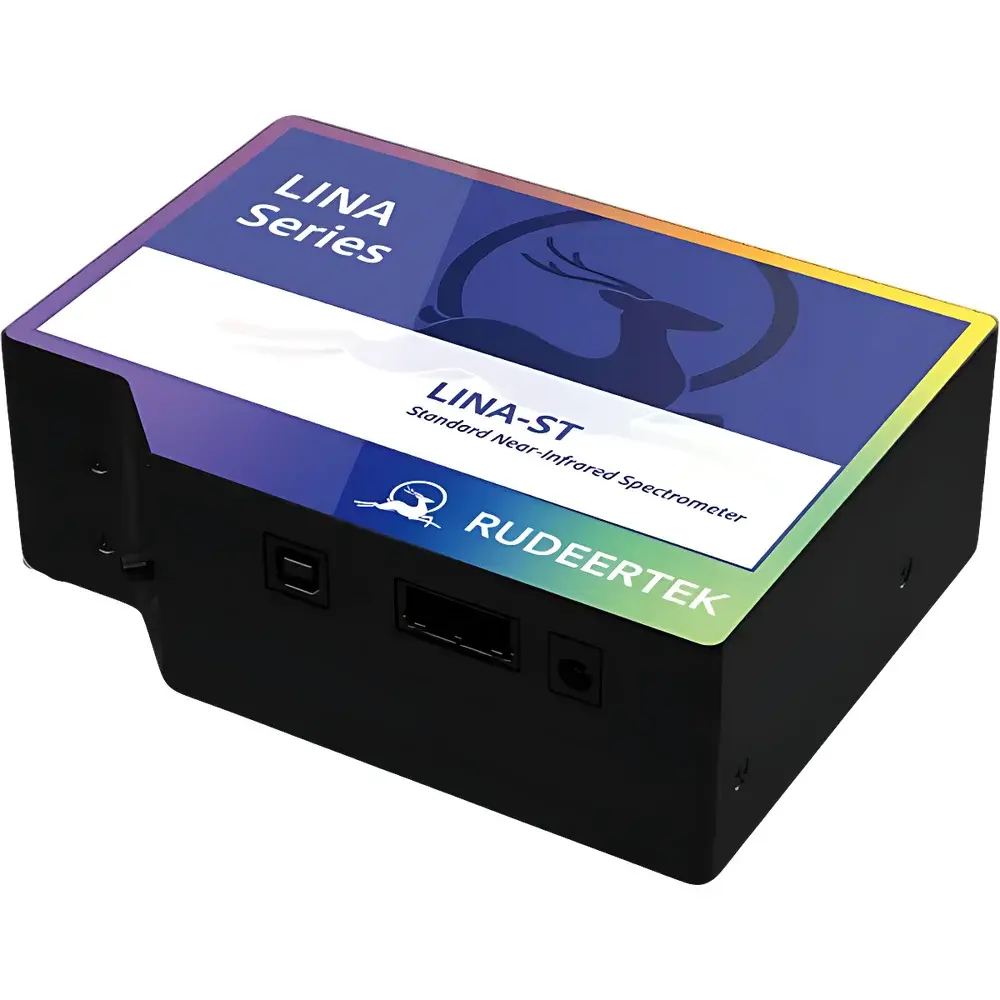
LINA-ST Fiber Optic Near-Infrared Spectrometer
| Brand | LQ Tech |
|---|---|
| Origin | Anhui, China |
| Manufacturer Type | OEM/ODM Producer |
| Spectral Range | 900–1700 nm |
| Detector | Uncooled InGaAs Linear Array (256 or 512 pixels) |
| Optical Resolution | ~4.3 nm (with 50 μm slit) |
| Signal-to-Noise Ratio | 2000:1 (full signal) |
| Dynamic Range | 4000:1 (single acquisition) |
| Stray Light | <1% |
| F-number | f/4 |
| Optical Design | Crossed Czerny-Turner |
| Slit Options | 10 / 25 / 50 / 75 / 100 μm |
| Integration Time | 1 ms – 10 s |
| Linearity | ≥0.998 |
| A/D Resolution | 16-bit |
| Weight | 1.07 kg |
| Interface | USB 2.0 Type-B, Digital I/O, SMA905 fiber port |
| OS Compatibility | 32/64-bit Windows 7/10/11 |
Overview
The LINA-ST Fiber Optic Near-Infrared Spectrometer is an engineered solution for robust, field-deployable NIR spectroscopic analysis in the 900–1700 nm spectral region. Based on a crossed Czerny-Turner optical architecture with an f/4 beam path, it delivers consistent spectral fidelity and mechanical stability under variable environmental conditions. Unlike cooled InGaAs spectrometers requiring thermoelectric or cryogenic stabilization, the LINA-ST utilizes an uncooled linear InGaAs photodiode array—reducing power consumption, thermal drift, and system complexity while maintaining sufficient sensitivity for industrial process monitoring, raw material verification, and quality control applications. Its design prioritizes long-term radiometric stability and repeatability over ultra-high resolution, making it suitable for quantitative and qualitative analysis where cost-efficiency, reliability, and integration flexibility are critical.
Key Features
- Uncooled InGaAs detector platform (256 or 512-pixel linear array) enabling low-power, maintenance-free operation without thermoelectric cooling circuitry
- Crossed Czerny-Turner optical layout with f/4 throughput, optimized for high light-gathering efficiency and reduced aberration across the NIR band
- Configurable entrance slits (10–100 μm) allowing trade-offs between resolution (~4.3 nm at 50 μm) and signal intensity based on application requirements
- Stray light suppression <1% — achieved through precision baffling, optimized grating coating, and internal black-anodized surfaces — critical for accurate quantitation in reflective or scattering samples
- 16-bit analog-to-digital conversion with ≥0.998 linearity ensures faithful digitization of broad dynamic range signals, supporting both weak absorbance features and strong baseline intensities
- Compact form factor (1.07 kg) and USB 2.0 Type-B + digital I/O interface facilitate seamless integration into OEM systems, inline process analyzers, and portable field instruments
Sample Compatibility & Compliance
The LINA-ST is compatible with standard SMA905 optical fibers (typically 200–600 μm core), enabling flexible coupling to diffuse reflectance probes, transmission flow cells, or integrating spheres. It supports common NIR sample presentation methods including solid tablet analysis, liquid cuvette measurements, and bulk granular material interrogation. While not certified as a medical device or GMP-compliant instrument out-of-the-box, its hardware architecture and stable spectral response support validation under ISO/IEC 17025 laboratory accreditation frameworks. When deployed with traceable NIST-traceable calibration standards (e.g., tungsten-halogen lamps, ceramic reflectance tiles), the system meets ASTM E1421 and ISO 14782 requirements for instrumental performance verification in routine NIR analysis workflows.
Software & Data Management
LINA-ST operates via vendor-provided SDKs (C/C++, Python, LabVIEW) and includes a native Windows application for real-time spectrum acquisition, dark/baseline correction, and basic peak identification. Raw data export is supported in CSV and binary formats, enabling compatibility with third-party chemometric platforms such as MATLAB, Unscrambler X, and Pirouette. The firmware implements full audit trail logging for integration time, slit selection, and detector gain settings — a prerequisite for GLP-aligned environments. Though not natively compliant with FDA 21 CFR Part 11, the system’s deterministic behavior, reproducible calibration routines, and external timestamping capability allow users to build compliant data acquisition protocols when paired with validated software layers.
Applications
- Real-time moisture content monitoring in pharmaceutical granulation and drying processes
- Raw material identity verification (e.g., excipients, polymers, agricultural feedstocks) using spectral fingerprint matching
- Quality assessment of edible oils (iodine value, free fatty acid content) via multivariate regression models
- In-line concentration measurement in chemical synthesis reactors using transmission NIR
- Sorting and classification of plastic recyclates based on polymer-specific absorption bands near 1200 nm and 1650 nm
- Field-portable soil organic carbon estimation using diffuse reflectance spectroscopy (DRS)
FAQ
Is the LINA-ST suitable for quantitative analysis?
Yes — when calibrated with reference standards and operated under controlled illumination and temperature conditions, it supports PLS and PCR-based quantification with typical RMSEP values below 0.5% w/w for moisture and API assays.
Can the detector be upgraded to a cooled InGaAs array?
No — the LINA-ST platform is mechanically and thermally designed exclusively for uncooled detectors; cooling integration would require redesign of the optical bench and electronics.
What is the recommended calibration frequency?
For production environments, wavelength calibration should be verified weekly using a neon or mercury-argon lamp; intensity calibration with a NIST-traceable halogen source is advised before each analytical batch.
Does the spectrometer support synchronization with external triggers?
Yes — the digital I/O port provides TTL-compatible input for hardware triggering and output for frame-ready signaling, enabling precise timing in conveyor-based or pump-synchronized measurements.
How does stray light performance affect quantitative accuracy?
Stray light 2 AU), thereby improving model transferability across instruments and reducing prediction bias in cross-laboratory applications.






