
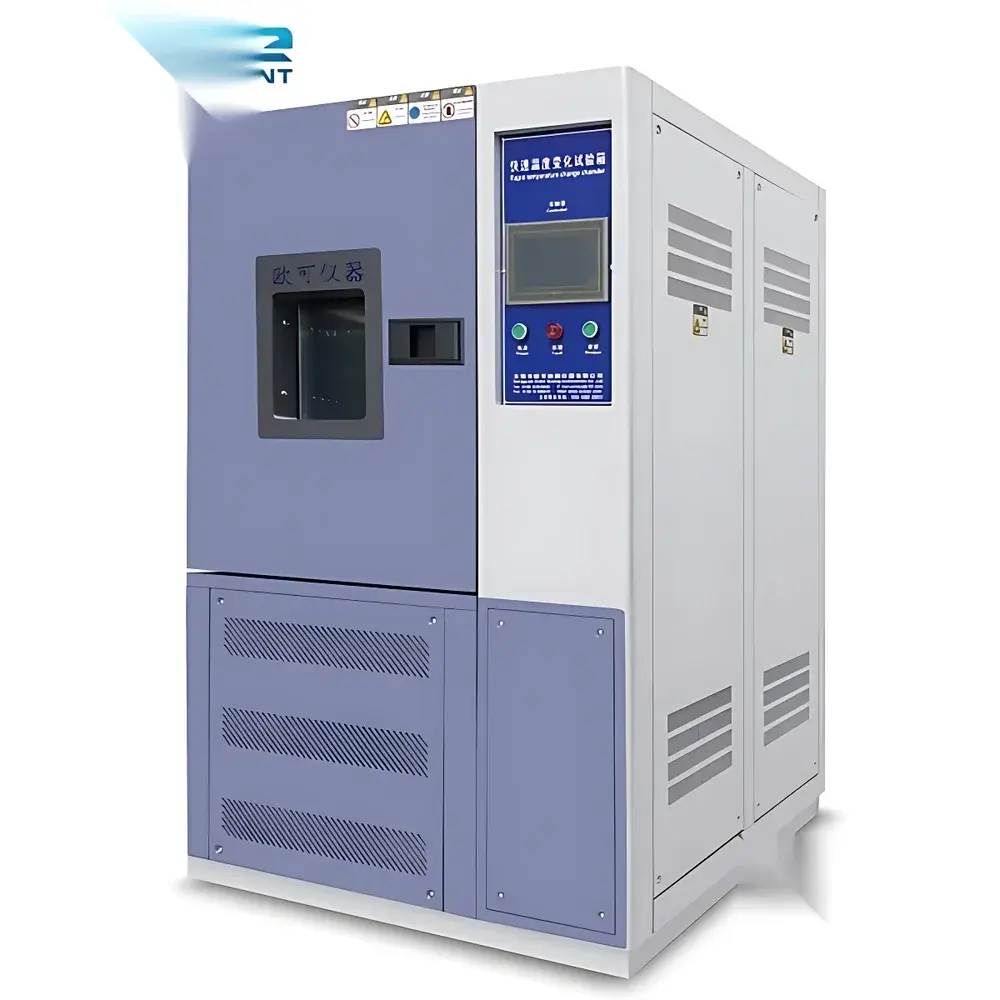
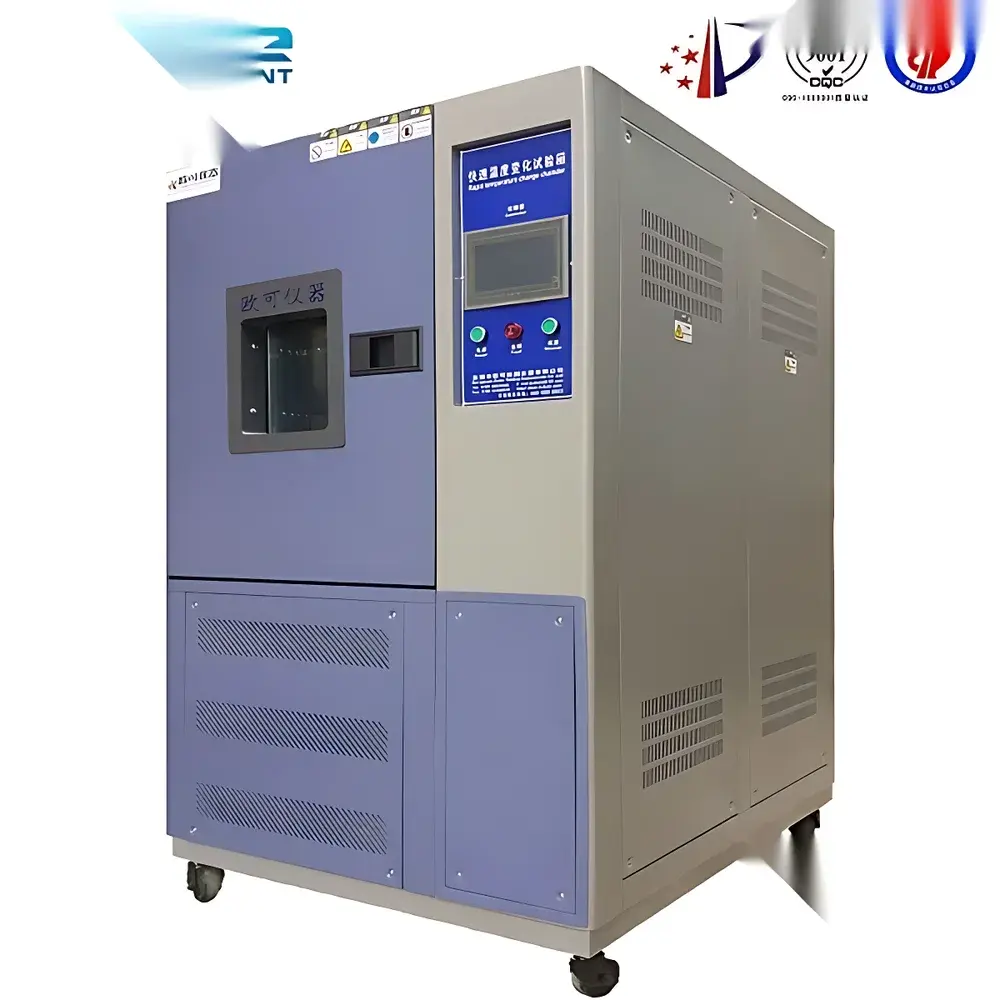
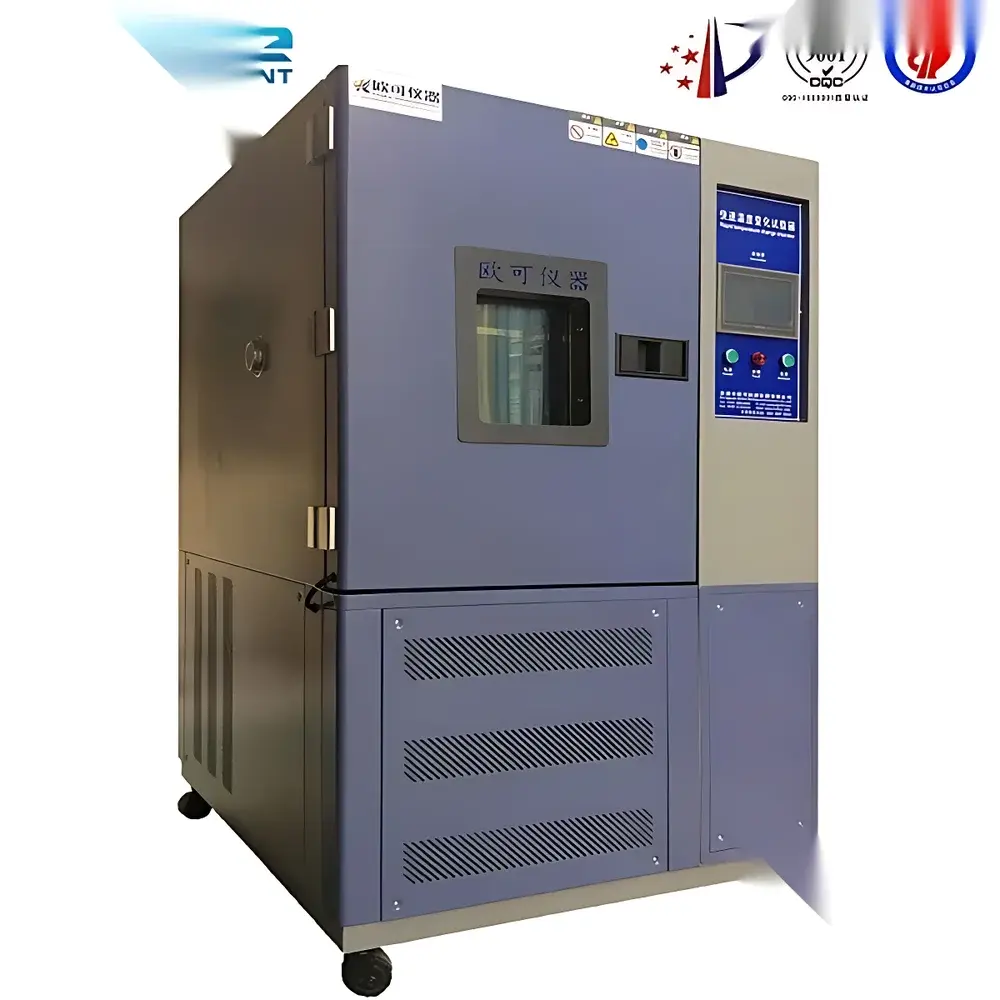
Linear-20°C Rapid Temperature Transition Environmental Test Chamber
| Brand | OEM |
|---|---|
| Origin | Imported |
| Manufacturer Type | Authorized Distributor |
| Price Range | USD 13,500–14,800 (FOB) |
| Control System | Siemens S7-1200 PLC + 10.1″ Color TFT Touchscreen HMI |
| Temperature Setpoint Accuracy | ±0.1 °C |
| Temperature Indication Accuracy | ±0.1 °C |
| Sensor | PT100 Class A Platinum Resistance Thermometer (DIN EN 60751) |
| Heating | Independent Nickel-Chromium Alloy Heaters (PID-controlled) |
| Refrigeration | Dual-stage Cascade Refrigeration System with Tecumseh/Tecumseh-derived Hermetic Compressors |
| Air Circulation | Low-Noise, High-Torque AC Inverter-Driven Motor + Multi-Blade Centrifugal Impeller |
| Internal Dimensions | 600 × 500 × 500 mm (W×H×D) |
| External Dimensions | 1500 × 2100 × 2250 mm (W×H×D) |
| Chamber Construction | AISI 304 Stainless Steel (Interior & Exterior), Matte-Finish Surface |
| Insulation | 120 mm Thickness — Hybrid Layer of High-Density Mineral Wool + Rigid Polyurethane (PU) Foam (λ ≤ 0.022 W/m·K) |
| Door Sealing | Dual-Lip High-Tensile Silicone Packing (Rated for −200 °C to +400 °C) |
| Transition Mechanism | Pneumatic Actuated Dual-Zone Partition with Active Thermal Isolation Valves |
| Sample Zone Configuration | Static Single-Chamber Mode or Dynamic Two-Zone Switching Mode |
| Recovery Time (from −20 °C to +85 °C) | ≤ 3.5 min (per IEC 60068-3-5) |
| Linear Ramp Rate | Up to 15 °C/min (programmable, load-dependent) |
Overview
The Linear-20°C Rapid Temperature Transition Environmental Test Chamber is an engineered solution for accelerated thermal stress evaluation of electronic components, automotive modules, aerospace subsystems, and advanced material specimens under dynamically controlled, high-fidelity temperature transients. Unlike conventional single-zone chambers, this system implements a dual-compartment architecture—comprising independent high-temperature and low-temperature zones—with a central test zone that remains stationary during operation. Temperature transitions are executed via precision pneumatic isolation valves and optimized airflow redistribution, enabling linear ramp rates up to 15 °C/min across the full operational range (−70 °C to +180 °C). The chamber operates on fundamental principles of convective heat transfer augmentation, cascade refrigeration thermodynamics, and closed-loop PID control of resistive heating and refrigerant expansion cycles. Its design conforms to the thermal profiling requirements of IEC 60068-2-14 (Change of Temperature), MIL-STD-810H Method 503.5, and JEDEC JESD22-A104F, making it suitable for qualification testing in ISO/IEC 17025-accredited laboratories.
Key Features
- Dual-zone pneumatic switching architecture minimizes thermal inertia and eliminates mechanical sample repositioning—critical for solder joint reliability assessment and wafer-level packaging validation.
- Siemens S7-1200 PLC-based control system with deterministic scan cycle (< 10 ms) ensures sub-second response to setpoint changes and supports custom ramp-soak profiles with up to 99 segments.
- AISI 304 stainless steel construction throughout interior and exterior surfaces provides long-term corrosion resistance, non-outgassing performance, and compatibility with cleanroom-class maintenance protocols.
- Hybrid insulation layer (mineral wool + rigid PU foam) achieves effective thermal resistance (R-value > 4.2 m²·K/W), reducing standby power consumption by ~37% versus standard polyurethane-only designs.
- Real-time thermal mapping capability via optional 16-channel PT100 input module—enabling spatial uniformity verification per IEC 60068-3-5 Annex B.
- Integrated anti-sweat heating circuit using K-type thermocouple feedback prevents condensation on observation windows and sensor housings during rapid cooldown sequences.
Sample Compatibility & Compliance
This chamber accommodates static samples up to 40 kg with dimensional envelope ≤ 550 × 450 × 450 mm (W×H×D), including PCB assemblies, battery packs, MEMS sensors, and polymer composite coupons. Its structural integrity and thermal management architecture meet mechanical safety requirements per EN 61000-6-2 (immunity) and EN 61000-6-4 (emission). All electrical interfaces comply with UL 61010-1 and CE Machinery Directive 2006/42/EC. Calibration traceability follows ISO/IEC 17025:2017 through NIST-traceable PT100 reference standards. The system supports audit-ready documentation packages aligned with FDA 21 CFR Part 11 (electronic records/signatures) when paired with validated data acquisition software.
Software & Data Management
Built-in controller firmware includes embedded logging at user-selectable intervals (100 ms to 60 s), storing ≥ 1 million data points locally. Export formats include CSV, Excel-compatible XML, and binary .tdms (NI DIAdem compatible). Optional PC-based software provides real-time multi-channel trending, deviation alarm scripting, and automated report generation compliant with GLP/GMP Annex 11 requirements. All historical profile executions—including ramp rates, dwell durations, and fault logs—are time-stamped with microsecond resolution and support digital signature workflows for QA sign-off.
Applications
- Thermal cycling qualification of automotive ECUs per AEC-Q200 Rev D.
- Accelerated life testing of Li-ion battery cells under dynamic thermal load profiles.
- Evaluation of coefficient of thermal expansion (CTE) mismatch in heterogeneous packaging stacks.
- Stress screening of optoelectronic modules prior to burn-in and HALT.
- Material glass transition (Tg) mapping via controlled ramp-rate differential scanning.
- Environmental stress screening (ESS) for defense electronics in accordance with MIL-STD-2164A.
FAQ
What is the minimum achievable temperature stabilization time after a −20 °C to +85 °C transition?
Typical stabilization (±0.5 °C band, 10-minute hold) is achieved within 120 seconds post-ramp completion, verified per IEC 60068-3-5 Clause 6.3.
Can the chamber operate in single-zone mode without pneumatic actuation?
Yes—the controller supports fixed-temperature operation across the full range, with optional gradient mapping using external probe arrays.
Is third-party calibration certification included with delivery?
Factory calibration certificates (as-found/as-left) are provided; ISO/IEC 17025-accredited field calibration services are available upon request.
What refrigerant is used in the cascade system?
R-404A (low-GWP alternative R-449A available on request) compliant with EU F-Gas Regulation (EU) No 517/2014.
Does the system support remote monitoring via Ethernet/IP or Modbus TCP?
Standard Ethernet interface with Modbus TCP server functionality enables integration into SCADA and MES platforms without additional gateways.



