
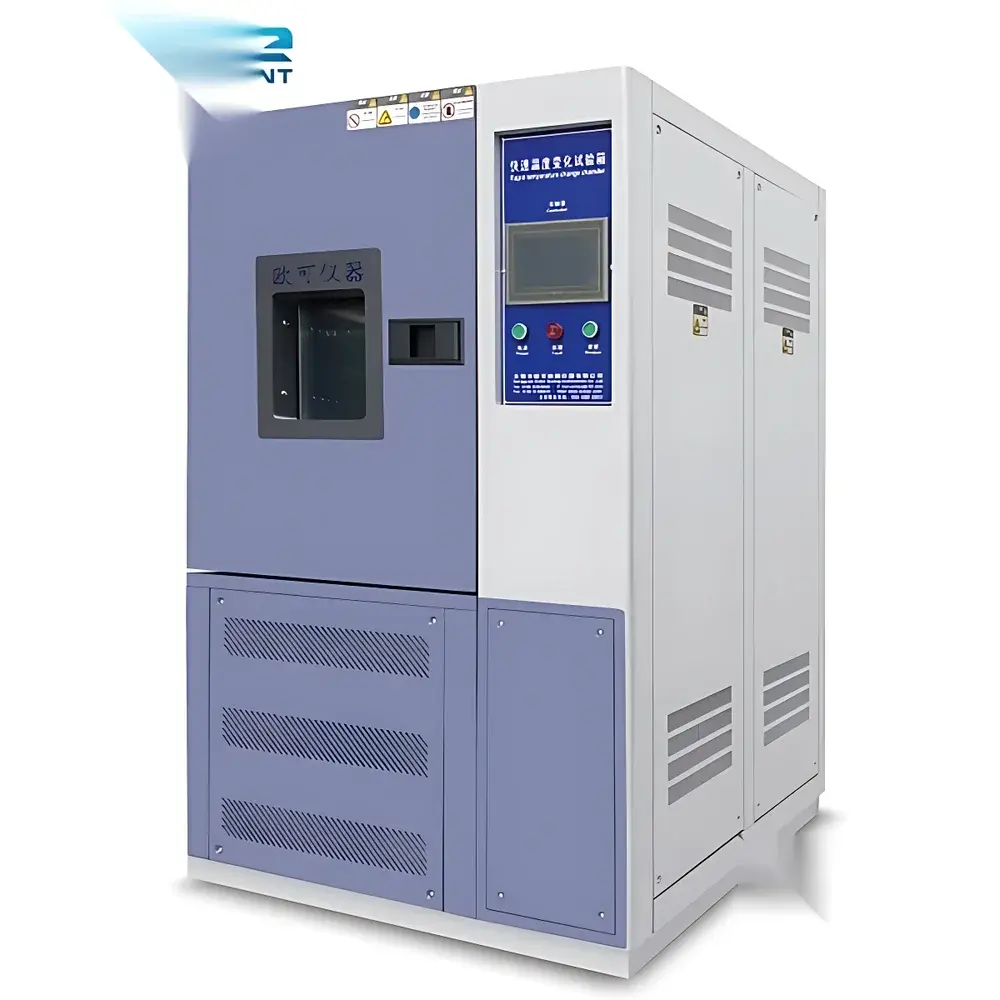
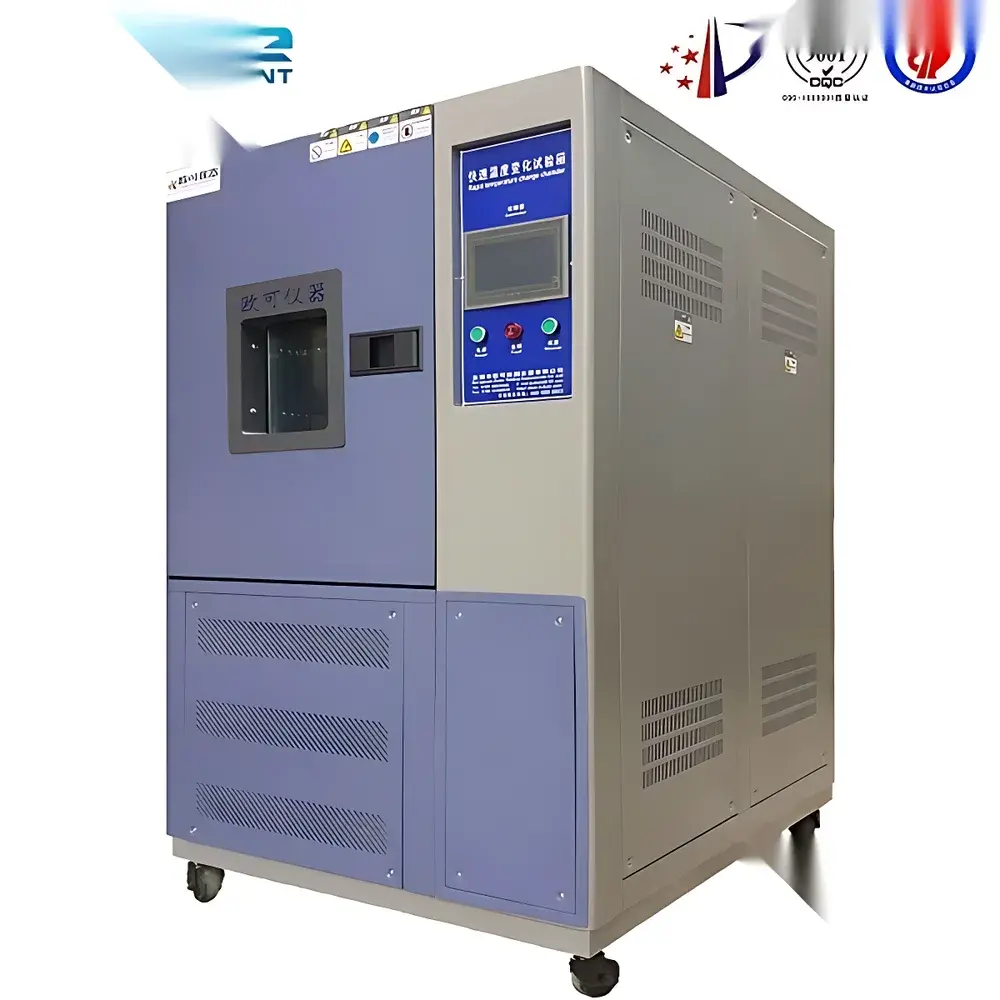
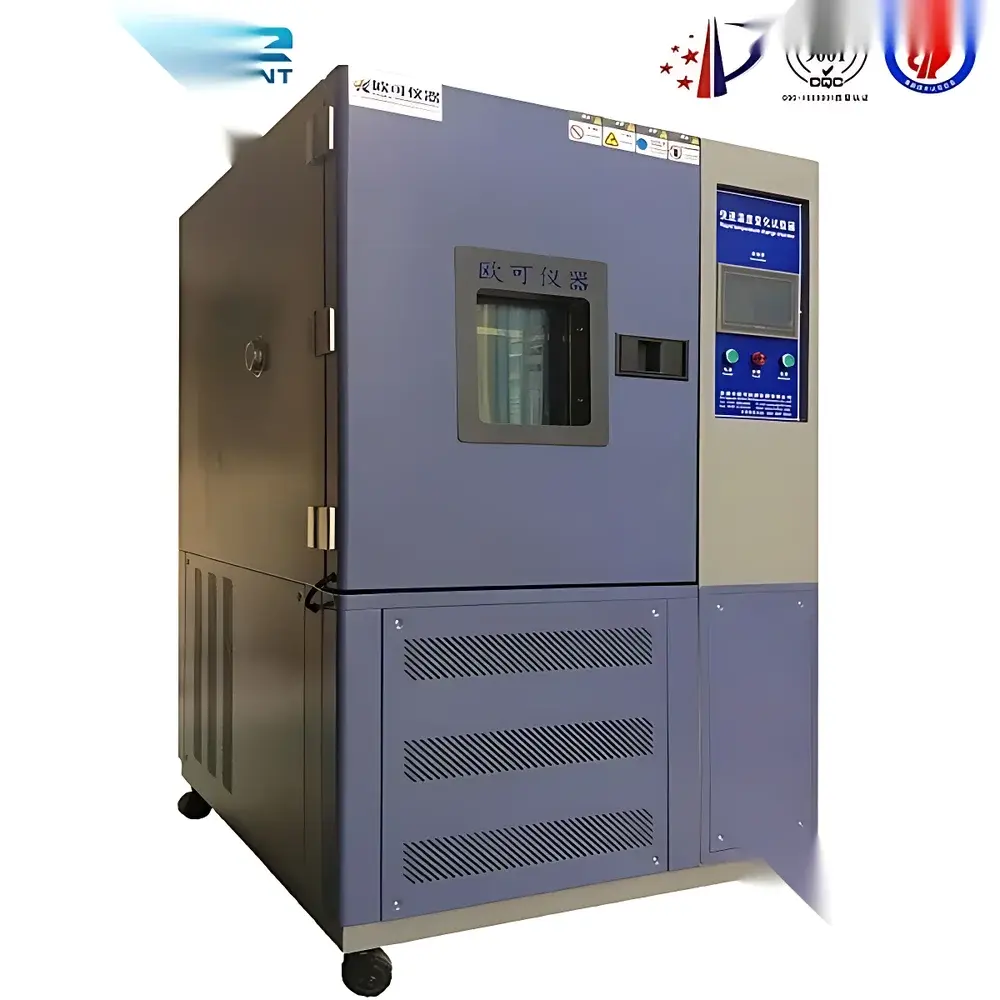
Linear Rapid Temperature Cycling Chamber – Technical Specification Compliance Model
| Brand | Generic OEM |
|---|---|
| Origin | Imported |
| Manufacturer Type | Authorized Distributor |
| Price | USD 2,650 (FOB) |
| Standards Compliance | GB 10589-89, GB 10592-89, GB 10586-89, GB 11158-89, GB/T 5170.2–1996, GB/T 5170.5–1996 |
| Construction | SUS304 brushed stainless steel exterior or Baosteel cold-rolled steel with electrostatic powder coating |
| Insulation | Rigid polyurethane foam + ultra-fine glass wool |
| Air Circulation | Dual-axis adjustable centrifugal blower with horizontal/vertical louver system |
| Control System | PID-based programmable temperature controller with linear ramp profiling |
| Cooling | Capillary tube-based auto-load capacity regulation |
| Heating | Stainless steel sheathed resistive elements |
| Viewing Window | Reinforced double-glazed observation port with LED illumination |
Overview
The Linear Rapid Temperature Cycling Chamber is an environmental test chamber engineered for precise, repeatable, and traceable thermal stress evaluation of electronic components, automotive modules, aerospace materials, and medical device packaging under controlled, dynamically varying temperature conditions. It operates on the principle of forced-air convection with dual-axis adjustable airflow distribution to achieve uniform thermal gradients across the working volume—critical for compliance with accelerated reliability testing protocols such as JEDEC JESD22-A104 (Temperature Cycling), MIL-STD-810H Method 503.7 (Temperature Shock), and IEC 60068-2-14 (Change of Temperature). Unlike basic thermal chambers, this model implements linear ramp rate control (e.g., 5°C/min to 15°C/min, configurable within operational limits), enabling accurate simulation of real-world thermal transients encountered during power-up/down cycles, transport logistics, or field deployment. Its structural architecture adheres strictly to Chinese national standards GB/T 5170.2–1996 (verification methods for temperature test equipment) and GB 10592–89 (technical requirements for high-low temperature alternating test chambers), ensuring metrological integrity and audit readiness in GLP/GMP-regulated laboratories.
Key Features
- Structural integrity: Exterior housing fabricated from either brushed SUS304 stainless steel or Baosteel cold-rolled steel with electrostatic powder coating—resistant to corrosion, abrasion, and long-term UV exposure.
- Thermal insulation: Composite wall construction featuring rigid polyurethane foam (thermal conductivity ≤ 0.022 W/m·K) combined with layered ultra-fine glass wool—achieving effective thermal resistance (R-value ≥ 2.8 m²·K/W) and minimizing heat leakage during rapid transitions.
- Uniformity assurance: Centrifugal blower system integrated with horizontally and vertically adjustable dual-louver air diffusers—eliminating stagnation zones and maintaining ±1.5°C temperature uniformity (per GB/T 5170.2–1996) across the entire working chamber at steady state.
- Observability & safety: Reinforced double-glazed observation window with low-emissivity coating and integrated LED illumination—enabling non-intrusive visual monitoring without thermal bridging or condensation interference.
- Control fidelity: Microprocessor-based PID temperature controller supporting programmable linear ramp profiles, soak dwell times, cycle repetition, and user-defined temperature setpoint sequences—calibration traceable to NIST-traceable reference thermistors.
- Cooling reliability: Capillary tube expansion system with automatic load capacity modulation—providing stable refrigerant flow response across wide evaporator load variations, eliminating hunting behavior common in thermostatic expansion valve (TXV) configurations.
Sample Compatibility & Compliance
This chamber accommodates standard test specimens up to 500 mm × 500 mm × 500 mm (W×D×H), with internal volume options ranging from 150 L to 1000 L. It supports both unpowered and powered-in operation modes for DUTs (Devices Under Test), including PCB assemblies, battery packs, sensor housings, and polymer-based enclosures. All thermal performance verifications conform to GB/T 5170.2–1996 for temperature deviation, uniformity, and stability assessment. The system meets electromagnetic compatibility (EMC) requirements per GB/T 18268.1–2010 and is designed for integration into ISO/IEC 17025-accredited testing laboratories. Documentation includes factory calibration certificates, installation qualification (IQ) templates, and operational qualification (OQ) test protocols aligned with FDA 21 CFR Part 11 data integrity expectations when paired with compliant data logging software.
Software & Data Management
The embedded controller provides RS-485 Modbus RTU and optional Ethernet TCP/IP interfaces for SCADA-level integration. Optional PC-based software enables real-time graphing, alarm logging, CSV export, and automated report generation—including timestamped ramp rate validation, maximum/minimum excursion tracking, and pass/fail status per test step. Audit trails record all parameter modifications, user logins, and calibration events—supporting ALCOA+ principles (Attributable, Legible, Contemporaneous, Original, Accurate, Complete, Consistent, Enduring, Available) required under GLP and GMP frameworks. Data files are stored in open-format CSV or XML, ensuring long-term readability without proprietary dependencies.
Applications
- Accelerated life testing of solder joints and interconnects per IPC-9701.
- Thermal shock screening of MEMS devices and optoelectronic packages.
- Validation of thermal interface material (TIM) performance under cyclic loading.
- Qualification of lithium-ion battery modules per UN 38.3 Section 38.3.4 (Thermal Cycling).
- Environmental stress screening (ESS) for military-grade electronics per MIL-STD-2164A.
- Material coefficient of thermal expansion (CTE) correlation studies via dimensional metrology during cycling.
FAQ
What standards does this chamber comply with for calibration and verification?
It conforms to GB/T 5170.2–1996 (temperature test equipment verification), GB 10592–89 (high-low temperature alternating chamber technical specifications), and supports traceable calibration against NIST-certified reference sensors.
Can the chamber operate continuously for extended thermal cycling tests?
Yes—the refrigeration system, heating elements, and airflow mechanism are rated for uninterrupted operation over 1,000-hour test durations, with maintenance intervals specified in the technical manual.
Is remote monitoring and control supported?
Standard RS-485 Modbus RTU allows integration with building management systems; optional Ethernet module enables web-based status viewing and parameter adjustment via secure HTTPS interface.
How is temperature uniformity validated inside the chamber?
Per GB/T 5170.2–1996, nine-point uniformity mapping is performed using calibrated PT100 sensors at defined spatial coordinates during stabilization at extreme setpoints (e.g., −40°C and +150°C).
Does the system support automated test sequence execution?
Yes—the controller stores up to 100 multi-step programs, each with independent ramp rates, dwell times, and cycle counts, with event-triggered digital I/O outputs for external device synchronization.



