
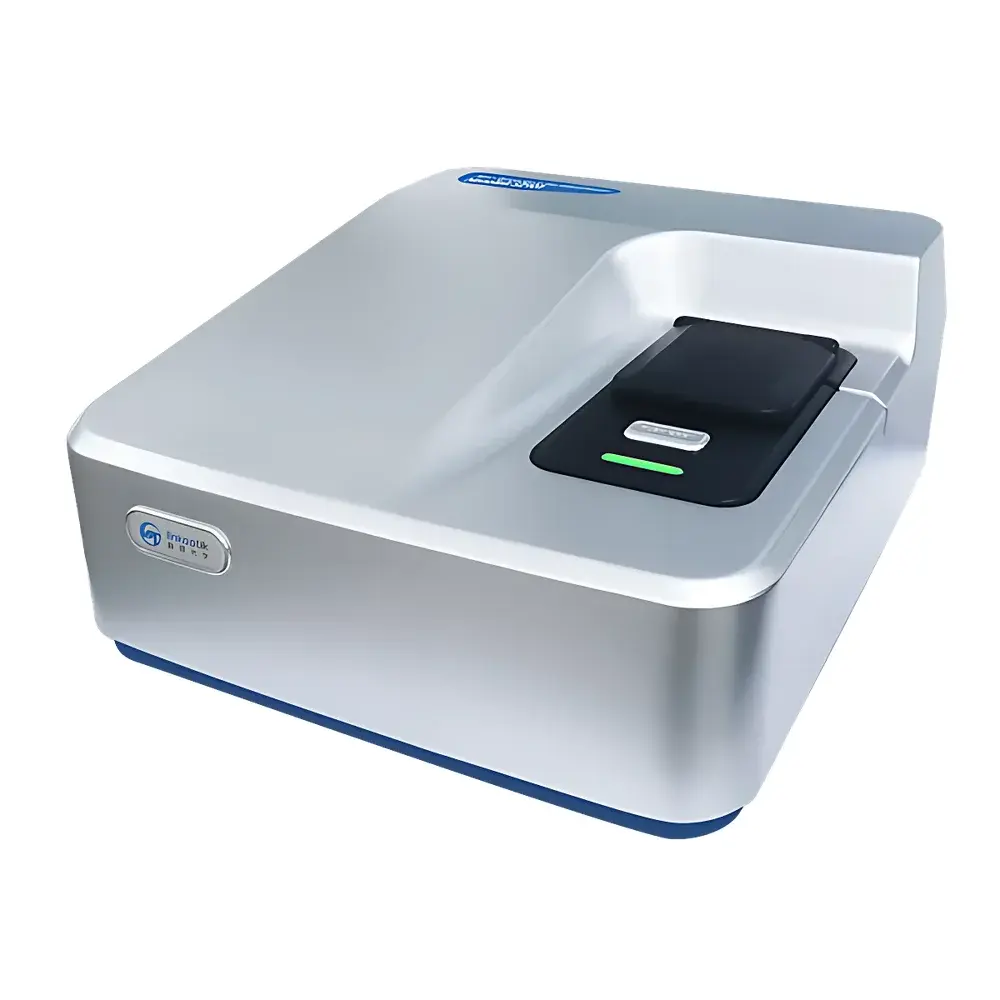
LINKOPTIK Nanolink SZ901 Nanoparticle Size and Zeta Potential Analyzer
| Brand | LINKOPTIK |
|---|---|
| Origin | Guangdong, China |
| Manufacturer Type | Manufacturer |
| Model | Nanolink SZ901 |
| Zeta Potential Range | No practical limit |
| Max Conductivity | 270 mS/cm |
| Temperature Operating Range | −15 °C to 120 °C |
| pH Resolution | 0.1 |
| Temperature Resolution | ±0.1 °C |
| Particle Size Range | 0.3 nm – 15 μm |
| Measurement Angles | 12°, 90°, 173° |
| Accuracy (Size) | Better than ±1% (NIST-traceable standards) |
| Repeatability (Size) | Better than ±1% (NIST-traceable standards) |
| Minimum Sample Volume | 3 µL |
| Minimum Concentration | 0.1 mg/mL |
| Laser | 638 nm, 50 mW solid-state diode with integrated TEC stabilization and fiber coupling |
| Detector | High-sensitivity APD with dark count <20 cps |
| Correlator | High-speed digital correlator, dynamic range >10¹¹ |
| Molecular Weight Range | 340 Da – 2 × 10⁷ Da |
| Zeta Applicable Size Range | 1 nm – 120 μm |
| Electrophoretic Mobility Range | 0 to no practical limit |
| Temperature Control Precision | ±0.1 °C |
| Dimensions | 430 mm × 512 mm × 230 mm (L×W×H) |
| Weight | 20 kg |
Overview
The LINKOPTIK Nanolink SZ901 Nanoparticle Size and Zeta Potential Analyzer is an advanced dual-mode characterization platform engineered for precision measurement of hydrodynamic diameter and surface charge in colloidal dispersions. It integrates three complementary optical scattering techniques—Dynamic Light Scattering (DLS), Static Light Scattering (SLS), and Electrophoretic Light Scattering (ELS)—within a single, compact benchtop architecture. DLS enables rapid, non-invasive determination of particle size distribution based on Brownian motion analysis; SLS provides absolute molecular weight and second virial coefficient (A₂) for macromolecular solutions; ELS quantifies electrophoretic mobility, which is converted to Zeta potential via the Henry equation and Smoluchowski or Hückel approximations depending on particle size and medium conductivity. The system supports multi-angle detection (12°, 90°, and 173° backscatter) to optimize signal-to-noise ratio across diverse sample types—from sub-1 nm peptides to micron-scale emulsion droplets—ensuring robust data acquisition under varying refractive index contrasts and polydispersity conditions.
Key Features
- Triple-scattering capability: Simultaneous DLS, SLS, and ELS measurements in one instrument, eliminating inter-system calibration drift and reducing cross-laboratory variability.
- High-power, thermally stabilized 638 nm solid-state laser (50 mW) with fiber-coupled illumination, reference, and signal paths—enabling consistent beam alignment, reduced thermal lensing, and long-term intensity stability.
- Proprietary Cosine-Fit Light Scattering (CFLS) algorithm: A model-free, iterative fitting method that improves resolution and accuracy over conventional FFT and PALS approaches—particularly critical for weakly scattering or highly polydisperse systems.
- Integrated fiber-optic interferometric detection: Combines signal and reference beams coherently prior to the APD detector, enhancing phase sensitivity and suppressing environmental noise.
- Ultra-low-noise APD detector with dark count rate <20 cps and optimized quantum efficiency at 638 nm—enabling reliable measurements down to 0.3 nm with minimal background interference.
- Wide temperature control range from −15 °C to 120 °C (optional high-temp module), regulated to ±0.1 °C via dual-stage Peltier elements and real-time feedback loop—essential for kinetic studies, aggregation onset detection, and formulation screening.
- Dry-gas purge system: Prevents condensation on optical windows during low-temperature operation, maintaining optical throughput and measurement fidelity over extended runs.
Sample Compatibility & Compliance
The Nanolink SZ901 accommodates aqueous and organic dispersions—including proteins, monoclonal antibodies, liposomes, polymeric micelles, metal oxides, quantum dots, and surfactant-stabilized emulsions—with conductivity tolerance up to 270 mS/cm. Its Zeta potential measurement capability extends across a broad size range (1 nm – 120 μm), supporting both colloidal stability assessment and surface functionalization verification. The system meets key regulatory expectations for analytical instrumentation used in pharmaceutical development and quality control: full audit trail functionality, user access levels, electronic signature support, and data integrity compliance aligned with FDA 21 CFR Part 11 requirements. All size and Zeta results are traceable to NIST-certified standard reference materials (e.g., NIST SRM 1963, SRM 2800), satisfying ISO 22412:2017 (DLS) and ISO 13099-2:2012 (ELS) guidelines. Routine calibration verification and system suitability testing protocols are embedded in the software workflow to support GLP and GMP environments.
Software & Data Management
Acquisition and analysis are managed through LINKOPTIK’s proprietary Nanolink Analysis Suite—a modular, Windows-based application designed for scientific rigor and operational transparency. The suite features automated measurement sequence scripting, batch processing for stability time-series, and customizable reporting templates compliant with internal SOPs and external regulatory submissions. Raw correlation functions, intensity/number/volume distributions, and Zeta potential histograms are stored in vendor-neutral HDF5 format with embedded metadata (instrument settings, sample ID, operator, timestamp, environmental conditions). Export options include CSV, PDF, and XML for LIMS integration. The software implements automatic outlier rejection, baseline correction, and regularization parameter optimization to minimize user bias while preserving statistical validity. Full version history, change logs, and electronic signatures are maintained per session, fulfilling ALCOA+ (Attributable, Legible, Contemporaneous, Original, Accurate, Complete, Consistent, Enduring, Available) principles.
Applications
- Biopharmaceutical development: Monitoring conformational stability of mAbs under stress conditions (pH, temperature, ionic strength); assessing aggregation propensity during formulation screening.
- Nanomedicine characterization: Size and surface charge profiling of lipid nanoparticles (LNPs), polymeric nanocarriers, and exosome isolates for IV or inhalation delivery.
- Materials science: Quantifying dispersion stability of carbon nanotubes, graphene oxide, and metal–organic frameworks (MOFs) in functional fluids.
- Food & cosmetics R&D: Evaluating emulsion breakdown kinetics, surfactant efficacy, and ingredient compatibility in complex matrices.
- Environmental nanotoxicology: Assessing colloidal behavior of engineered nanomaterials in natural waters with variable salinity and NOM content.
- Academic research: Fundamental studies of protein–polymer interactions, self-assembly mechanisms, and interfacial electrokinetics.
FAQ
What is the minimum required sample volume for a valid DLS or ELS measurement?
The Nanolink SZ901 requires only 3 µL of sample when using the standard quartz cuvette, making it suitable for precious or low-yield biological samples.
Can the instrument measure samples with high ionic strength, such as physiological saline or cell culture media?
Yes—the system supports conductivities up to 270 mS/cm, enabling direct analysis of PBS-diluted formulations, serum-containing suspensions, and other high-salt matrices without dilution-induced artifacts.
Is temperature control accurate enough for Arrhenius-based activation energy calculations?
With ±0.1 °C stability and programmable ramping profiles, the instrument supports quantitative kinetic modeling, including aggregation rate constants and activation energies derived from time-resolved size monitoring.
How does the CFLS algorithm improve resolution compared to traditional PALS?
CFLS avoids binning artifacts inherent in FFT-based methods and eliminates phase ambiguity in PALS by directly fitting the cosine-transformed electric field autocorrelation function—yielding higher mobility resolution and improved discrimination of closely spaced Zeta populations.
Does the system support 21 CFR Part 11 compliance out-of-the-box?
Yes—user authentication, role-based permissions, electronic signatures, and immutable audit trails are enabled by default and configurable per organizational validation requirements.



