
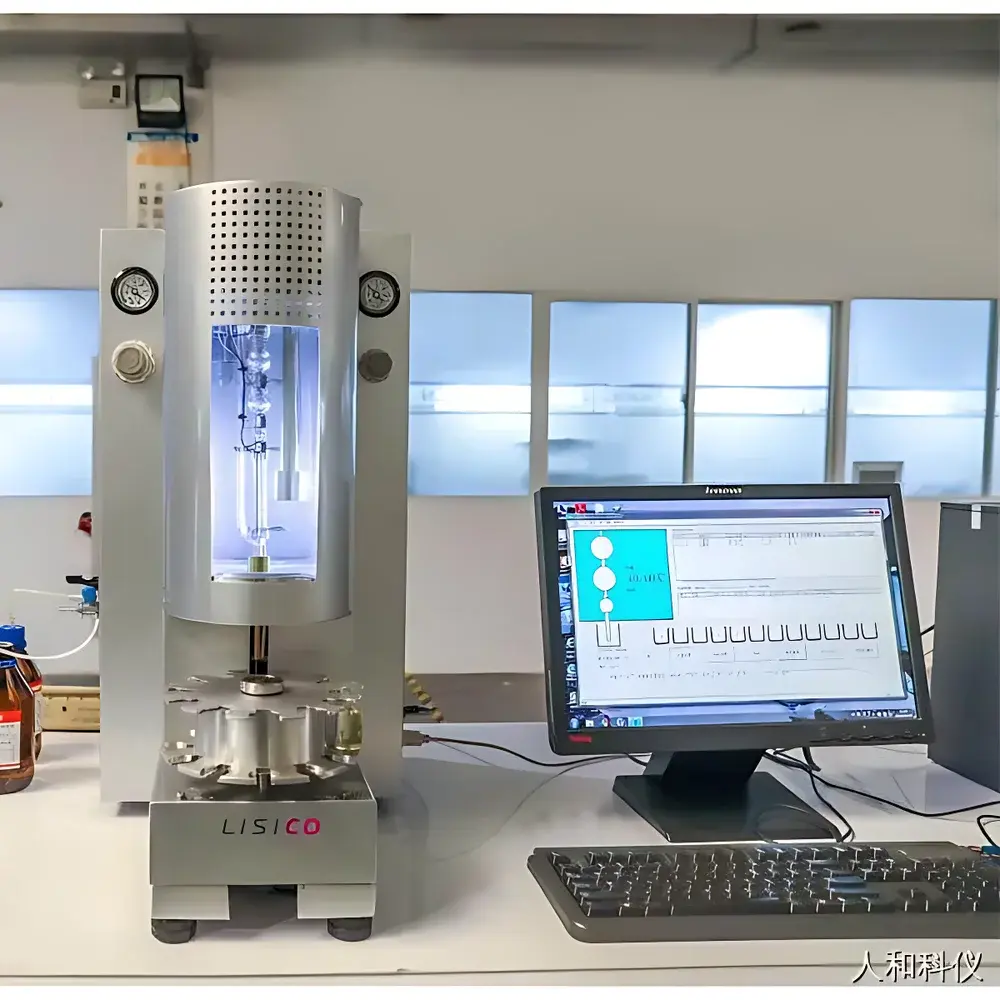
LISICO LS-V Automated Mini Kinematic Viscometer
| Brand | LISICO |
|---|---|
| Origin | Shanghai, China |
| Manufacturer Type | Authorized Distributor |
| Product Category | Domestic (China-made) |
| Model | LS-V |
| Pricing | Upon Request |
Overview
The LISICO LS-V Automated Mini Kinematic Viscometer is an ASTM D445- and ISO 3104-compliant instrument engineered for precise, high-throughput kinematic viscosity measurement of Newtonian liquid petroleum products—including transparent, dyed, and opaque oils. It operates on the capillary efflux principle: a fixed volume of sample flows under gravity through a calibrated glass capillary tube; kinematic viscosity (ν, in mm²/s) is calculated as ν = C × t, where C is the capillary constant and t is the efflux time, corrected for kinetic energy and temperature-dependent density effects. The system integrates a proprietary modified Ubbelohde-type viscometer with triple-bulb design, enabling single-tube measurement across a 100-fold viscosity range—eliminating frequent capillary swaps in routine QC labs. Its miniaturized 2.5 L silicone oil bath (dimethyl polysiloxane) delivers exceptional thermal stability (±0.01 °C from 20 °C to 100 °C), while NTC-based liquid-level detection ensures reliable timing for dark or turbid samples—overcoming limitations of traditional optical (IR/photodiode) sensors.
Key Features
- NTC thermistor-based meniscus detection: Enables accurate efflux timing for transparent, amber, and opaque petroleum liquids without optical interference.
- Triple-bulb modified Ubbelohde viscometer: Each capillary supports a 100× dynamic range (e.g., 40–400 s efflux time per bulb), covering 0.5–10,000 mm²/s (cSt) with minimal tube changes.
- Compact, corrosion-resistant design: Accepts aggressive solvents (e.g., toluene, xylene, chlorinated hydrocarbons) for automated cleaning; dual-solvent (A/B) capability for recalcitrant waxy or heavy oil residues.
- High-efficiency automation: Full cycle—including sample aspiration (≈30 s), pre-warm (if required), thermal equilibration (≈150 s), efflux measurement (≈120 s), solvent rinse (≈90 s), drain (≈30 s), and air-dry (≈180 s)—averages ≤10 minutes per sample.
- 12-position rotating autosampler: Supports unattended batch operation with priority queueing; tray slides forward for easy access to suction nozzles and maintenance.
- Low sample & solvent consumption: Requires only ≈10 mL sample and ≤15 mL total cleaning solvent per test—reducing operational cost and hazardous waste generation.
- Integrated thermal management: 600 W heating element + optional external chiller (required for 20 °C operation); ambient operating range: 5–35 °C, 20–90% RH (non-condensing).
Sample Compatibility & Compliance
The LS-V is validated for kinematic viscosity determination of crude oils, lubricants, fuel oils, biodiesel blends, and other Newtonian hydrocarbon liquids per GB/T 265, ASTM D445 (Standard Test Method for Kinematic Viscosity of Transparent and Opaque Liquids), ASTM D446 (Specifications for Glass Capillary Kinematic Viscometers), and ISO 3104 (Petroleum Products — Determination of Kinematic Viscosity and Calculation of Dynamic Viscosity). Its NTC-level sensing and triple-bulb capillary architecture ensure compliance with repeatability requirements of ASTM D445 (≤0.35% RSD for duplicate runs) across the full 0.5–10,000 mm²/s range. The instrument’s firmware logs all critical parameters—including bath temperature, efflux time, capillary ID, calibration constants, and cleaning sequence—with timestamped audit trails compatible with GLP and GMP documentation practices.
Software & Data Management
Controlled via Windows-based application, the LS-V software provides full method configuration, sequence scheduling, real-time monitoring, and traceable data export. All measurements are stored in a relational database with unlimited capacity; results include raw efflux times, applied corrections (kinetic energy, temperature), calculated ν values, and pass/fail flags against user-defined specification limits. Audit trail functionality records operator ID, method version, instrument state, and any manual intervention—supporting FDA 21 CFR Part 11 readiness when deployed with appropriate IT governance controls. Export formats include CSV, PDF reports, and direct integration with LIMS via configurable ODBC drivers.
Applications
- Quality control of base oils and finished lubricants in refinery and additive manufacturing facilities.
- Viscosity grading of diesel, jet fuel (Jet A-1), and marine fuels per ISO 8217 specifications.
- Monitoring thermal degradation or oxidation-induced viscosity drift during engine oil service life studies.
- Batch release testing of transformer oils (IEC 60296) and hydraulic fluids (ISO 3448).
- R&D screening of biofuel blends (FAME, HVO) where low-temperature flow behavior correlates strongly with kinematic viscosity at 40 °C and 100 °C.
- Contract laboratory testing supporting regulatory submissions requiring ASTM D445 traceability.
FAQ
What standards does the LS-V comply with?
It meets ASTM D445, ASTM D446, ISO 3104, and GB/T 265 for kinematic viscosity measurement of petroleum liquids.
Can it measure waxy or high-pour-point oils?
Yes—the system includes programmable pre-heating to dissolve wax crystals prior to aspiration and testing.
Is external refrigeration required?
Only for operation at 20 °C; the built-in heater supports 20–100 °C, but stable 20 °C control requires an external chiller.
How is calibration traceability maintained?
Capillaries are supplied with NIST-traceable calibration certificates; software enforces mandatory entry of capillary constant (C) and verification date before test execution.
What cleaning solvents are compatible?
The fluid path is chemically resistant to common hydrocarbon and chlorinated solvents—including toluene, xylene, trichloroethylene, and isopropanol—enabling robust residue removal.
Does the system support 21 CFR Part 11 compliance?
With validated software configuration, electronic signatures, and audit trail archiving, it fulfills core technical requirements for regulated environments.
Related Products



