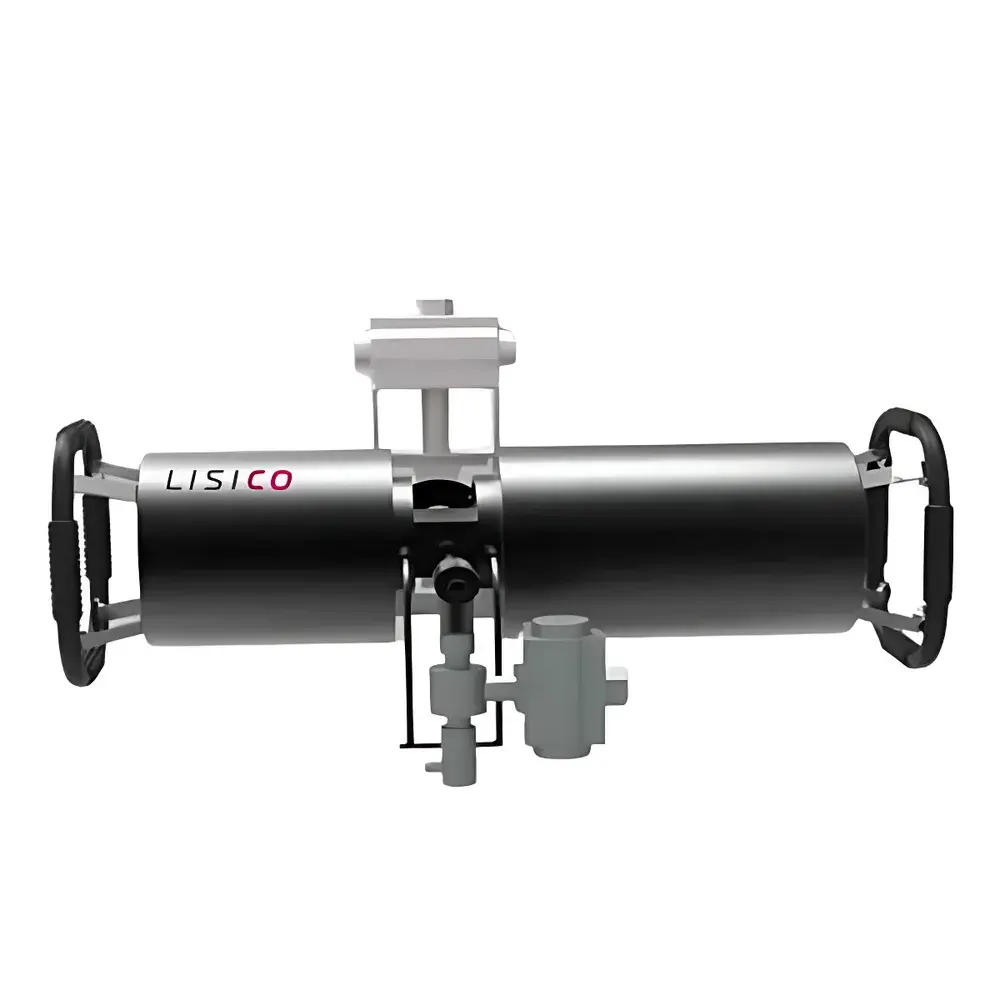
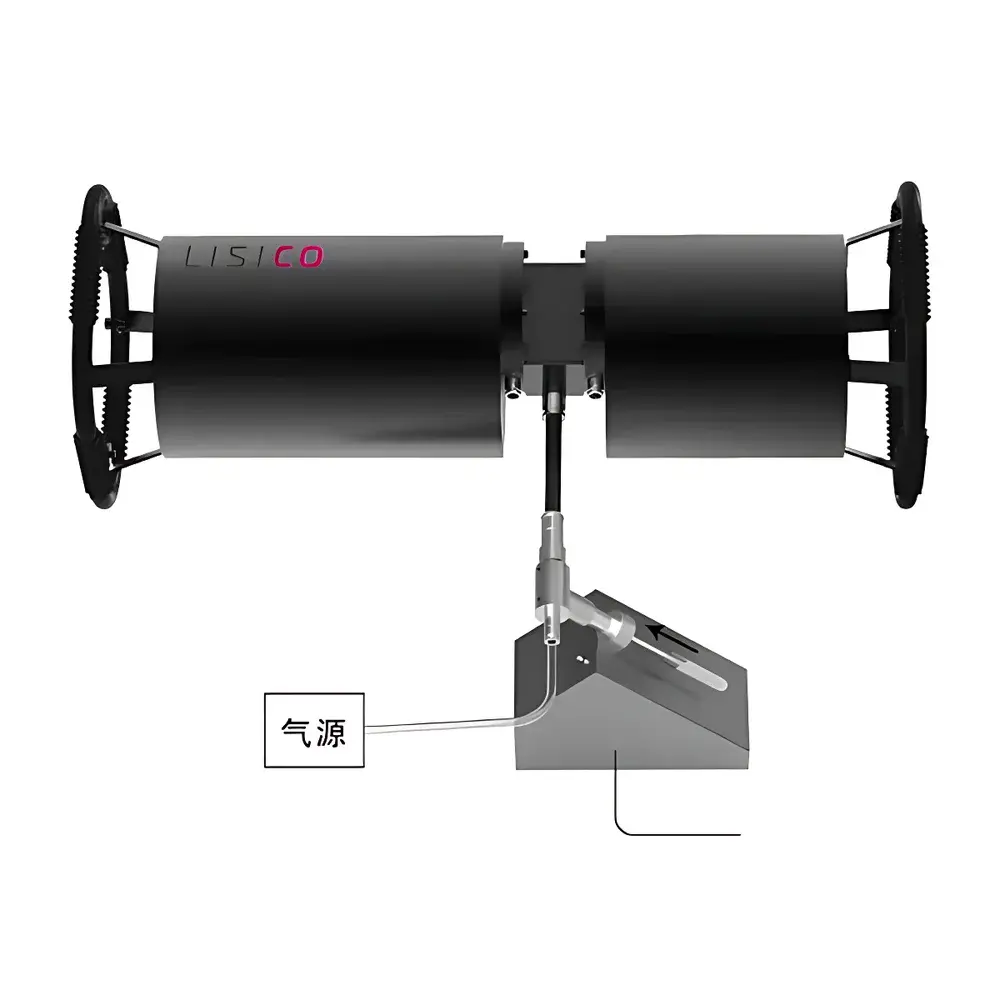
LISICO Online 1 Industrial Online Dry-Process Laser Diffraction Particle Size Monitoring and Control System
| Brand | LISICO |
|---|---|
| Model | Online 1 |
| Measurement Principle | Mie & Fraunhofer Light Scattering |
| Test Range | 0.1–1000 µm |
| Repeatability Error | ≤1% (D50 of certified reference material) |
| Accuracy Error | ≤1% (D50 of certified reference material) |
| Sampling Method | Venturi-based negative-pressure sampling with anti-clogging design |
| Lens Protection | Dual-air-curtain optical protection |
| Maintenance Interval | ≥180 days |
| Laser Source | Imported semiconductor laser |
| Detector Array | 68-element photodiode array |
| Operating System | Windows |
| Communication Protocols | Modbus RTU, TCP/IP, 4–20 mA analog output |
| Dispersing Medium | Compressed air or inert gas (N₂) |
| Gas Supply | 0.4–0.8 MPa, ≥1000 L/min |
| Filtration System | 4-stage imported precision filter (particulate, oil, moisture removal) |
| Sample Throughput | 2–20 g per cycle |
| Power Supply | AC 220 V, 50/60 Hz, 90 W |
| Enclosure Rating | IP65 |
| Dimensions (H×W×D) | 800 × 280 × 280 mm |
| Weight | 21 kg |
| Compliance | GB/T 19077–2016, ISO 13320:2009, Q/ASA 001–2021 |
Overview
The LISICO Online 1 is an industrial-grade, real-time dry-process online particle size monitoring and control system engineered for continuous integration into high-throughput powder manufacturing lines. It operates on the principle of laser diffraction—specifically leveraging both Mie theory (for sub-micron to fine particles) and Fraunhofer approximation (for coarse particles)—to deliver quantitative, volume-based particle size distribution (PSD) data under dynamic process conditions. Unlike laboratory-based analyzers requiring manual sampling and offline analysis, the Online 1 performs fully automated, in-situ measurement directly from pneumatic or gravity-fed powder transport ducts. Its optical architecture features a large-aperture Fourier lens and a 68-channel photodetector array, enabling high-fidelity angular scattering signal capture across a broad detection solid angle. This configuration ensures enhanced resolution in the sub-10 µm range and reliable quantification up to 1000 µm—critical for quality assurance in cement, pharmaceutical excipients, battery cathode materials, metal powders, and specialty ceramics production.
Key Features
- Automated Venturi-negative-pressure sampling via multi-point, static-dissipative, self-cleaning probe assemblies—including optional auger-type samplers for dense or cohesive powders
- Dual-air-curtain optical protection system, designed using aerodynamic principles to isolate the laser path and detector window from airborne particulates; validated maintenance interval ≥180 days under continuous operation
- Integrated 4-stage compressed-air filtration unit (particulate, coalescing, adsorption, and desiccant stages) ensuring clean, dry, oil-free dispersant gas—essential for long-term instrument stability and repeatability
- Real-time auto-alignment mechanism comprising precision stepper-driven actuators and closed-loop feedback control, compensating for thermal drift or mechanical vibration-induced beam misalignment
- Modular multi-line monitoring capability: standard configuration supports time-multiplexed sequential analysis of up to four independent production streams via isolated sample lines and valve-controlled routing
- Full-cycle automation: one-click initiation triggers synchronized sampling, dry dispersion (optional integrated disperser), optical measurement, sample return (closed-loop), and data transmission—no operator intervention required
Sample Compatibility & Compliance
The Online 1 is optimized for free-flowing, dry, non-sticky powders typical of mineral processing, additive manufacturing feedstocks, catalyst carriers, and agrochemical formulations. It accommodates materials with moderate cohesion through optional dry dispersion modules utilizing controlled shear and turbulent acceleration. The system complies with ISO 13320:2009 for laser diffraction methodology and meets the metrological requirements of GB/T 19077–2016, including traceability protocols for D10, D50, D90, D97, and volumetric mean diameters (D[4,3], D[3,2]). Calibration verification is supported via NIST-traceable polystyrene latex (PSL) standards or customer-supplied reference materials. All hardware interfaces adhere to IEC 61000-6-2/6-4 for electromagnetic compatibility, and the enclosure satisfies IP65 ingress protection for dust-tight and low-pressure water jet resistance—suitable for harsh plant-floor environments.
Software & Data Management
The embedded Windows-based control software provides configurable real-time visualization of PSD trends, statistical metrics (e.g., % 80 µm), and derived parameters including specific surface area estimates. Measurement intervals are programmable down to 1 second, with historical data logged at user-defined frequencies into timestamped, CSV-compatible archives. Communication interfaces include native Modbus RTU (RS-485), TCP/IP Ethernet, and 4–20 mA analog outputs for direct PLC integration. Audit trails, user access levels, and electronic signature support align with GLP and GMP documentation expectations. Raw scattering patterns and full PSD datasets are exportable for third-party statistical process control (SPC) platforms or multivariate analysis tools.
Applications
- Cement and clinker grinding circuits—enabling real-time adjustment of classifier speed and mill load to maintain Blaine fineness targets
- Pharmaceutical dry blending and micronization—monitoring API particle size consistency pre-tableting or inhalation formulation
- Lithium-ion battery cathode/anode powder production—ensuring narrow D50 distribution critical for electrode slurry rheology and cell performance uniformity
- Metal injection molding (MIM) feedstock preparation—verifying powder flowability and packing density via D10/D90 ratios
- Pigment and filler manufacturing—controlling pigment strength and dispersion behavior through fine-fraction (<5 µm) content tracking
FAQ
Can the Online 1 be integrated with existing DCS or SCADA systems?
Yes—via Modbus RTU, TCP/IP, or 4–20 mA analog signals, enabling bidirectional communication for setpoint updates and alarm triggering.
Is sample return mandatory, or can it be bypassed?
The system supports both closed-loop return (to production stream) and open-loop waste collection modes; no emission or contamination occurs in either configuration.
How is accuracy verified during routine operation?
Certified reference materials (e.g., NIST SRM 1963) can be introduced manually into the sampling line at scheduled intervals; deviation from certified D50 values is logged automatically.
What maintenance is required beyond the 180-day optical inspection?
Scheduled replacement of filter elements (every 6 months under typical use), calibration of pressure regulators and flow meters (annually), and validation of valve timing sequences (per ISO 9001 internal audit cycles).
Related Products