
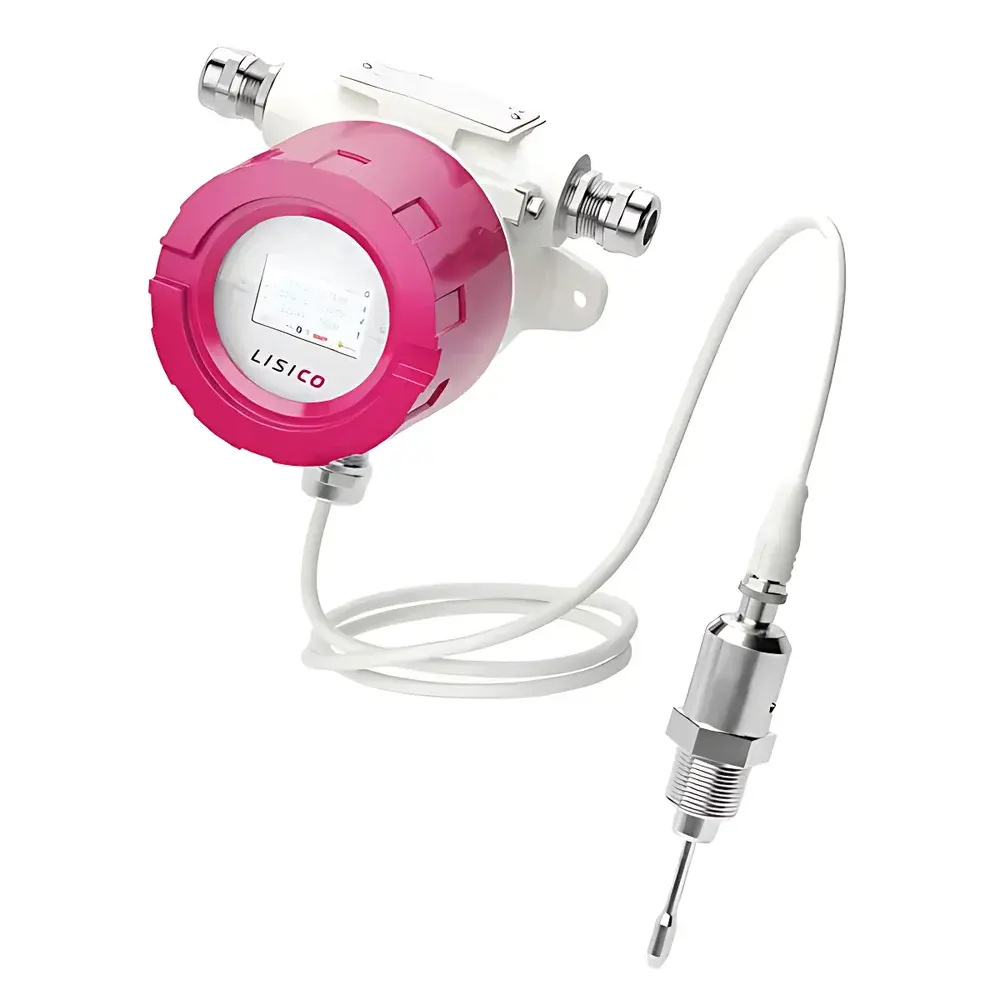
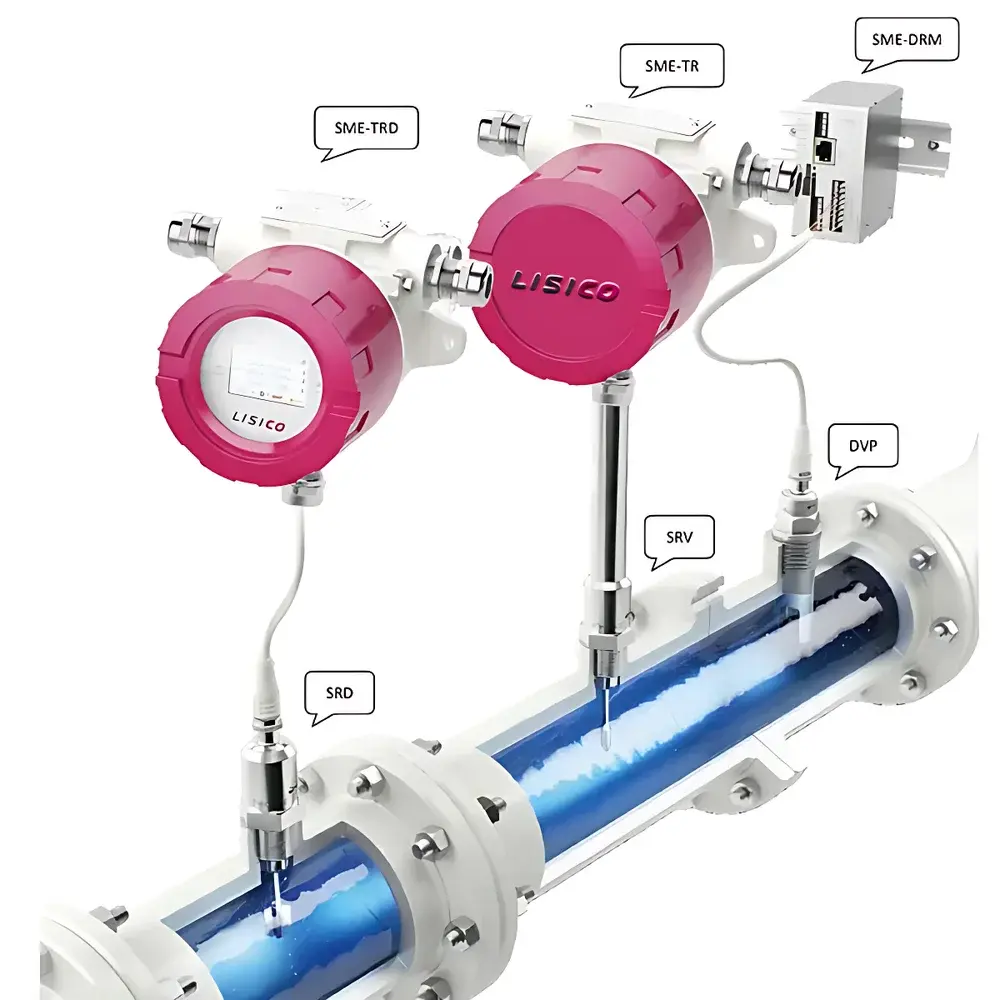
LISICO SRV/SRD/DVP/DVM Online Viscometer & Densimeter
| Brand | LISICO |
|---|---|
| Model Series | SRV / SRD / DVP / DVM |
| Measurement Principle | Torsional Resonance (Viscosity & Density) |
| Viscosity Range | 0–3,000 mPa·s (cP), up to 50,000 mPa·s (cP) optional |
| Density Range | 0–1.5 g/mL, extended range available |
| Viscosity Accuracy | ±1% of reading or better (customizable) |
| Density Accuracy | ±0.01 g/mL standard, ±0.001 g/mL optional |
| Viscosity Resolution | 0.001 mPa·s (cP) |
| Density Resolution | 0.001 g/mL |
| Temperature Sensor | Pt1000 (Class B or AA), integrated |
| Operating Temp | −50 to +300 °C (model-dependent) |
| Pressure Rating | up to 207 MPa (30,000 psi) |
| Wetted Materials | 316L SS or Titanium Grade 5 |
| Enclosure Rating | IP68/IP69, Ex ia IIC T2–T6 |
| Response Time | <1 s |
| Sample Volume | 0.7 mL |
| Electrical Interface | M12 connector or fixed cable |
| Process Connection | 3/4″ NPT, sanitary clamp, 1″ NPT, or 1/4″ HP (9/16-18 UNF) |
Overview
The LISICO SRV/SRD/DVP/DVM series represents a family of industrial-grade online viscometers and densimeters engineered for real-time, simultaneous measurement of dynamic viscosity and fluid density under demanding process conditions. Based on patented torsional resonance technology, each instrument integrates a micro-machined resonator immersed directly into the process stream. As fluid flows past the resonator, its mechanical oscillation is damped proportionally to viscosity, while its natural resonant frequency shifts inversely with fluid density—enabling dual-parameter extraction from a single physical transduction mechanism. This principle eliminates moving parts, avoids shear-rate dependency inherent in rotational systems, and ensures intrinsic suitability for Newtonian and non-Newtonian fluids—including slurries, emulsions, and particle-laden suspensions—without clogging or calibration drift. Designed for continuous operation in pipelines, reactors, and high-pressure vessels, the system delivers sub-second response (<1 s), high repeatability (±0.5% of reading), and long-term stability even under thermal cycling, vibration, or pressure transients.
Key Features
- Torsional resonance sensing architecture—no rotating elements, no bearings, no wear-prone components
- Simultaneous, independent measurement of viscosity and density in a single probe footprint
- Integrated Pt1000 temperature sensor (Class B or AA) for real-time thermal compensation and process monitoring
- High-pressure variants rated up to 207 MPa (30,000 psi) and high-temperature variants operating up to 300 °C
- Wetted materials configurable in 316L stainless steel or corrosion-resistant Titanium Grade 5
- Intrinsically safe (Ex ia IIC T2–T6) and ingress-protected (IP68/IP69) for hazardous area deployment
- Minimal sample volume requirement (0.7 mL) and low-pressure drop design compatible with laminar and turbulent flow regimes
- Sub-millipascal-second resolution (0.001 mPa·s) and milligram-per-milliliter density resolution (0.001 g/mL)
Sample Compatibility & Compliance
The LISICO online viscometer-densimeter is validated for use with Newtonian and time-independent non-Newtonian fluids—including polymer melts, drilling muds, pharmaceutical suspensions, food emulsions, fuel oils, and chemical intermediates. It is unsuitable for fluids containing ferromagnetic particles due to potential interference with resonator dynamics. The instrument complies with international standards for industrial instrumentation, including IEC 60079-0 (explosive atmospheres), IEC 60529 (IP ratings), and ISO 9001 manufacturing controls. Optional configurations support validation protocols aligned with FDA 21 CFR Part 11 requirements for electronic records and signatures, as well as GLP/GMP audit trails when integrated with compliant SCADA or MES platforms. All models meet CE marking requirements for electromagnetic compatibility (EMC) and low-voltage directive (LVD) compliance.
Software & Data Management
LISICO instruments output analog (4–20 mA, 0–10 V) and digital (RS-485 Modbus RTU, optional Ethernet/IP or Profibus DP) signals for seamless integration into existing DCS, PLC, or historian systems. The optional LISICO Insight software suite provides configuration, real-time visualization, trend analysis, alarm management, and export to CSV or OPC UA. Data logging supports timestamped, multi-parameter records (viscosity, density, temperature, pressure if externally supplied) with user-defined sampling intervals down to 100 ms. Audit-trail functionality includes operator login, parameter change history, calibration event logging, and firmware version tracking—fully traceable for regulatory review. Firmware updates are performed via secure signed packages to maintain integrity and prevent unauthorized modification.
Applications
- Real-time monitoring of polymerization kinetics and molecular weight trends in batch and continuous reactors
- Viscosity-based control of coating, ink, and adhesive formulation consistency during roll-to-roll manufacturing
- Drilling fluid characterization in oilfield applications—including rheological profiling of bentonite and synthetic-based muds
- Density-viscosity correlation for LNG composition verification and custody transfer accuracy
- Corrosion inhibitor efficacy assessment via viscosity shift in acidic or saline process streams
- In-line quality assurance for biopharmaceutical fermentation broths and cell culture media
- Pump efficiency diagnostics and leak detection through anomalous viscosity-density deviations in closed-loop systems
- Enhanced oil recovery (EOR) process optimization using polymer slug viscosity and density feedback in injection lines
- Core flooding experiments under reservoir-relevant P/T conditions (up to 200 °C / 69 MPa)
FAQ
Can this instrument measure non-Newtonian fluids accurately?
Yes—the torsional resonance method is inherently insensitive to shear rate, making it suitable for pseudoplastic, dilatant, and yield-stress fluids without requiring empirical flow-curve modeling.
Is calibration required after installation?
Factory calibration is traceable to NIST standards; field verification is recommended at commissioning using certified reference fluids. No routine recalibration is needed unless mechanical damage or extreme environmental exposure occurs.
How does the system handle particulates or abrasives in the fluid?
The resonator’s solid-state design and smooth wetted surfaces minimize fouling. Titanium Grade 5 variants are recommended for highly abrasive or chloride-rich environments.
What communication protocols are supported?
Standard: Modbus RTU over RS-485. Optional: Ethernet/IP, Profibus DP, or HART. Analog outputs (4–20 mA) are provided for all models.
Can the device operate submerged or in direct contact with steam?
Yes—IP68/IP69-rated housings and high-temp variants (rated to 300 °C) allow direct immersion in pressurized liquid or saturated steam environments, provided process connections are properly sealed.



