
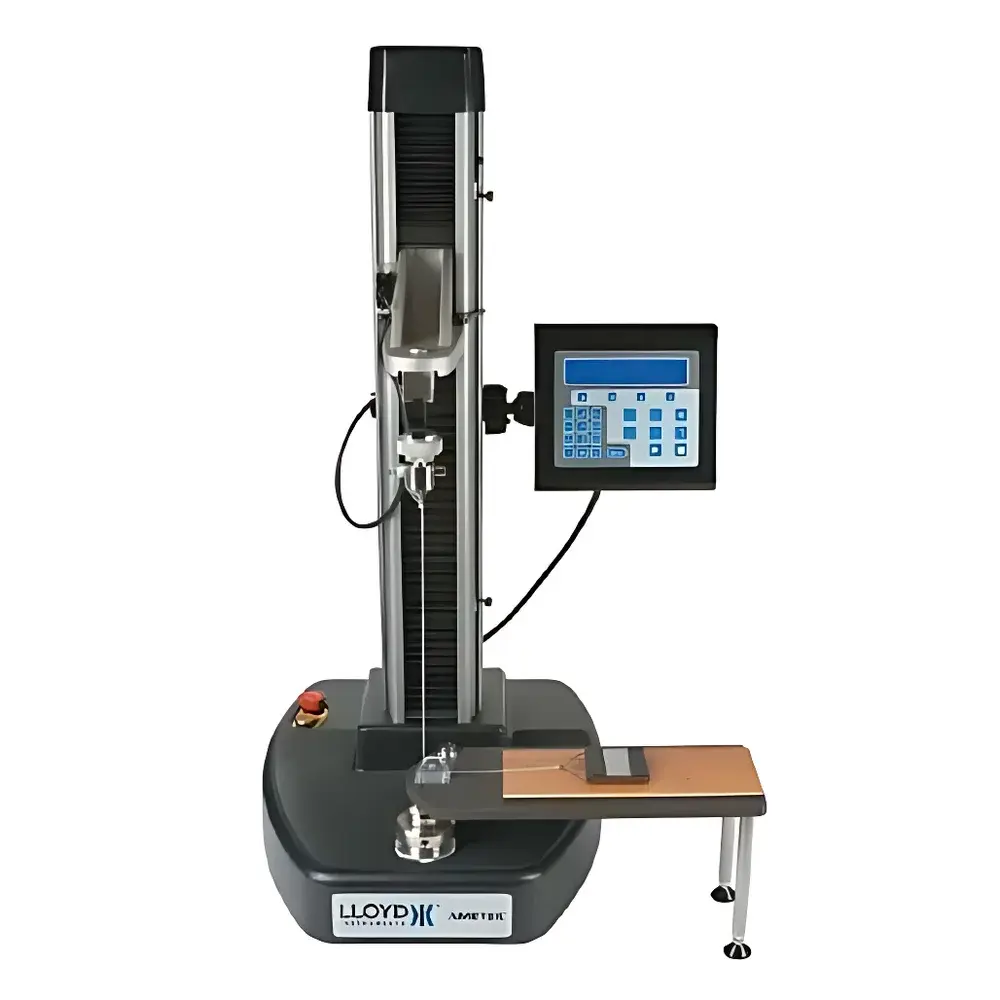
Lloyd Instruments FT1 Coefficient of Friction Tester
| Brand | Lloyd Instruments |
|---|---|
| Origin | USA |
| Model | FT1 |
| Load Capacity | 1 kN |
| Crosshead Travel | 500 mm |
| Speed Range | 0.05–2032 mm/min |
| Speed Accuracy | <0.2% (steady-state) |
| Force Sensor Accuracy | <0.5% |
| Extension Resolution | <2 µm |
| Data Sampling Rate | 8 kHz |
| Sensor Options | YLC Series (10 N, 50 N, 100 N |
| Standards Compliance | ASTM D1894, ISO 8295, TAPPI T549 |
| Onboard Test Methods | 3 preconfigured (static/kinetic COF, peak/average force) + 7 user-defined |
| Data Storage | Up to 600 test records |
Overview
The Lloyd Instruments FT1 Coefficient of Friction Tester is a benchtop, single-column materials testing system engineered specifically for precise and repeatable measurement of static (μs) and kinetic (μk) coefficients of friction in packaging, film, paper, plastic, and laminated substrate applications. It operates on the fundamental principle of horizontal pull testing: a standardized sled (sliding block) of defined mass and footprint is pulled across a fixed sample surface at controlled velocity, while high-fidelity load cells record the instantaneous normal and tangential forces required to initiate and sustain motion. The resulting force-time profiles are processed in real time to compute μs (from the peak force at breakaway) and μk (from the average force during steady sliding), in strict accordance with internationally recognized test protocols.
Key Features
- Integrated friction platform directly mounted to the crosshead base—eliminates external fixtures and ensures mechanical alignment stability.
- Dedicated COF user interface with intuitive workflow navigation, eliminating reliance on general-purpose materials testing software.
- Preloaded compliance templates for ASTM D1894 (plastic film and sheeting), ISO 8295 (plastics—determination of coefficient of friction), and TAPPI T549 (paper and paperboard—coefficient of friction).
- Seven fully configurable user-defined test methods supporting custom sled geometries, variable dwell times, multi-speed ramp sequences, and programmable displacement limits.
- YLC-series interchangeable load cells (10 N, 50 N, 100 N) featuring plug-and-play connectivity and guaranteed force accuracy ≤0.5% of full scale.
- Real-time calculation of static and dynamic COF, peak and average frictional force, normalized by applied normal load—displayed simultaneously with raw force-displacement curves.
- Onboard storage for up to 600 complete test records, each retaining metadata including operator ID, date/time stamp, sample ID, sled parameters (mass, contact area), and environmental notes.
Sample Compatibility & Compliance
The FT1 accommodates standard sled configurations per ASTM D1894 (e.g., 63.5 mm × 63.5 mm, 200 g mass) and ISO 8295 (200 mm × 200 mm test surface, 200 g sled), but also supports nonstandard sleds via user-defined dimensions and mass inputs. Its rigid frame and low-inertia drive system minimize vibration-induced noise, ensuring high reproducibility across thin films (<12 µm), metallized coatings, heat-sealed pouches, corrugated board liners, and textured polymer surfaces. All preconfigured methods include built-in pass/fail logic aligned with specification thresholds defined in packaging quality agreements. The system supports audit-ready documentation for GLP- and GMP-regulated environments, with optional timestamped electronic signatures and exportable CSV/Excel reports traceable to instrument calibration certificates.
Software & Data Management
The FT1 runs embedded firmware with deterministic real-time control—no PC dependency for core test execution. Data acquisition occurs at 8 kHz, capturing transient stick-slip events and micro-slip phenomena critical for evaluating anti-blocking performance or seal integrity. Raw data and calculated metrics are stored internally and exportable via USB flash drive in ASCII-delimited format compatible with LIMS, statistical process control (SPC) platforms, and FDA 21 CFR Part 11-compliant validation packages (when paired with optional software add-ons). Calibration constants for each YLC sensor are stored in EEPROM and auto-loaded upon connection, maintaining metrological traceability without manual entry.
Applications
- Quality control of flexible packaging films (BOPP, PET, PE, PVDC-coated) for consistency in high-speed filling lines.
- Evaluation of slip agent efficacy (e.g., erucamide, oleamide) and migration behavior under accelerated aging conditions.
- Comparative assessment of printed vs. unprinted surfaces, matte vs. glossy finishes, and corona-treated substrates.
- Validation of hot-tack and peel initiation behavior where interfacial shear resistance governs opening force.
- Supporting root-cause analysis of jamming, misfeeds, or inconsistent stack separation in automated packaging machinery.
- Research into tribological interactions between food-contact materials and dry particulates (e.g., powders, granules) under controlled humidity.
FAQ
Does the FT1 require a connected computer to perform standard COF tests?
No—the system executes ASTM, ISO, and TAPPI methods autonomously using its onboard processor and touchscreen interface.
Can I use my own sled design with non-standard mass or contact area?
Yes—user-defined test methods allow input of arbitrary sled mass, footprint dimensions, and normal load values for accurate COF normalization.
Is the 0.5% force accuracy maintained across the full range of each YLC sensor?
Yes—accuracy is specified as ≤0.5% of full scale per ISO 376:2011, verified at multiple points during factory calibration.
How is system compliance with FDA 21 CFR Part 11 addressed?
While the base FT1 firmware provides audit trails and exportable data, full Part 11 compliance requires optional validated software modules with electronic signatures, role-based access control, and secure archive functionality.
What maintenance is required to ensure long-term measurement stability?
Annual recalibration of the load cell and speed verification using traceable standards are recommended; routine cleaning of the friction platform and sled rails is sufficient for daily operation.





