
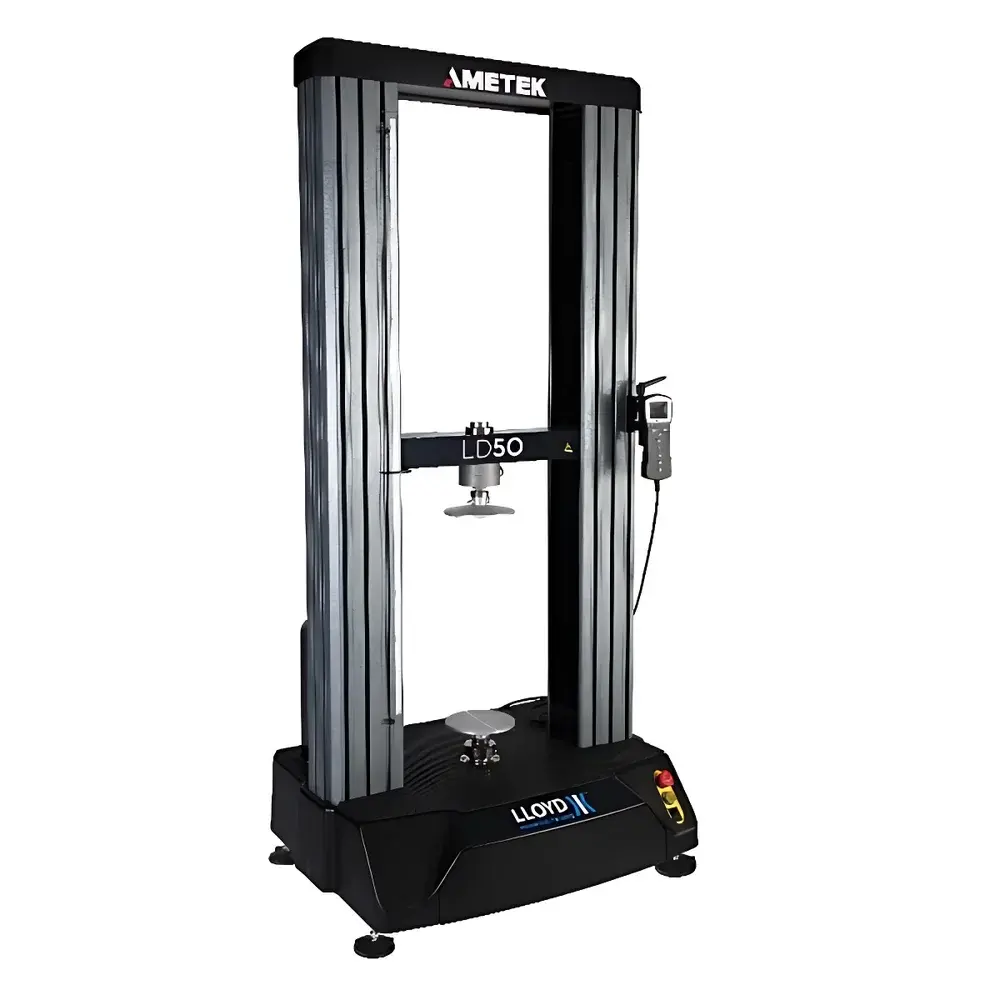
Lloyd Instruments LD30 Dual-Column Universal Testing Machine
| Brand | Lloyd Instruments |
|---|---|
| Origin | USA |
| Model | LD30 |
| Maximum Load Capacity | 30 kN (6,744 lbf) |
| Column Spacing | 452 mm (17.8 in) |
| Standard Crosshead Travel | 1070 mm (42 in) |
| Extended Crosshead Travel | 1669 mm (65.7 in) |
| Drive System | AC Servo Motor with Preloaded Ball Screw |
| Load Cell Type | Interchangeable Spoke-Type Load Cells |
| Compliance | CE Certified |
| Software | NEXYGENPlus with Built-in Standards Library |
| Frame Stiffness | High-Rigidity Dual-Column Architecture |
| Ease of Use | Intuitive Setup, Low Maintenance Design |
Overview
The Lloyd Instruments LD30 Dual-Column Universal Testing Machine is a precision-engineered electromechanical system designed for static and quasi-static mechanical property evaluation of materials and components under tension, compression, flexure, peel, shear, and cyclic loading conditions. Based on servo-controlled linear motion architecture, the LD30 employs an AC servo motor coupled to a preloaded recirculating ball screw transmission to deliver high-resolution displacement control (±0.001 mm typical resolution) and exceptional force linearity across its full 30 kN capacity range. Its dual-column rigid frame—constructed from high-tensile steel with optimized moment-of-inertia geometry—minimizes deflection during high-load testing and eliminates parasitic lateral forces that compromise measurement fidelity. The machine conforms to fundamental metrological requirements outlined in ISO 7500-1 (Class 1 accuracy), ASTM E4, and ISO 5893, ensuring traceable, repeatable, and auditable test data suitable for quality assurance, R&D validation, and regulatory submission environments.
Key Features
- High-rigidity dual-column frame with 452 mm column spacing and 1070 mm standard crosshead travel (extendable to 1669 mm), accommodating large or irregularly shaped specimens including composites, orthopedic implants, packaging assemblies, and structural adhesives.
- Interchangeable spoke-type load cells calibrated to ±0.5% of reading over 1–100% of full scale, enabling rapid reconfiguration between low-force (e.g., thin films, biomedical textiles) and high-force (e.g., metal fasteners, polymer rods) applications without recalibration downtime.
- AC servo drive system with closed-loop position and torque control, delivering smooth acceleration/deceleration profiles and consistent strain rates per ISO 6892-1 Annex A and ASTM D638 protocols.
- Integrated anti-rotation guide system with linear bearing rails ensures axial alignment stability during off-center loading, reducing bending moments and improving repeatability in compression and buckling tests.
- CE-compliant safety architecture including emergency stop circuitry, interlocked guard zones, and software-enforced load/displacement limits aligned with Machinery Directive 2006/42/EC.
Sample Compatibility & Compliance
The LD30 supports specimen geometries ranging from sub-millimeter wires and microtensile coupons to full-scale automotive gaskets and architectural sealants. Standard grips include pneumatic, wedge, and hydraulic options; custom fixtures are available for ASTM D3039 (composite tensile), ISO 178 (flexural), and ISO 1133 (melt flow index auxiliary testing). All hardware and firmware comply with ISO/IEC 17025 documentation requirements for accredited laboratories. The system meets electromagnetic compatibility (EMC) standards per EN 61326-1 and carries CE marking for use within the European Economic Area. For regulated industries, optional 21 CFR Part 11-compliant audit trail logging and electronic signature modules are available through NEXYGENPlus configuration.
Software & Data Management
NEXYGENPlus v5.x serves as the embedded control and analysis platform, offering real-time graphical monitoring, automated pass/fail decision logic, and multi-channel synchronized data acquisition (load, displacement, extensometer, environmental sensor inputs). The software includes over 200 preconfigured test methods compliant with ASTM, ISO, DIN, JIS, and GB standards—including tensile modulus calculation per ISO 527-2, yield point determination via offset method (ASTM E8), and creep compliance modeling. Export functionality supports direct integration with Microsoft Excel and Word templates via OLE automation, enabling seamless report generation within enterprise document management systems. Raw data is stored in vendor-neutral ASCII and XML formats, facilitating third-party analysis in MATLAB, Python (NumPy/Pandas), or statistical process control (SPC) platforms. Audit trails record all user actions, parameter changes, and calibration events with timestamped, immutable logs.
Applications
- Quality control of thermoplastics, elastomers, and fiber-reinforced composites in automotive and aerospace Tier-1 supply chains.
- Mechanical validation of medical devices per ISO 14243 (hip joint simulators) and ASTM F2118 (bone cement fatigue).
- Adhesion strength assessment of pressure-sensitive tapes, laminates, and printed electronics using 90° peel and T-peel configurations.
- Compression testing of foams, corrugated board, and pharmaceutical tablet hardness per USP .
- Dynamic mechanical analysis (DMA) support via optional high-speed data capture (up to 10 kHz sampling) for viscoelastic characterization.
FAQ
What is the maximum test speed achievable on the LD30?
The LD30 achieves speeds from 0.001 mm/min to 1000 mm/min, programmable in 0.001 mm/min increments, supporting both slow-rate creep tests and high-speed impact-simulation protocols.
Can the LD30 be integrated into an automated production line?
Yes—via Ethernet/IP or Modbus TCP interfaces, the LD30 supports PLC-triggered test initiation, real-time status feedback, and pass/fail signal output for inline QC gatekeeping.
Is extensometer support included as standard?
A digital video extensometer (DVE) or clip-on contact extensometer can be added as a field-upgradable option; NEXYGENPlus provides native driver support and automatic gauge length compensation.
How often does the system require calibration verification?
Per ISO/IEC 17025 recommendations, load cell and displacement transducer verification should occur at least annually—or after any event affecting mechanical integrity—and documented calibration certificates are provided with each service.
Does Lloyd Instruments offer application-specific validation packages?
Yes—GxP-compliant IQ/OQ documentation, installation qualification kits, and protocol-driven test method validation services are available for pharmaceutical, biotech, and medical device customers.



