
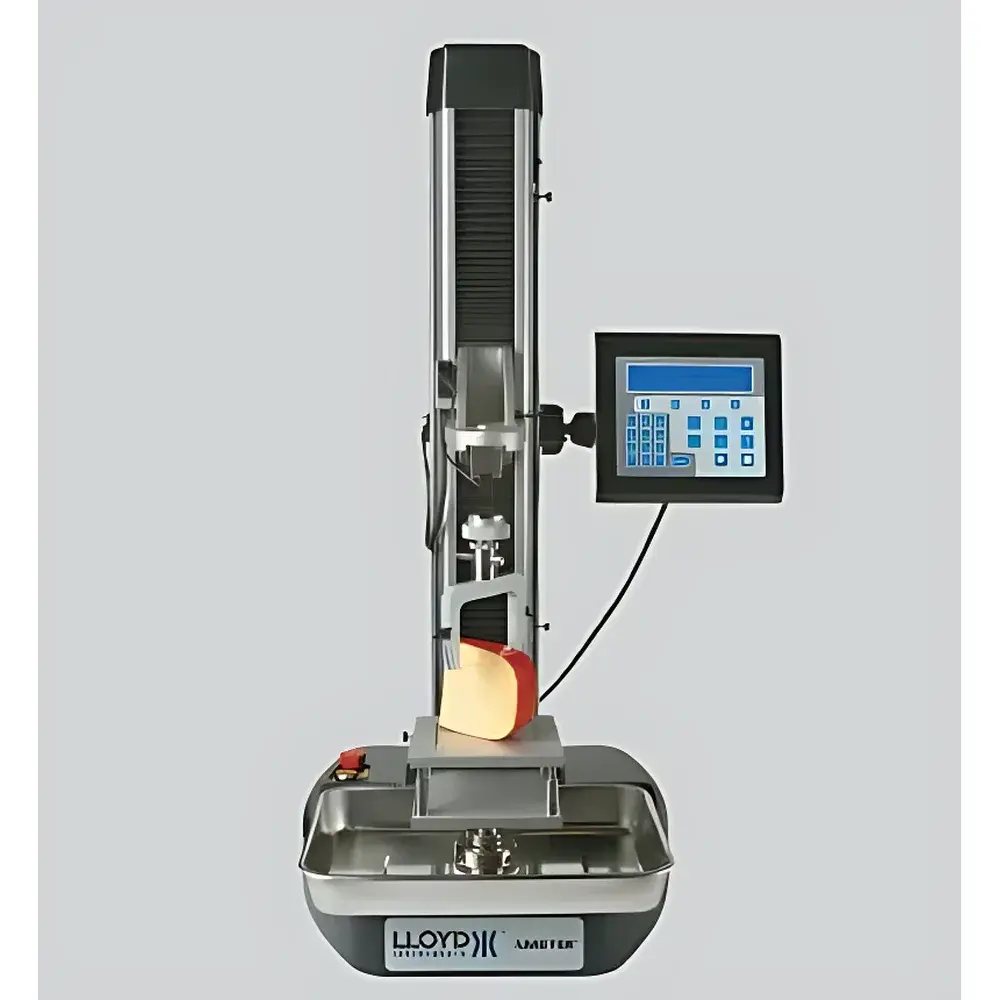
LLOYD TA1 Texture Analyzer
| Brand | LLOYD |
|---|---|
| Origin | United Kingdom |
| Model | TA1 |
| Maximum Load Capacity | 1 kN (225 lbf) |
| Load Accuracy | ±0.5% of reading from 1% of full scale |
| Sampling Rate | 8 kHz |
| Data Storage | Up to 600 test results |
| Programmable Test Methods | 10 |
| Software | NEXYGENPlus with Excel/Word integration |
| Throat Depth | 180 mm |
| Compliance | ASTM F3107, ISO 11357-4, USP <1141>, GLP/GMP-ready audit trail support |
Overview
The LLOYD TA1 Texture Analyzer is a benchtop mechanical testing system engineered for precision texture profiling across food, pharmaceutical, cosmetic, and pet food industries. It operates on the principle of controlled uniaxial force application—measuring resistance to deformation under standardized compression, penetration, shear, extrusion, and puncture protocols. Designed in accordance with rheological and mechanical testing fundamentals, the TA1 delivers repeatable force–distance–time data essential for product development, quality control, and regulatory documentation. Its modular architecture supports both routine QC screening and advanced texture profile analysis (TPA), enabling quantification of parameters including hardness, cohesiveness, springiness, chewiness, adhesiveness, and fracturability per established sensory correlation models.
Key Features
- High-accuracy load cell calibrated to ±0.5% of reading from 1% of full scale (1 kN range), ensuring metrological traceability across low- and high-force regimes without sensor swapping
- 180 mm throat depth accommodates oversized samples—including whole fruits, baked goods, packaged meals, and veterinary chews—without repositioning or custom fixtures
- Digital sampling at 8 kHz captures transient mechanical events (e.g., brittle fracture onset, gel rupture, or viscoelastic recovery) with temporal resolution sufficient for dynamic TPA cycle decomposition
- Onboard memory stores up to 600 complete test records with timestamps, operator IDs, and method metadata—enabling offline review and batch traceability
- 10 user-programmable test methods with customizable speed profiles, dwell times, return positions, and trigger thresholds—reducing operator dependency and inter-test variability
- Multi-language interface (English, French, German, Spanish, Chinese) and dual-unit display (N, kgf, lbf, mm, in) facilitate global lab deployment and cross-regional method harmonization
Sample Compatibility & Compliance
The TA1 accepts diverse physical forms—from semi-solids (yogurts, creams) and viscoelastic gels (carrageenan, pectin) to rigid solids (chocolates, cheeses, tablets) and fibrous matrices (meats, pet treats). Standard fixtures include cylindrical probes (P/2, P/36), Warner–Bratzler blades, Kramer shear cells, and 36-pin arrays for bulk food homogeneity assessment. All mechanical tests align with internationally recognized standards: ASTM F3107 (food texture instrumentation), ISO 11357-4 (thermal-mechanical behavior of polymers), and USP <1141> (mechanical testing of pharmaceutical dosage forms). When operated with NEXYGENPlus under configured audit trail and electronic signature settings, the system meets FDA 21 CFR Part 11 requirements for regulated environments.
Software & Data Management
NEXYGENPlus serves as the analytical engine for the TA1, offering real-time curve visualization, automated parameter extraction (peak force, area under curve, slope, relaxation time), and statistical reporting (mean, SD, CV%, confidence intervals). Raw force–displacement data exports natively to CSV, ASCII, and proprietary .nxd formats. Direct OLE automation enables seamless insertion of formatted graphs and summary tables into Microsoft Excel workbooks and Word reports—preserving corporate branding and eliminating manual transcription errors. Version-controlled method libraries, user access levels (admin/operator/auditor), and timestamped change logs ensure compliance with GLP and GMP documentation practices.
Applications
- Food R&D: Optimization of starch gelatinization, fat crystallization, and protein network formation via compression-cycle hysteresis analysis
- QC/QA Labs: Release testing of confectionery hardness, baked good firmness, and dairy spread spreadability against internal specifications
- Pharmaceuticals: Tablet friability, capsule shell rupture force, and ointment extrudability per ICH Q5C stability guidelines
- Pet Nutrition: Kibble crunch index, wet food viscosity mapping, and chew toy tensile endurance profiling
- Cosmetics: Cream stiffness modulus, lipstick break force, and hydrogel film elasticity quantification
FAQ
What standards does the TA1 comply with for food texture testing?
The TA1 adheres to ASTM F3107 for instrument calibration and test protocol definition, and supports method development aligned with ISO 11357-4 for thermomechanical characterization.
Can the TA1 integrate with LIMS or ERP systems?
Yes—via NEXYGENPlus’ COM/DCOM interface and configurable CSV export templates, it supports bidirectional data exchange with major laboratory information management systems (LIMS) and enterprise resource planning (ERP) platforms.
Is validation documentation available for regulated use?
LLOYD provides IQ/OQ documentation packages, including installation checklists, operational verification protocols, and factory calibration certificates traceable to UKAS-accredited standards.
How is force accuracy maintained over time?
The TA1’s load cell undergoes factory calibration with NIST-traceable deadweight standards; annual recalibration is recommended, and built-in zero-balance diagnostics enable daily verification prior to testing.
Does the system support third-party fixture design?
Yes—the universal crosshead mounting interface (M6 threaded holes, 50 mm pitch) and open API in NEXYGENPlus allow integration of custom fixtures developed in-house or by certified engineering partners.





