
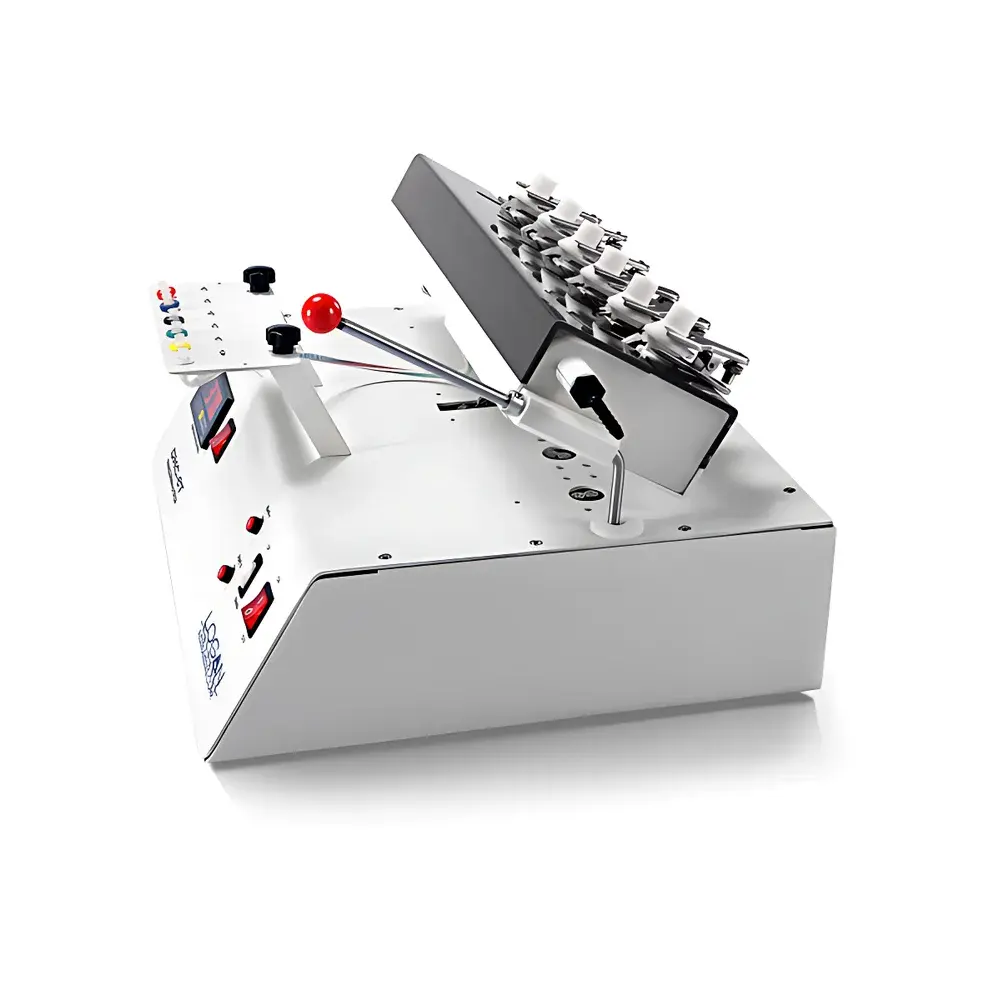
LOGAN DHC-6T Dry-Heat Transdermal Diffusion System
| Brand | LOGAN |
|---|---|
| Origin | USA |
| Model | DHC-6T |
| Heating Method | Dry-heat parallel heating |
| Diffusion Cell Type | DHBF (Dry-Heat Bubble-Free) |
| Cell Material | PTFE-molded donor chamber, precision-cut borosilicate glass receptor chamber |
| Temperature Control | Independent dual-zone dry-heating with ±0.3 °C stability |
| Sample Capacity | 6 parallel diffusion cells |
| Automation | Mechanical auto-tilt degassing mechanism |
| Compliance | Designed for USP <724> and ISO 10993-12 compliant transdermal permeation studies |
Overview
The LOGAN DHC-6T Dry-Heat Transdermal Diffusion System is an engineered platform for in vitro evaluation of percutaneous drug delivery kinetics under controlled thermal conditions. Unlike traditional water-jacketed diffusion cells, the DHC-6T employs a dry-heat parallel heating architecture that eliminates water bath contamination risks, condensation artifacts, and thermal lag—critical factors influencing membrane integrity and solute flux reproducibility. At its core, the system utilizes the proprietary DHBF (Dry-Heat Bubble-Free) diffusion cell, which integrates a PTFE-molded donor chamber and a precision-ground borosilicate glass receptor chamber. This design ensures dimensional consistency, chemical inertness toward organic solvents and surfactants, and optical clarity for real-time visual inspection of membrane adherence and bubble formation. The system operates on the principle of Fickian diffusion across a synthetic or biological membrane (e.g., Strat-M®, human epidermis, or porcine skin), with receptor medium sampling conducted at defined time intervals to quantify cumulative drug permeation via HPLC, UV-Vis, or LC-MS analysis.
Key Features
- Dry-heat parallel heating system with independent temperature control for each of six diffusion cells—ensuring uniform thermal profiles without cross-cell interference.
- Mechanical auto-tilt degassing mechanism that physically reorients the DHBF cell to displace trapped air from the donor–membrane interface prior to experiment initiation, minimizing non-physiological barrier disruption.
- Modular DHBF cell construction: chemically resistant PTFE donor chamber (injection-molded to ±5 µm tolerance) and optically transparent, low-autofluorescence borosilicate glass receptor chamber (precision-cut to ISO 9001-certified dimensional specifications).
- Integrated fixed-volume sampling port with stainless-steel needle guide—enabling reproducible, minimally invasive withdrawal of receptor medium without disturbing membrane position or diffusion geometry.
- Thermal stability of ±0.3 °C over 24 h at 32 °C, validated per ASTM E2251-22 for laboratory thermal equipment calibration protocols.
Sample Compatibility & Compliance
The DHC-6T accommodates standard 12-mm and 18-mm diameter membranes—including synthetic lipid bilayers, reconstituted human epidermis (RhE), full-thickness porcine skin, and silicone-based reference membranes. Its open-cell architecture supports both infinite-dose and finite-dose application protocols. The system is explicitly configured to meet the apparatus requirements outlined in United States Pharmacopeia Chapter <724> “Transdermal Delivery Systems” and aligns with ISO 10993-12:2021 for biocompatibility evaluation of medical devices. All wetted components comply with USP Class VI testing for extractables and leachables. DHBF cell geometry conforms to the diffusion area and volume ratios specified in FDA Guidance for Industry: “In Vitro Release Testing of Transdermal and Topical Dosage Forms” (2022).
Software & Data Management
While the DHC-6T operates as a hardware-controlled analog platform (no embedded microprocessor or touchscreen), it is fully compatible with third-party laboratory data management systems. Temperature logs are recorded via external calibrated thermocouple arrays (Type T, NIST-traceable) connected to compliant DAQ systems supporting 21 CFR Part 11 audit trails. Experimental metadata—including cell ID, membrane lot number, donor formulation, sampling timestamps, and environmental humidity/temperature—is structured for import into electronic lab notebooks (ELNs) such as LabArchives or Benchling. LOGAN provides SOP templates aligned with GLP and GMP documentation standards, including instrument qualification (IQ/OQ/PQ) protocols and preventive maintenance schedules.
Applications
- Comparative permeation screening of topical formulations (gels, creams, patches) during preformulation development.
- Stability-indicating release profiling of transdermal systems exposed to accelerated aging conditions (e.g., 40 °C/75% RH).
- Regulatory submission support for ANDA, NDA, and MAA dossiers requiring in vitro-in vivo correlation (IVIVC) modeling inputs.
- Investigation of enhancer mechanisms (e.g., terpenes, fatty acids) on stratum corneum lipid fluidity using synchronized thermal ramping and flux monitoring.
- Quality control release testing of commercial transdermal products against established historical permeation baselines.
FAQ
Does the DHC-6T require water bath maintenance or deionized water replenishment?
No—the dry-heat architecture eliminates all liquid thermal media, removing risks of microbial growth, mineral scaling, and evaporation-induced temperature drift.
Can DHBF cells be sterilized for repeated use with biological membranes?
Yes—PTFE chambers withstand autoclaving at 121 °C for 20 min; glass receptor chambers are compatible with ethylene oxide and gamma irradiation (25 kGy).
Is the mechanical tilt function programmable or manually triggered?
It is manually actuated via a calibrated lever mechanism with positive end-stop feedback—ensuring consistent 15° tilt angle and dwell time per USP <724> recommendations.
What receptor medium volumes are supported per DHBF cell?
Standard configuration supports 5.0 mL (12-mm cells) and 12.0 mL (18-mm cells), with custom volume options available upon request.
How is temperature uniformity verified across all six cells?
Calibration requires simultaneous immersion of six traceable thermocouples (±0.1 °C accuracy) in receptor chambers during steady-state operation; LOGAN supplies validation kits and IQ/OQ documentation templates.






