
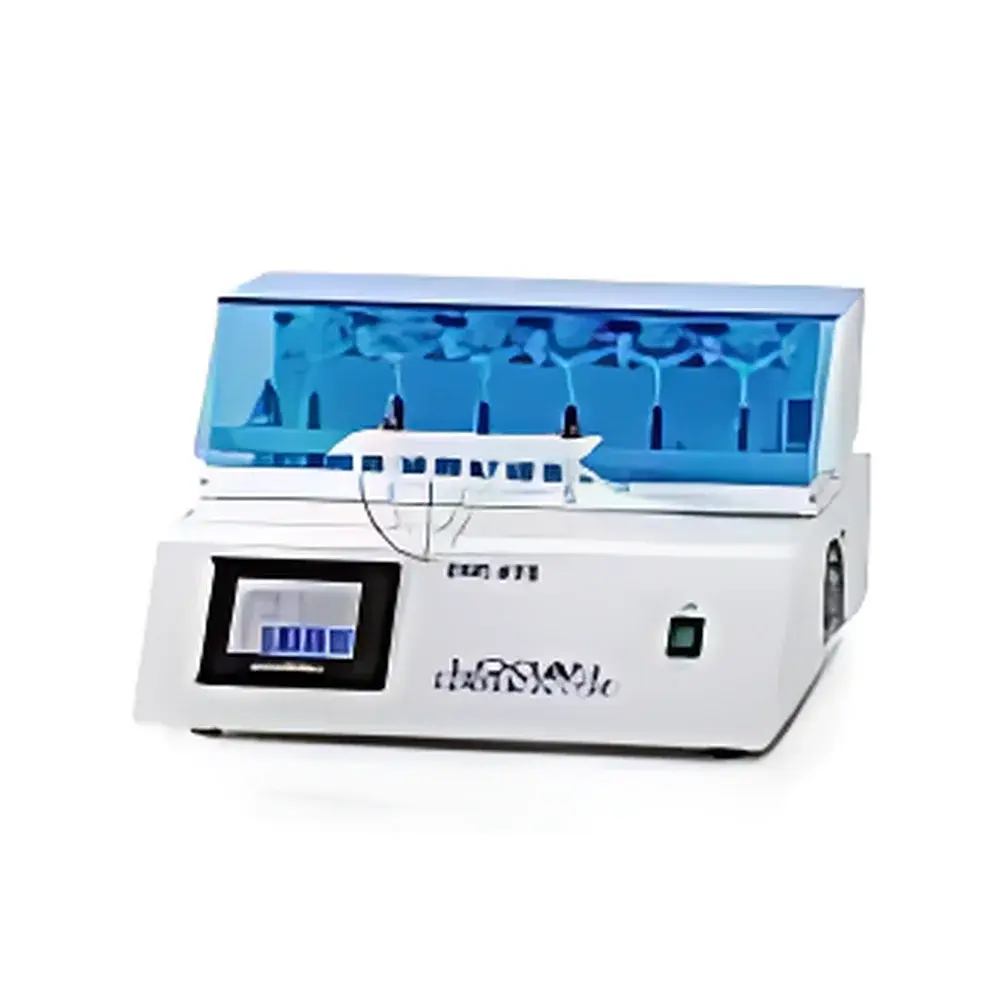
LOGAN DHC-6TD Dry-Heated Transdermal Diffusion System
| Brand | LOGAN |
|---|---|
| Origin | USA |
| Manufacturer Type | Authorized Distributor |
| Origin Category | Imported |
| Model | DHC-6TD |
| Pricing | Upon Request |
Overview
The LOGAN DHC-6TD Dry-Heated Transdermal Diffusion System is a precision-engineered, six-station in vitro diffusion apparatus designed for quantitative evaluation of drug permeation and release kinetics across biological or synthetic membranes. It operates on the principle of Franz diffusion cell methodology—comprising donor and receptor compartments separated by a membrane—where drug transport is governed by Fick’s laws of diffusion under controlled thermal and hydrodynamic conditions. Unlike conventional water-jacketed systems, the DHC-6TD employs a proprietary dry-heating architecture that eliminates condensation, minimizes thermal lag, and ensures rapid, uniform temperature stabilization across all six diffusion cells. This design is particularly suited for regulatory-compliant studies supporting ICH Q5C, USP “Drug Release”, and ASTM E2850–19 (Standard Guide for In Vitro Skin Permeation Testing). The system supports both static and dynamic diffusion protocols, enabling reproducible assessment of semi-solid dosage forms—including ointments, gels, creams, transdermal patches, lotions, sunscreens, and cosmetic formulations—under physiologically relevant conditions (32 ± 0.5 °C skin surface temperature).
Key Features
- Integrated automatic bubble evacuation mechanism: Removes trapped air from the donor-receptor interface prior to assay initiation, ensuring consistent membrane contact and eliminating artifact-induced variability in flux calculations.
- Dry-heating thermal control system: Utilizes Peltier-based heating elements with PID feedback loops to maintain receptor medium temperature within ±0.3 °C across all six stations—without water bath maintenance, evaporation drift, or cross-contamination risks.
- Modular, low-profile diffusion cell assembly: Features chemically resistant borosilicate glass and PTFE components; optimized geometry reduces mechanical stress during disassembly and enables full visual inspection and rapid cleaning between runs.
- Real-time receptor compartment temperature monitoring: Each station includes a calibrated Pt100 sensor embedded in the receptor chamber wall, with data logged at 1-second intervals and synchronized to the central controller.
- Light-blocking, thermally insulated lid assembly: Minimizes photodegradation of light-sensitive actives and reduces ambient heat exchange, critical for stability-indicating assays per ICH Q1B.
- Interchangeable silicone gasket kits: Available in multiple inner diameters (e.g., 0.6 cm², 1.0 cm², 1.77 cm²) to standardize dosing area and enable direct correlation with pharmacokinetic modeling inputs.
Sample Compatibility & Compliance
The DHC-6TD accommodates a broad range of sample viscosities and rheological profiles—from low-viscosity solutions (10⁴ mPa·s)—without compromising membrane integrity or donor-phase homogeneity. Compatible membrane types include human epidermis (fresh/frozen), porcine ear skin, Strat-M® synthetic membrane, and regenerated cellulose (RC) for method development. All wetted materials comply with USP Class VI biocompatibility standards. The system meets essential requirements for GLP-compliant laboratories: audit-trail enabled operation logs, user-access controls, electronic signature support (per FDA 21 CFR Part 11), and traceable calibration records for temperature and volume delivery.
Software & Data Management
Controlled via LOGAN’s WinDHC v4.2 software (Windows 10/11 compatible), the DHC-6TD supports scheduled sampling, programmable agitation profiles, and automated data acquisition from integrated temperature sensors and optional peripheral modules. Raw time-series concentration data are exported in CSV and Excel-compatible formats, with built-in tools for zero-order/first-order kinetic fitting, apparent permeability coefficient (Kp) calculation, and lag-time derivation. Software validation documentation (IQ/OQ/PQ protocols) is available upon request to support regulated submissions to FDA, EMA, or PMDA.
Applications
- In vitro release testing (IVRT) of generic topical products per FDA Guidance for Industry (2022).
- Comparative permeation studies for biosimilar transdermal patch development.
- Formulation screening of penetration enhancers (e.g., terpenes, fatty acids, surfactants).
- Stability-indicating permeation assays under oxidative or UV stress conditions.
- Regulatory dossier preparation for ANDA, NDA, and CPMP/QWP/037/014-compliant dossiers.
- Cosmetic efficacy validation per ISO 18562-3 (biocompatibility of breathing gas pathways) and SCCS Notes of Guidance.
FAQ
Does the DHC-6TD support automated sampling integration?
Yes—via optional third-party autosamplers (e.g., Gilson GX-271 or CTC Analytics HTC-PAL) using TTL-triggered I/O ports.
Can receptor medium temperature be independently adjusted per station?
No—temperature is uniformly controlled across all six stations to ensure inter-cell comparability; this aligns with USP recommendations for multi-cell parallel testing.
Is the system compliant with 21 CFR Part 11 for electronic records?
Yes—WinDHC v4.2 includes role-based access, electronic signatures, and immutable audit trails meeting ALCOA+ principles.
What membrane thicknesses are supported without modification?
Standard configuration accommodates membranes 0.2–1.0 mm thick; custom spacers are available for thicker excised tissue preparations.
How is system performance verified post-installation?
LOGAN provides an IQ/OQ package including temperature uniformity mapping, volume delivery accuracy verification (±1% tolerance), and bubble evacuation efficacy test protocol.






