
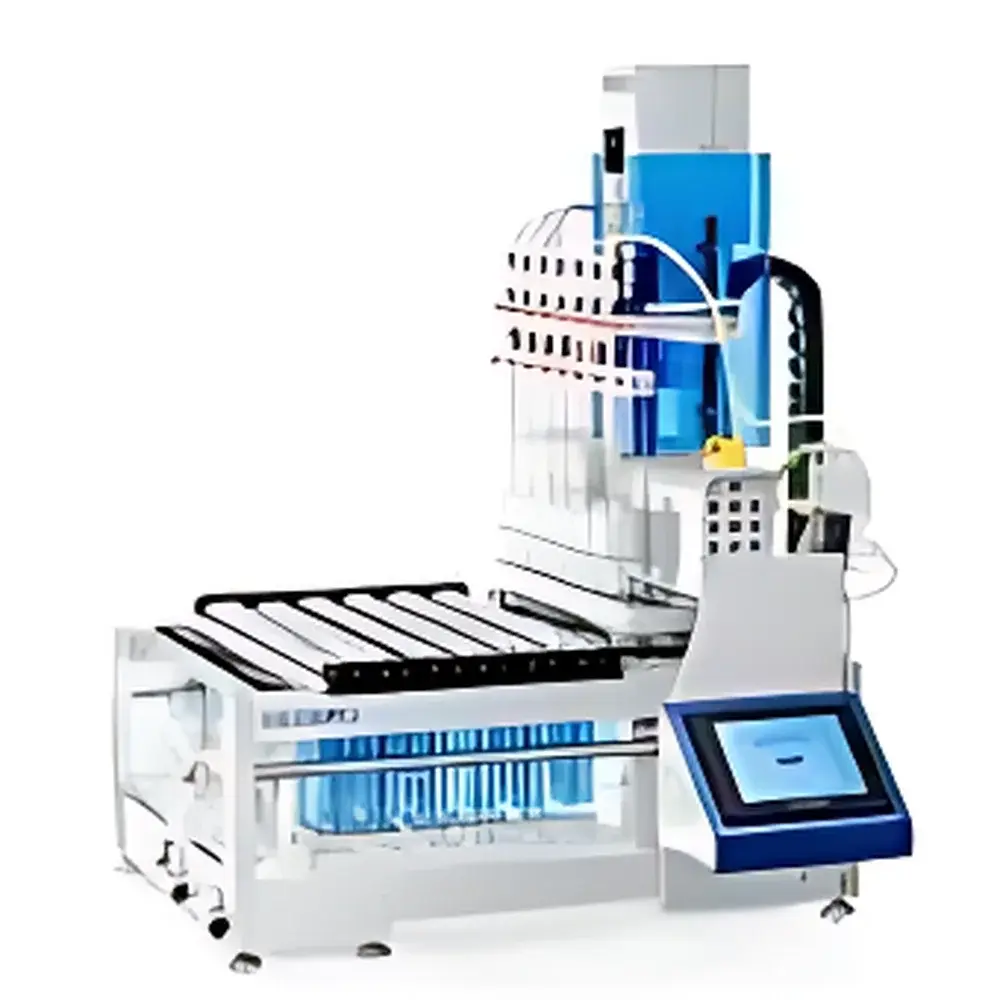
LOGAN DISSOIII-7 Reciprocating Cylinder & Reciprocating Holder Dissolution Tester
| Brand | LOGAN |
|---|---|
| Origin | USA |
| Model | DISSOIII-7 |
| Instrument Type | Online Dissolution Tester |
| Vessel Configuration | 8 vessels/row × 6 rows OR 12 vessels/row × 12 rows |
| Temperature Range | 20–60°C |
| Temperature Accuracy | ±0.1°C |
| Water Bath Temperature Range | Ambient to 45°C |
| Water Bath Temperature Resolution | 0.1°C |
| Water Bath Volume | 28 L |
| Compliance | USP <711> (Method 3 & Method 7) |
| Data Integrity | FDA 21 CFR Part 11-compliant audit trail and three-tier user access control |
Overview
The LOGAN DISSOIII-7 Reciprocating Cylinder & Reciprocating Holder Dissolution Tester is a purpose-built, modular platform engineered for precise and reproducible drug release testing under United States Pharmacopeia (USP) Method 3 (Reciprocating Cylinder) and Method 7 (Reciprocating Holder). Unlike conventional rotating paddle or basket systems, the DISSOIII-7 employs linear oscillatory motion—vertically reciprocating cylinders or holders—to simulate physiologically relevant mechanical stress on dosage forms that are unsuitable for rotational agitation. This includes extended-release tablets, enteric-coated granules, soft gelatin capsules, chewable formulations, transdermal patches, implantable devices, drug-eluting stents, and intravascular balloon catheters. Its dual-mode architecture enables laboratories to maintain a single instrument platform across diverse product development and quality control workflows while ensuring strict adherence to regulatory dissolution testing requirements.
Key Features
- Modular dual-mode operation supporting both USP Method 3 (cylinder-based immersion) and USP Method 7 (holder-mounted device fixation) within one integrated chassis.
- High-precision temperature control system with ±0.1°C accuracy over the full 20–60°C operational range; water bath maintains stable thermal uniformity up to 45°C with 0.1°C resolution and 28 L capacity.
- Evaporation-minimizing sealed lid design featuring inert gasketing and vapor-trap geometry—reduces solvent loss by >90% compared to open-bath configurations and eliminates cross-contamination between vessels.
- Programmable reciprocation frequency and stroke length: users may define discrete amplitude (e.g., 10–30 mm) and cycle rate (e.g., 5–30 cycles/min) per row or group, enabling systematic evaluation of hydrodynamic impact on release kinetics.
- Optically transparent acrylic water bath chamber allows real-time visual monitoring of tablet disintegration, patch adhesion, or device deployment without interrupting test conditions.
- FDA 21 CFR Part 11–compliant software architecture with electronic signatures, immutable audit trail, and three-level role-based access control (Administrator, Supervisor, Analyst).
Sample Compatibility & Compliance
The DISSOIII-7 accommodates heterogeneous solid dosage forms and advanced delivery systems requiring non-rotational hydrodynamic stress. It supports standard USP-certified dissolution vessels (e.g., 1000 mL cylindrical glass vessels), as well as custom fixtures for transdermal patches, subcutaneous implants, and vascular devices. All mechanical and thermal parameters comply with USP , ICH Q5D, and ISO 17025–accredited laboratory practices. The system meets GLP/GMP documentation standards for method validation, equipment qualification (IQ/OQ/PQ), and routine QC release testing in regulated pharmaceutical environments.
Software & Data Management
The embedded control interface provides intuitive setup of reciprocation profiles, temperature ramping, sampling triggers, and alarm thresholds. Raw sensor data—including real-time temperature, position feedback, and cycle count—is timestamped and stored in encrypted binary format. Export options include CSV, PDF, and XML for integration into LIMS or statistical analysis platforms. Audit logs record all user actions, parameter changes, and system events with tamper-proof hashing. Electronic signatures adhere to ALCOA+ principles (Attributable, Legible, Contemporaneous, Original, Accurate, Complete, Consistent, Enduring, Available), satisfying regulatory expectations for data integrity during inspections.
Applications
- Development and validation of extended-release oral dosage forms where rotational methods induce artificial erosion or aggregation.
- In vitro release testing (IVRT) of transdermal patches under simulated skin contact conditions using USP Method 7.
- Dissolution-permeation correlation studies when interfaced with parallel artificial membrane permeability assay (PAMPA) or Franz diffusion cells.
- Comparative biorelevant dissolution profiling of generic versus reference listed drugs (RLDs) to support bioequivalence (BE) justification.
- Stability-indicating release assessment of implantable polymers and resorbable scaffolds under physiological pH and temperature gradients.
- Automated multi-point sampling integration with UV-Vis spectrophotometers, HPLC autosamplers, fiber-optic probes, or dilution modules for end-to-end dissolution analytics.
FAQ
What regulatory standards does the DISSOIII-7 support?
It is fully compliant with USP Methods 3 and 7, and its software architecture satisfies FDA 21 CFR Part 11, EU Annex 11, and WHO TRS 992 data integrity requirements.
Can the system be integrated with analytical instruments?
Yes—standardized analog/digital I/O and RS-232/USB interfaces enable seamless synchronization with UV, HPLC, fiber-optic sensors, and automated dilution platforms.
Is camera-based release monitoring available as an option?
An optional high-resolution time-lapse imaging module with adjustable LED illumination and synchronized frame capture is available for documenting morphological changes during dissolution.
What vessel configurations are supported?
Two configurations are offered: 48-vessel (8×6) for high-throughput screening and 144-vessel (12×12) for large-scale comparative studies or matrix-based experimental designs.
Does the system support temperature ramping protocols?
Yes—the controller supports programmable linear or stepwise temperature ramps between 20°C and 60°C, with dwell time and rate definition per test phase.






