
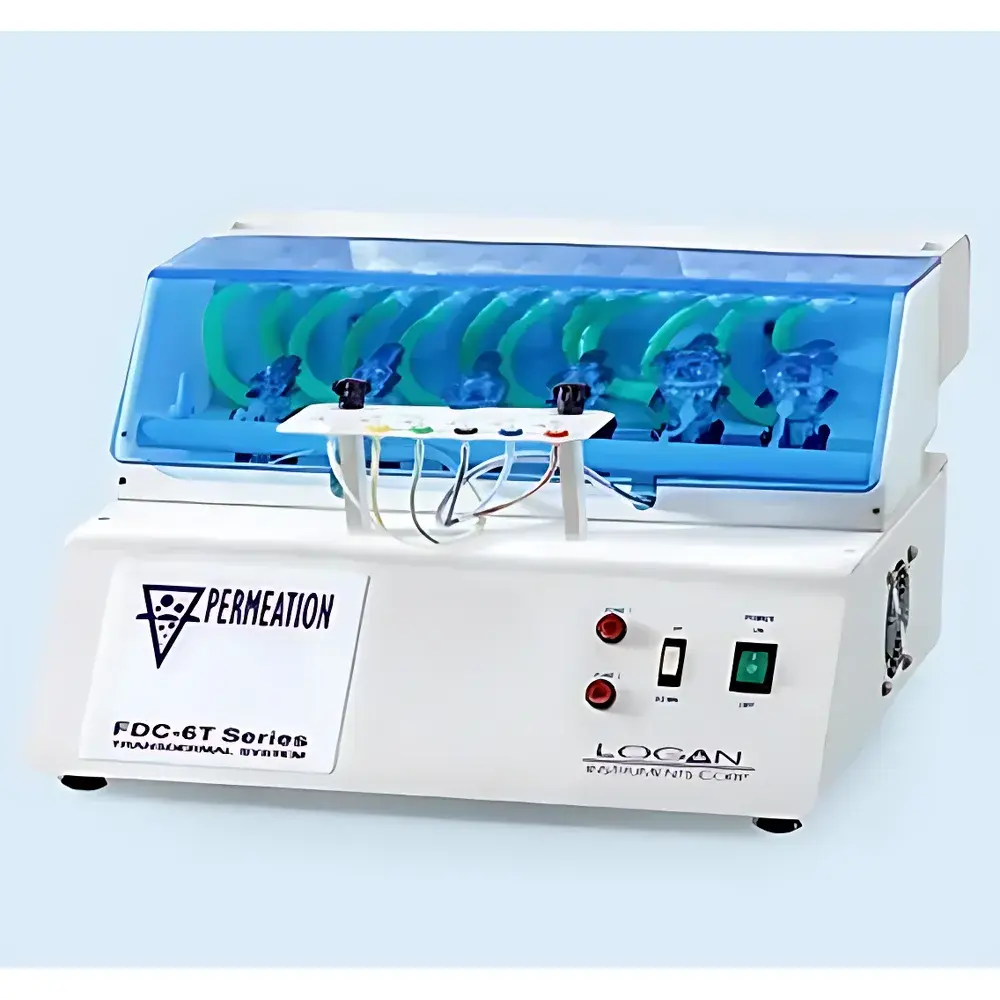
LOGAN FDC-6 Vertical Transdermal Diffusion System
| Brand | LOGAN |
|---|---|
| Origin | USA |
| Manufacturer Type | Authorized Distributor (Non-OEM) |
| Product Origin | Imported |
| Model | FDC-6 |
| Pricing | Available Upon Request |
Overview
The LOGAN FDC-6 Vertical Transdermal Diffusion System is an engineered platform for in vitro assessment of drug permeation and release kinetics across biological or synthetic membranes under physiologically relevant conditions. Designed in strict alignment with USP General Chapter <724> Transdermal Delivery Systems and ICH Q5C stability guidance, the FDC-6 implements a vertical Franz-type diffusion cell configuration with water-jacketed temperature control to maintain precise thermal equilibrium (±0.2 °C) throughout the donor–receiver interface. Its upright orientation minimizes hydrostatic pressure artifacts, eliminates air bubble entrapment at the membrane surface, and ensures consistent donor-phase volume geometry—critical for reproducible flux calculations in regulatory submissions. The system supports both static and flow-through receiver modes and is routinely deployed in preformulation screening, formulation optimization, and comparative bioavailability studies during topical and transdermal product development.
Key Features
- Vertical Franz diffusion cell architecture compliant with USP <724> and Ph. Eur. 2.9.17 methodologies
- Dual-zone independent temperature control: two thermally isolated compartments, each accommodating three diffusion cells (total six cells)
- Water-jacketed cell bodies with integrated circulation manifolds for uniform thermal distribution and minimal gradient deviation (<0.3 °C across cell height)
- Modular silicone gasket kit with standardized inner diameters (1.0 cm, 1.5 cm, and 2.0 cm) enabling precise dosing volume control and membrane area definition
- Stainless-steel donor chambers with PTFE-coated internal surfaces to prevent adsorption of lipophilic actives
- Receiver vessels equipped with magnetic stirrers featuring speed calibration traceability to NIST standards
- Compatible with standard 12-mm and 18-mm diameter synthetic membranes (e.g., Strat-M®, Epiderm™, cellulose ester) and excised human/porcine skin
Sample Compatibility & Compliance
The FDC-6 accommodates a broad spectrum of semi-solid and topical dosage forms including ointments, gels, creams, lotions, emulsions, sunscreens, patches, masks, and liquid washes. Its mechanical design permits direct application of viscous formulations without shear-induced phase separation. All wetted components are constructed from USP Class VI-certified materials and comply with ISO 10993-5 cytotoxicity requirements. The system meets essential elements of FDA 21 CFR Part 11 for electronic records when paired with validated LOGAN WinControl™ software (v5.2+), supporting audit trails, user access levels, and electronic signatures. It is routinely referenced in protocols aligned with ASTM E2577 (Standard Practice for In Vitro Release Testing of Transdermal Delivery Systems) and supports GLP-compliant study execution per OECD Principles of Good Laboratory Practice.
Software & Data Management
When operated with LOGAN WinControl™ software, the FDC-6 enables automated temperature logging, real-time receiver sampling scheduling, and time-stamped concentration tracking via integrated HPLC/GC interface triggers. Data files are generated in .csv and .xlsx formats with embedded metadata (cell ID, membrane type, donor mass, ambient RH, operator ID). The software enforces version-controlled method templates, supports multi-user role assignment (Administrator, Analyst, Reviewer), and maintains immutable audit trails for all parameter changes and data exports—fully satisfying 21 CFR Part 11 Subpart B requirements for record retention and integrity. Exported datasets conform to CDISC SEND standards for seamless integration into pharmacokinetic modeling platforms (e.g., Phoenix WinNonlin®).
Applications
- Permeation rate quantification of APIs through synthetic and biological membranes under sink/non-sink conditions
- Comparative release profiling of generic versus reference listed drugs (RLDs) for ANDA submissions
- Excipient effect analysis on stratum corneum partitioning and lag-time reduction
- Stability-indicating release testing across accelerated and long-term storage conditions
- In vitro–in vivo correlation (IVIVC) model development for transdermal patch products
- Regulatory dossier preparation for FDA, EMA, PMDA, and Health Canada submissions
FAQ
Is the FDC-6 compatible with human epidermal membrane models such as EpiDerm™ or SkinEthic™?
Yes—the system’s vertical geometry and low-torque stirring ensure minimal mechanical disruption to reconstructed human epidermis tissues.
Can the dual-zone temperature control operate at different setpoints simultaneously?
No—both zones share a common recirculating chiller unit and must be maintained at identical temperatures to preserve thermal symmetry across all six cells.
What is the minimum required sample volume for donor-phase application using the 1.0-cm gasket?
Approximately 15–20 µL, depending on formulation viscosity and spreadability characteristics.
Does LOGAN provide IQ/OQ/PQ documentation packages for the FDC-6?
Yes—validated qualification protocols and executed reports are available upon request and align with ASTM E2500-13 and EU Annex 15 guidelines.
Is the FDC-6 suitable for non-pharmaceutical applications such as cosmetic ingredient penetration testing?
Yes—it is widely used in personal care R&D for assessing active delivery efficiency of vitamins, peptides, and botanical extracts across stratified membrane models.
Related Products







