
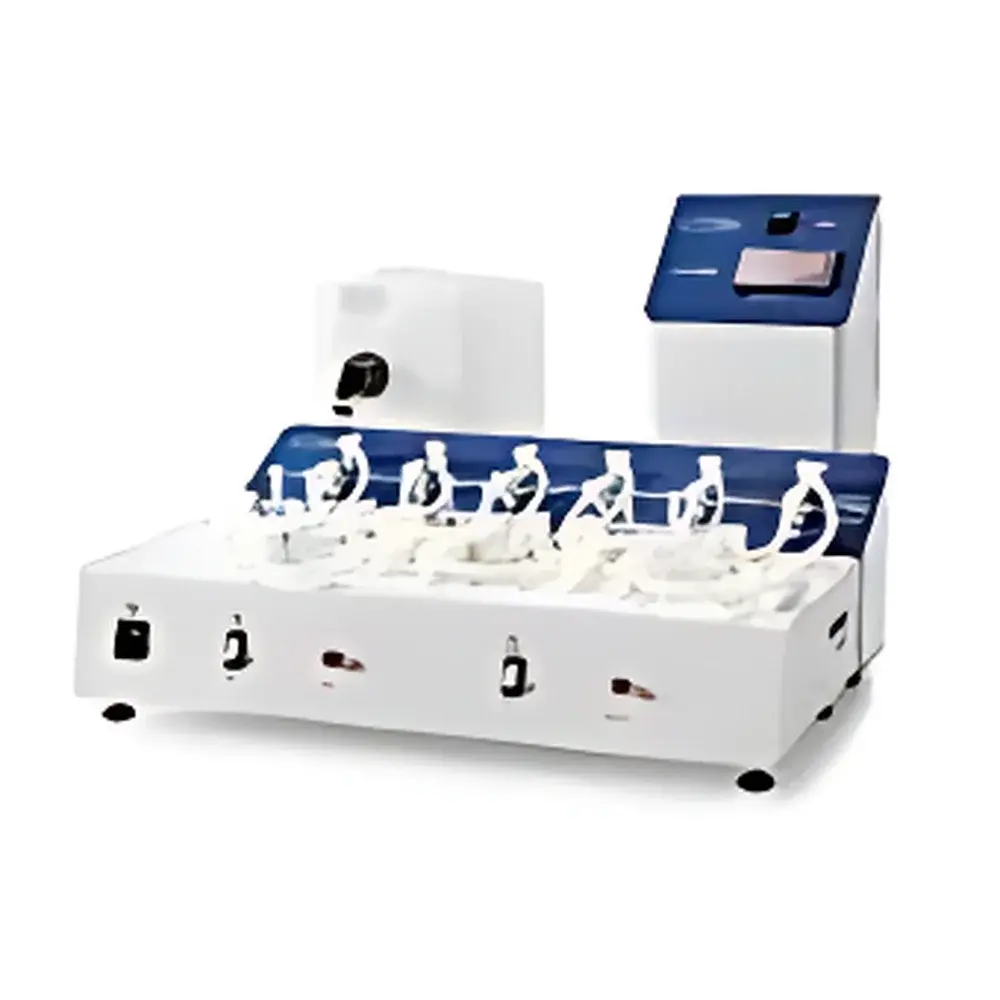
LOGAN SDC-6 Horizontal Transdermal Diffusion System
| Brand | LOGAN |
|---|---|
| Origin | USA |
| Model | SDC-6 |
| Configuration | Water-jacketed horizontal diffusion cell system |
| Temperature Control | Dual-zone independent heating (each zone controls 3 diffusion cells) |
| Cell Orientation | Horizontal |
| Primary Application | In vitro permeation testing (IVPT) of ophthalmic solutions, lotions, washes, and topical formulations |
| Compliance Context | Designed to support USP <724> and OECD TG 428 guidelines |
Overview
The LOGAN SDC-6 Horizontal Transdermal Diffusion System is an engineered platform for in vitro permeation testing (IVPT) of topical and ophthalmic dosage forms. Unlike vertical Franz-type diffusion cells, the SDC-6 employs a horizontal orientation of diffusion cells—minimizing air entrapment at the membrane–donor interface and improving reproducibility for low-viscosity liquids such as eye drops, aqueous lotions, and cleansing solutions. The system operates on the principle of passive diffusion across synthetic or biological membranes (e.g., Strat-M®, pig ear skin, or human epidermis), with analyte quantification typically performed via HPLC, LC-MS, or UV-Vis spectroscopy post-sampling. Its water-jacketed thermal architecture ensures precise, uniform temperature maintenance at physiologically relevant conditions (typically 32 °C for skin or 34 °C for ocular models), critical for mimicking in vivo barrier function and kinetic behavior.
Key Features
- Horizontal cell configuration reduces bubble formation and interfacial artifacts during dosing of volatile or low-surface-tension formulations—enhancing data fidelity in early-stage formulation screening.
- Integrated dual-zone water-jacketed heating system allows independent temperature control for two distinct experimental groups (e.g., active vs. vehicle control; different membrane types), each supporting three diffusion cells simultaneously.
- Stainless steel construction with corrosion-resistant fluid pathways accommodates aqueous, alcoholic, and surfactant-containing donor media without degradation or leaching.
- Modular cell design enables rapid assembly/disassembly and compatibility with standard 12-mm or 18-mm diameter diffusion membranes—supporting both regulatory-compliant and exploratory assay formats.
- Thermal stability maintained within ±0.2 °C across all six positions under steady-state operation, verified per ASTM E2252-19 calibration protocols.
Sample Compatibility & Compliance
The SDC-6 supports a broad range of sample types including sterile ophthalmic solutions, hydroalcoholic gels, micellar washes, nanoemulsions, and polymer-based film-forming systems. It is routinely deployed in GLP-compliant laboratories conducting IVPT studies aligned with FDA guidance for topical product bioequivalence and OECD Test Guideline 428 (Skin Absorption: In Vitro Method). While not itself a regulated device, its mechanical design and thermal performance are validated to meet the physical requirements outlined in USP Chapter “Drug Release” for transdermal and topical semisolid dosage forms. All wetted surfaces comply with USP Class VI biocompatibility standards, and the system integrates seamlessly into workflows requiring 21 CFR Part 11–compliant data capture when paired with validated third-party acquisition software.
Software & Data Management
The SDC-6 operates as a hardware platform without embedded firmware or proprietary control software. Temperature setpoints and monitoring are managed externally via calibrated digital thermoregulators (e.g., Omega CNi16D or equivalent), with real-time logging supported through analog outputs or RS-485 interfaces. Users commonly integrate the system with LabVIEW, MATLAB, or custom Python-based acquisition tools to timestamp sampling events, correlate temperature drift with flux calculations, and generate audit-ready reports. Full traceability—including operator ID, calibration certificate numbers, membrane lot tracking, and environmental logs—is maintained through laboratory information management systems (LIMS) or electronic lab notebooks (ELN) compliant with ISO/IEC 17025 and ALCOA+ principles.
Applications
- Comparative IVPT of generic versus reference listed drug (RLD) ophthalmic solutions under identical membrane and receptor conditions.
- Evaluation of penetration enhancers (e.g., oleic acid, ethanol, terpenes) on stratum corneum permeability using excised porcine or human skin.
- Stability-indicating permeation assays assessing formulation degradation effects on drug delivery kinetics over time.
- Regulatory submission support for ANDAs, NDAs, and M4 modules requiring robust in vitro release and permeation datasets.
- Academic and industrial research into structure–permeability relationships of novel chemical entities across anatomical barriers.
FAQ
Is the SDC-6 compatible with human cadaver skin or reconstructed epidermal models?
Yes—the horizontal geometry accommodates variably hydrated membranes, including cryopreserved human epidermis (e.g., EpiDerm™, SkinEthic™) and fresh/frozen porcine or rat skin, provided mounting fixtures are appropriately sized.
Can the dual-zone controller maintain different temperatures in each zone?
Yes—each zone features independent PID-controlled heating and PT100 sensing, enabling simultaneous testing at 32 °C (skin) and 34 °C (ocular) without cross-talk.
Does LOGAN provide validation documentation for the SDC-6?
LOGAN supplies equipment qualification templates (IQ/OQ), dimensional drawings, and material certifications; full PQ must be conducted by the end user per internal SOPs and applicable regulatory frameworks.
What membrane sizes are supported out-of-the-box?
Standard configurations support 12-mm and 18-mm diameter membranes; custom adapters for 25-mm cells are available upon request.
Is the water jacket filled manually or connected to a recirculating chiller?
It is designed for connection to an external temperature-controlled circulator (e.g., Huber Ministat or similar) to ensure long-duration thermal stability and minimize evaporation-related drift.





