
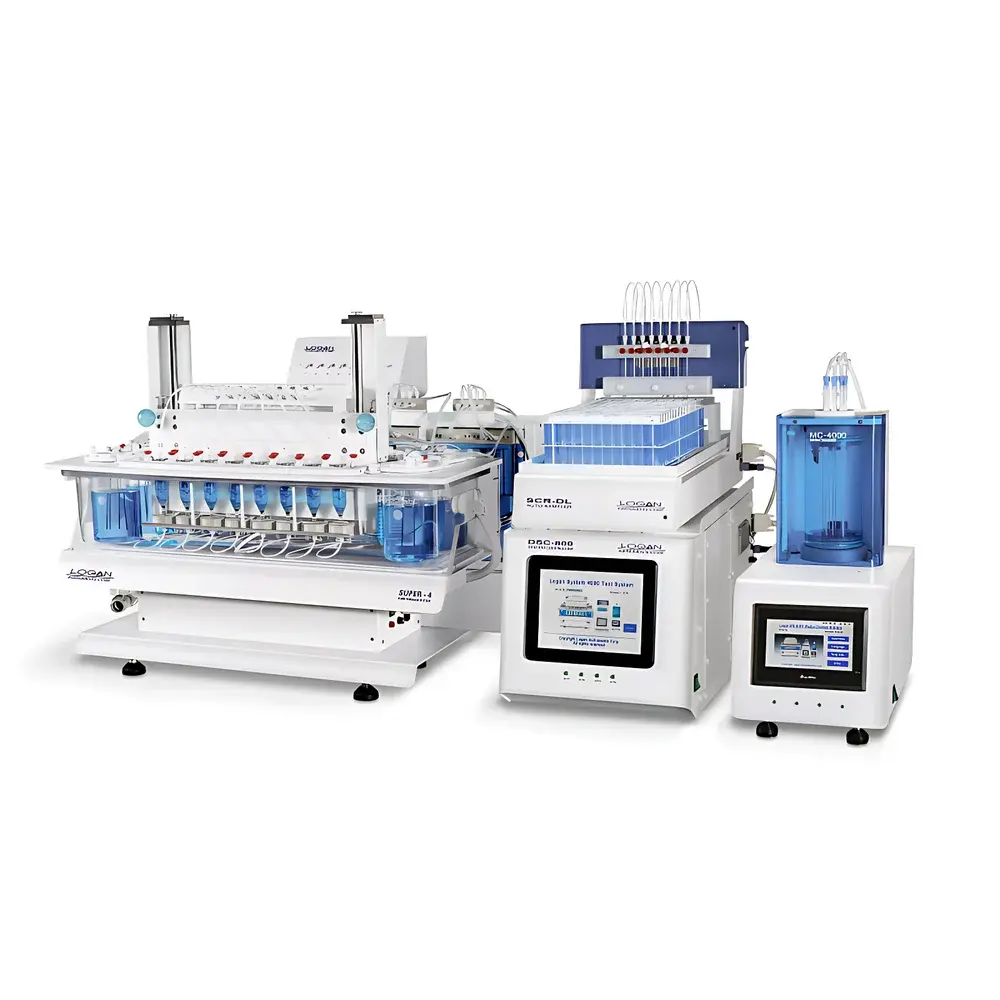
LOGAN SYSTEM 4000 USP Flow-Through Dissolution Tester
| Brand | LOGAN |
|---|---|
| Origin | USA |
| Model | SYSTEM 4000 |
| Instrument Type | Online Flow-Through Dissolution System |
| Temperature Range | Ambient to 45 °C |
| Temperature Accuracy | ±0.1 °C |
| Flow Rate Control Modes | Constant Flow or Pulsed Flow (user-selectable) |
| Flow Cell Options | 12 mm, 22.6 mm, Powder Cell, Suppository Cell, Granule Cell |
| Number of Parallel Flow Channels | 8 |
| Bath Volume | 20 L |
| Bath Temperature Resolution | 0.1 °C |
| Shaft Wobble Tolerance (Paddle/Rotating Basket) | ≤1 mm |
| Motor Speed | 500 rpm (50 Hz), 600 rpm (60 Hz) |
| Compliance | Fully compliant with USP <4>, USP <711>, and FDA 21 CFR Part 11 requirements for audit trail, electronic signature, and data integrity |
Overview
The LOGAN SYSTEM 4000 is a fully automated, eight-channel online flow-through dissolution testing system engineered for rigorous pharmaceutical development and quality control in accordance with United States Pharmacopeia (USP) Chapter <4> — the standardized methodology for flow-through cell dissolution testing. Unlike traditional basket or paddle apparatuses (USP <711>), the SYSTEM 4000 employs a hydrodynamically controlled laminar flow regime through precision-machined dissolution cells, enabling quantitative assessment of drug release from challenging dosage forms including poorly soluble compounds, extended-release matrices, implants, transdermal patches, and highly viscous or particulate suspensions. Its modular architecture integrates peristaltic or syringe-based fluid handling, real-time temperature monitoring at both bath and cell levels, and programmable media delivery protocols — all synchronized via embedded microcontroller logic to ensure high reproducibility across method transfers and regulatory submissions.
Key Features
- Eight independent flow-through channels with individual solubilization cell mounting stations, supporting parallel testing under identical or differentiated experimental conditions.
- Multi-format cell compatibility: standardized 12 mm and 22.6 mm cylindrical cells, plus specialized configurations for powders, suppositories, granules, and semi-solids — each featuring integrated tower-style filtration to minimize tubing occlusion and maintain consistent flow resistance.
- Dual-mode fluid delivery: selectable constant-flow (volumetrically precise) or pulsed-flow operation, configurable per channel to emulate physiological peristalsis or simulate gastric/intestinal transit dynamics.
- Real-time, in-cell temperature sensing using calibrated Pt100 probes mounted directly within each flow cell — decoupled from water bath readings to eliminate thermal lag and ensure accurate correlation between measured dissolution rate and thermodynamically defined solubility limits.
- Integrated solvent pre-warming loop and insulated transfer lines mitigate enthalpic losses during media transport, preserving set-point temperature stability (±0.1 °C) at the dissolution interface even over extended run durations (>24 h).
- Automated media switching capability enables sequential pH profiling — critical for evaluating enteric-coated tablets or pH-dependent release kinetics — without manual intervention or system shutdown.
Sample Compatibility & Compliance
The SYSTEM 4000 accommodates a broad spectrum of solid oral and non-oral dosage forms, including immediate- and modified-release tablets, capsules, pellets, osmotic pumps, buccal films, and implantable depot formulations. All mechanical tolerances — including shaft wobble (≤1 mm), rotational speed fidelity (±0.5 rpm), and bath temperature uniformity (±0.2 °C across 20 L volume) — conform to USP <4> dimensional and performance verification criteria. The system’s firmware and data management framework are validated for compliance with FDA 21 CFR Part 11, supporting role-based user access, immutable audit trails, electronic signatures, and secure data archiving aligned with ICH GCP, GLP, and GMP documentation standards.
Software & Data Management
Control and analysis are executed via LOGAN’s proprietary WinDiss software, a Windows-based platform designed for method development, instrument orchestration, and regulatory-grade reporting. It supports full method recall and versioning, time-stamped raw data logging (including temperature, flow rate, UV absorbance if coupled with optional spectrophotometer), and automated calculation of dissolution efficiency (DE), mean dissolution time (MDT), and similarity factor (f2). All electronic records retain metadata required for inspection readiness — including operator ID, timestamped parameter changes, calibration logs, and deviation annotations — ensuring traceability throughout the product lifecycle.
Applications
- Biorelevant dissolution profiling under fed/fasted state-simulating media conditions.
- Comparative dissolution testing for ANDA submissions and post-approval change assessments.
- Stability-indicating release studies of light- or oxygen-sensitive APIs using inert gas-purged flow paths.
- Early-stage formulation screening of nanosuspensions, amorphous solid dispersions, and lipid-based delivery systems.
- Regulatory support for IVIVC (in vitro–in vivo correlation) model development and validation.
FAQ
Does the SYSTEM 4000 meet USP <4> mechanical calibration requirements?
Yes — all mechanical parameters (cell alignment, shaft concentricity, flow rate accuracy, and temperature uniformity) are verified against USP <4> Appendix A specifications using NIST-traceable standards.
Can the system interface with third-party HPLC or UV-Vis detectors?
Yes — analog and digital I/O ports support hardware synchronization and signal acquisition from external analytical modules, enabling real-time quantification without sample fraction collection.
Is remote monitoring and control supported?
The WinDiss software includes secure TCP/IP connectivity options for supervised remote operation, subject to site-specific network security policies and firewall configuration.
What validation documentation is provided with the system?
Each shipment includes Factory Acceptance Test (FAT) reports, Installation Qualification (IQ) templates, Operational Qualification (OQ) protocols aligned with ASTM E2503 and USP <1058>, and a complete electronic record of firmware revision history.





