
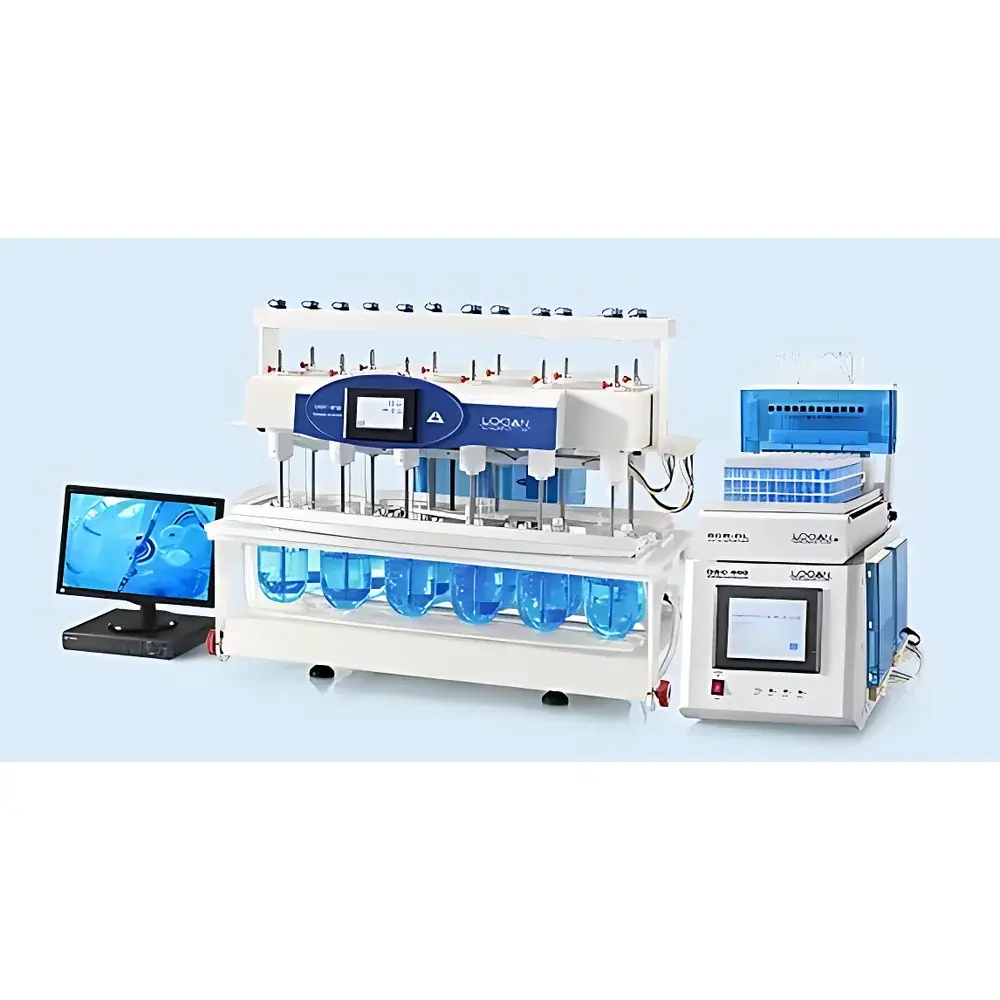
LOGAN SYSTEM 860CDL 12-Position Automated Sampling and Imaging Dissolution System
| Brand | LOGAN |
|---|---|
| Origin | USA |
| Manufacturer Type | Authorized Distributor |
| Origin Category | Imported |
| Model | SYSTEM 860CDL |
| Instrument Type | Online Dissolution System |
| Dissolution Vessels | 12 |
| Temperature Range | 20–60 °C |
| Temperature Accuracy | ±0.1 °C |
| Rotation Speed Range | 25–250 rpm (±1 rpm) |
| Paddle Wobble Amplitude | ≤0.5 mm |
| Basket Wobble Amplitude | ≤1.0 mm |
| Water Bath Temperature Range | Ambient to 45 °C |
| Water Bath Temperature Resolution | 0.1 °C |
| Water Bath Volume | 30 L |
Overview
The LOGAN SYSTEM 860CDL is a fully integrated, modular online dissolution testing platform engineered for regulatory-compliant, high-throughput solubility and release profiling of solid oral dosage forms. Built upon the Couette-flow principle and USP Apparatus 1 (basket) and Apparatus 2 (paddle) methodologies, it delivers precise hydrodynamic control across all 12 vessels simultaneously. The system combines mechanical dissolution hardware with real-time visual documentation—enabling correlation between physical disintegration behavior and quantitative analyte release kinetics. Designed for pharmaceutical development laboratories operating under ICH Q5, Q8, and Q9 frameworks, the SYSTEM 860CDL supports both early-stage formulation screening and late-phase bioequivalence (BE) studies requiring full auditability and process traceability.
Key Features
- Simultaneous operation of 12 dissolution vessels with independent temperature monitoring via 12 embedded Pt100 probes—ensuring vessel-to-vessel thermal uniformity within ±0.1 °C.
- High-stability drive mechanism delivering rotation speeds from 25 to 250 rpm with ±1 rpm accuracy; paddle wobble ≤0.5 mm and basket wobble ≤1.0 mm per USP <711> mechanical calibration requirements.
- Dual-stage filtration during automated sampling (0.45 µm pre-filter + optional 0.22 µm secondary filter), minimizing particulate carryover and protecting downstream analytical instrumentation.
- Integrated high-resolution imaging module with adjustable LED illumination and macro lens optics, enabling time-synchronized video capture of tablet erosion, capsule shell rupture, or gel matrix hydration in both basket and paddle configurations.
- 12-position syringe pump (SYP-12L, 10 mL capacity) with programmable aspiration/dispense cycles, temperature-matched media replenishment, and sample return functionality to maintain sink conditions.
- Comprehensive data integrity architecture: electronic signatures, role-based three-tier user permissions (Administrator/Supervisor/Operator), and full FDA 21 CFR Part 11–compliant audit trail generation—including timestamped event logs for parameter changes, sample triggers, and system alerts.
Sample Compatibility & Compliance
The SYSTEM 860CDL accommodates standard USP-compliant dosage forms—including immediate- and extended-release tablets, hard/soft gelatin capsules, suspensions, transdermal patches, and hydrophilic gels—across multiple dissolution apparatus types. With optional accessory kits, the system can be reconfigured for small-volume apparatus (e.g., mini-basket, flow-through cell), rotating cylinder, paddle-over-disc, and intrinsic dissolution testing per ASTM E2579 and ISO 10993-12. All thermal, mechanical, and fluidic subsystems are validated per USP <711>, <724>, and <1092>, and support GLP/GMP-aligned qualification protocols (IQ/OQ/PQ). Dual-lid dissolution vessel design reduces solvent evaporation by >90% over 6-hour runs at 37 °C, maintaining volume stability within ±1% of nominal fill level.
Software & Data Management
Controlled via DSC-800 system controller with embedded Windows OS and LOGAN Dissolution Suite v5.x, the platform provides intuitive workflow configuration, real-time graphing of cumulative release profiles, and export-ready data formatting (CSV, PDF, XML). Software modules include automated method sequencing, adaptive sampling logic based on dissolution rate thresholds, and seamless integration with LIMS environments via OPC UA or HL7 interfaces. Remote monitoring is supported through secure HTTPS-enabled web dashboard and optional mobile application access—allowing protocol review, alarm acknowledgment, and status verification without local workstation login. All data files are cryptographically hashed and stored with immutable metadata tags, satisfying ALCOA+ principles for regulatory submissions to FDA, EMA, PMDA, and Health Canada.
Applications
- Comparative dissolution profiling for generic product development and Quality-by-Design (QbD) risk assessment.
- In vitro–in vivo correlation (IVIVC) model development using synchronized image-derived morphological metrics (e.g., surface area loss, fragmentation index) alongside HPLC/UV concentration data.
- Biopharmaceutics Classification System (BCS) and Biopharmaceutics Drug Disposition Classification System (BDDCS) classification support through robust sink condition maintenance and pH-shift testing capability.
- Permeation-dissolution coupling studies when interfaced with Franz diffusion cells or parallel artificial membrane permeability assays (PAMPA).
- Stability-indicating dissolution method validation per ICH Q2(R2), including specificity, linearity, accuracy, precision, and robustness assessments across multiple analysts and instruments.
FAQ
Does the SYSTEM 860CDL comply with FDA 21 CFR Part 11 requirements?
Yes—the system implements electronic signatures, audit trail logging with tamper-evident hashing, and configurable user access controls aligned with Part 11 Subpart B technical safeguards.
Can the imaging module be used with non-USP dissolution apparatus configurations?
Yes—custom mounting brackets and optical alignment tools support integration with flow-through cells, reciprocating holders, and other non-standard vessels.
Is remote software update capability available?
Firmware and application updates are delivered via encrypted USB media or authenticated HTTPS download; no internet-facing ports are exposed on the controller.
What third-party analytical instruments can be directly interfaced?
Standard RS-232, USB-TTL, and Ethernet TCP/IP interfaces enable native communication with UV-Vis spectrophotometers, HPLC autosamplers, fiber-optic dissolution probes, and dilution workstations.
How is temperature uniformity verified across all 12 vessels?
Each vessel is equipped with a calibrated Pt100 sensor connected to an independent analog input channel; real-time deviation alerts trigger if any vessel exceeds ±0.2 °C from setpoint for >30 seconds.





