
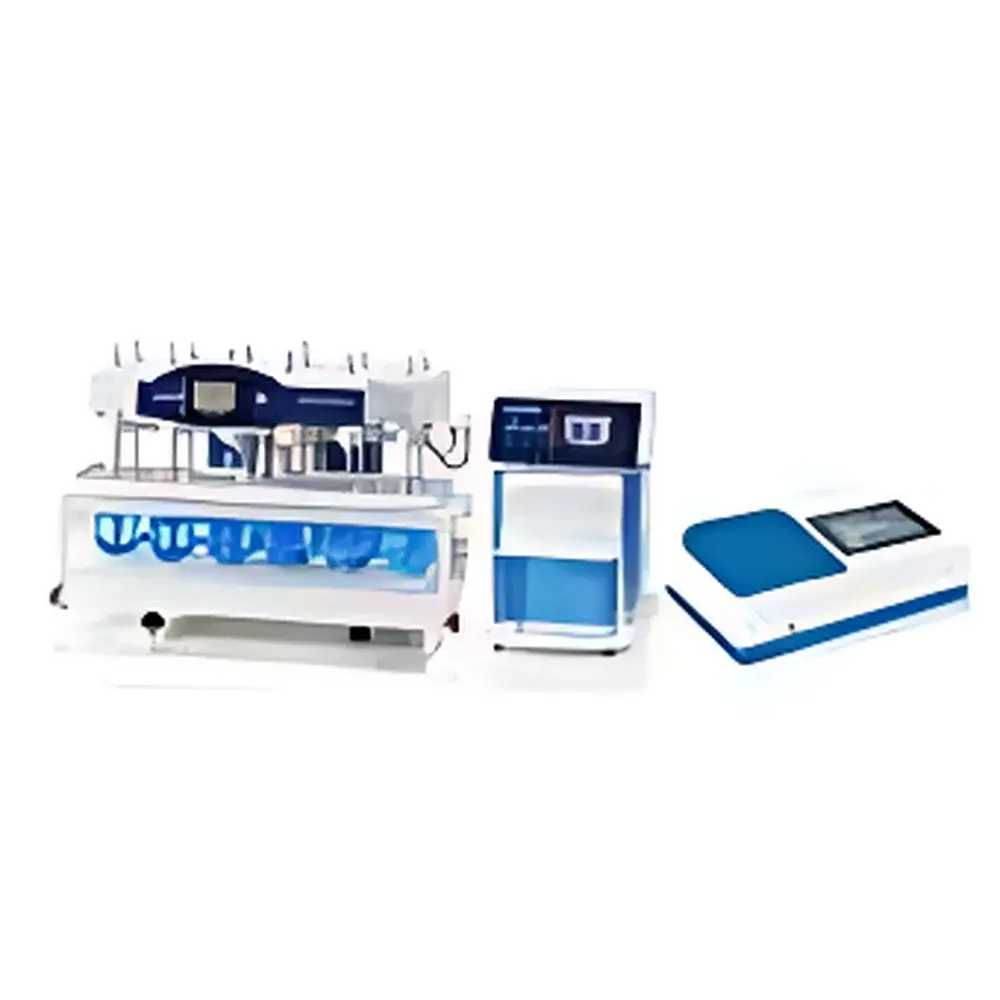
LOGAN SYSTEM UV 1900-12 Automated 12-Position Dissolution Testing System with Integrated UV Spectrophotometric Detection
| Brand | LOGAN |
|---|---|
| Origin | USA |
| Model | SYSTEM UV 1900-12 |
| Instrument Type | Online Dissolution Analyzer |
| Configuration | Modular, Fully Automated 12-Station System |
| Compliance | FDA 21 CFR Part 11 (Audit Trail, Electronic Signatures, Role-Based Access Control) |
| Detection Method | UV-Vis Spectrophotometry (Fixed-Wavelength or Scanning Mode) |
| Sampling Mechanism | High-Precision Peristaltic/Injection Pump (SYP-1200 Series) |
| Temperature Monitoring | 12 Independent RTD Probes per Vessel |
| Flow Cell Pathlengths | 2 mm, 5 mm, 10 mm (Standardized to USP <711>, <724>, <731>) |
| Filtration | Dual-Stage In-Line Filtration (0.45 µm + 0.22 µm) |
| Regulatory Alignment | USP, Ph. Eur., JP, ISO 16850, ASTM E2503 |
Overview
The LOGAN SYSTEM UV 1900-12 is a fully integrated, modular online dissolution testing platform engineered for pharmaceutical R&D, QC/QA laboratories, and regulatory submission support. It combines a 12-position automated dissolution apparatus (UDT series), a high-precision fluid handling module (SYP-1200 pump), a UV-Vis spectrophotometric detector, and validated control software into a single cohesive system. Unlike conventional offline dissolution workflows—where manual sampling, filtration, dilution, and cuvette-based analysis introduce variability—the SYSTEM UV 1900-12 performs real-time, in-line UV quantification directly from the dissolution medium, eliminating human intervention at the sampling stage. The system operates on the principle of Beer-Lambert law-based absorbance measurement, calibrated against reference standards traceable to NIST-certified materials. Its architecture supports both fixed-wavelength monitoring (e.g., 220 nm, 276 nm) and full-spectrum scanning (190–1100 nm), enabling method flexibility across diverse active pharmaceutical ingredients (APIs) with varying extinction coefficients and spectral profiles.
Key Features
- Simultaneous 12-vessel dissolution testing with independent temperature control (±0.2 °C) via 12 embedded RTD sensors—ensuring compliance with USP thermal uniformity requirements.
- Integrated dual-stage filtration (0.45 µm pre-filter + 0.22 µm sterilizing-grade membrane) minimizing particulate carryover and flow cell fouling during extended runs.
- Modular flow cells with selectable optical pathlengths (2 mm, 5 mm, 10 mm), allowing linear dynamic range extension without sample dilution—critical for low-dose or highly potent compounds.
- Automated pass/fail evaluation per USP monograph criteria, including Q-value assessment, time-point tolerance windows, and profile similarity metrics (f2 calculation).
- Real-time solubility monitoring with automatic curve generation, interpolation, and outlier detection based on statistical process control (SPC) thresholds.
- FDA 21 CFR Part 11-compliant software architecture featuring electronic signatures, immutable audit trails, and three-tiered user permission levels (Administrator, Supervisor, Analyst).
Sample Compatibility & Compliance
The SYSTEM UV 1900-12 accommodates all USP-approved dissolution apparatus types—including Apparatus 1 (basket), Apparatus 2 (paddle), Apparatus 3 (reciprocating cylinder), Apparatus 4 (flow-through cell), and specialized configurations such as paddle-over-disc and rotating disk. It supports solid oral dosage forms (tablets, capsules), semisolids (gels, patches), suspensions, and extended-release formulations. Each vessel is fitted with a dual-layer lid to suppress solvent evaporation (<1% mass loss over 8 h at 37 °C), maintaining sink conditions throughout the test duration. The system conforms to ISO 16850:2021 (pharmaceutical dissolution equipment performance verification) and undergoes routine mechanical calibration per ASTM E2503-22 (standard guide for validation of dissolution apparatus). All hardware and firmware are CE-marked and designed to meet GLP/GMP environmental controls for regulated environments.
Software & Data Management
The proprietary LOGAN Dissolution Suite v5.x provides end-to-end data lifecycle management—from method definition and instrument calibration to report generation and long-term archival. Raw absorbance spectra, temperature logs, pump actuation timestamps, and system error codes are timestamped and stored in encrypted SQLite databases with SHA-256 hashing. Audit trails record every user action, parameter change, and result modification—including before/after values—with retention configurable up to 10 years. Export options include PDF/A-2b compliant reports, CSV for statistical analysis (e.g., JMP, Minitab), and XML files compatible with LIMS integration (ASTM E1482, HL7). Remote monitoring is enabled via secure HTTPS API endpoints, supporting authenticated access through enterprise mobile applications (iOS/Android) with TLS 1.3 encryption.
Applications
This system is routinely deployed in comparative dissolution studies for bioequivalence assessments (FDA Guidance for Industry, 2023), formulation development of modified-release products, stability-indicating method validation, and quality-by-design (QbD) parameter mapping. Its precision enables detection of subtle formulation differences—such as polymer hydration kinetics in matrix tablets or surfactant-mediated solubilization in nanosuspensions—that correlate with in vivo performance. Regulatory submissions leveraging SYSTEM UV 1900-12 data have been accepted by the FDA, EMA, PMDA, and Health Canada for ANDAs, NDAs, and MAAs. It also serves as a reference platform for dissolution method transfer between sites and supports ICH Q5E comparability protocols following manufacturing process changes.
FAQ
Does the SYSTEM UV 1900-12 comply with FDA 21 CFR Part 11 for electronic records and signatures?
Yes—the system implements role-based authentication, digital signature capture with biometric or token-based verification, and tamper-evident audit trails meeting all technical and procedural requirements of Subpart B.
Can the UV detector be used for multi-wavelength or kinetic scan modes?
Yes—the spectrophotometer supports both fixed-wavelength quantitation and full-range scanning (190–1100 nm) with 1 nm resolution, programmable scan speed, and peak identification algorithms.
Is method transfer between different LOGAN dissolution systems supported?
Yes—method portability is ensured through standardized XML-based protocol definitions and vendor-validated inter-system equivalence testing per ASTM E2503 Annex A3.
What maintenance routines are required for sustained regulatory compliance?
Daily: Flow cell cleaning with IPA/water; Weekly: Pump tubing inspection and filter replacement; Quarterly: Photometric calibration using NIST-traceable holmium oxide and neutral density filters; Annually: Full mechanical verification per USP and ISO 16850.
How does the system handle turbid or particulate-containing samples?
Dual-stage filtration, adjustable flow rate control, and optional inline centrifugal separators mitigate clogging; absorbance correction algorithms compensate for light scattering effects in accordance with USP .






