
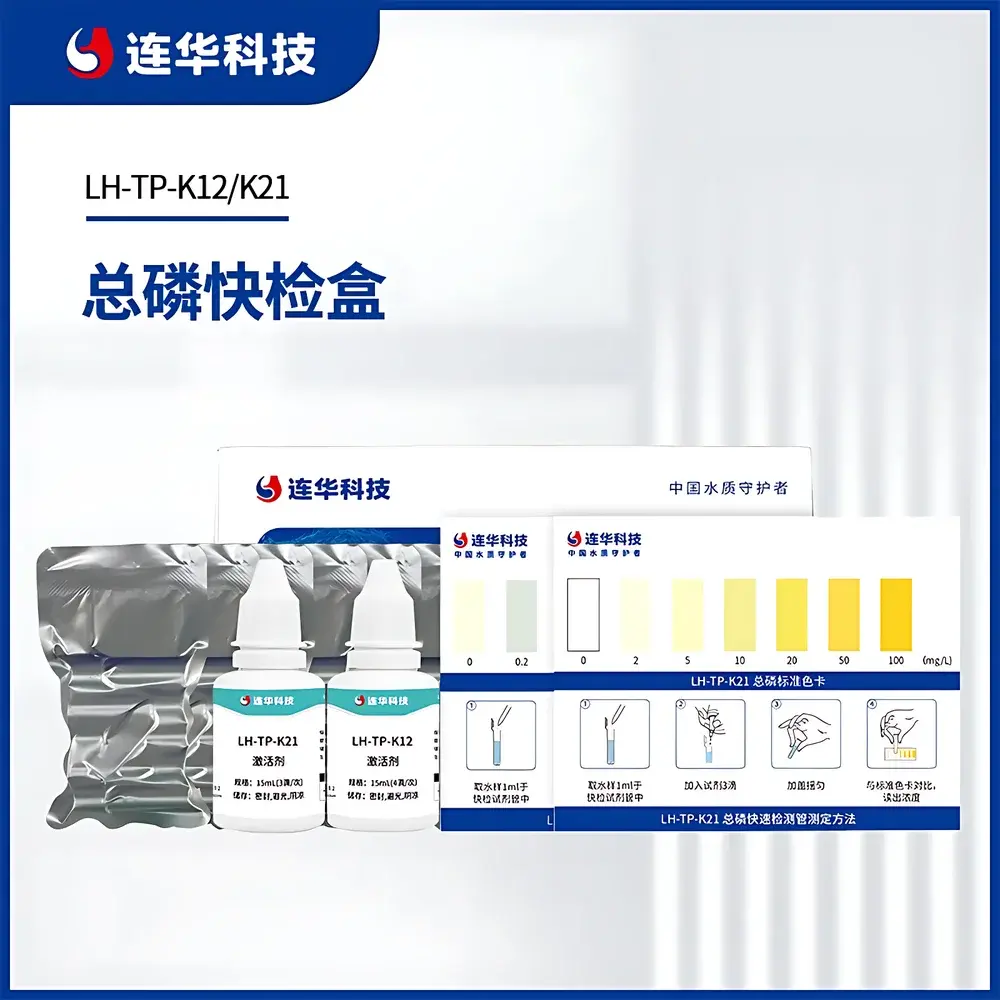
LoHua Technology Total Phosphorus Quick Test Kit (High-Range LH-TP-K21 / Low-Range LH-TP-K12)
| Brand | LoHua Technology |
|---|---|
| Origin | Beijing, China |
| Manufacturer Type | Direct Manufacturer |
| Country of Origin | China |
| Model | LH-TP-K21 / LH-TP-K12 |
| Pricing | Available Upon Request |
Overview
The LoHua Technology Total Phosphorus Quick Test Kit (LH-TP-K21 for high-range and LH-TP-K12 for low-range) is a field-deployable, colorimetric analytical system engineered for rapid, on-site quantification of total phosphorus (TP) in aqueous environmental samples. Based on the standard ascorbic acid–molybdate blue method (aligned with ISO 6878:2004 and EPA Method 365.4), the kit employs acid digestion followed by catalytic reduction to generate a stable phosphomolybdenum blue complex. Absorbance is measured visually against calibrated color standards under controlled lighting conditions, enabling semi-quantitative or quantitative estimation without instrumentation. Designed specifically for emergency response, mobile monitoring, and routine field screening, the kit delivers reliable TP data within 15–20 minutes—critical for assessing eutrophication risk, wastewater discharge compliance, and surface water quality during time-sensitive deployments.
Key Features
- Two-Tier Range Coverage: LH-TP-K12 supports detection from 0.01–1.00 mg/L P (low-range), while LH-TP-K21 extends linear response to 0.5–10.00 mg/L P (high-range), minimizing dilution errors and ensuring optimal sensitivity across diverse sample matrices.
- Optimized Reagent Formulation: Pre-measured, vacuum-sealed reagents eliminate weighing and volumetric errors; proprietary stabilizers extend shelf life to ≥18 months when stored at 2–8 °C, maintaining consistent color development kinetics.
- Standardized Visual Color Comparison: Includes a high-resolution, UV-stabilized color chart printed on inert polymer substrate, with 11 discrete reference hues per range—calibrated using NIST-traceable spectrophotometric validation (±0.02 ΔE*ab).
- Robust Field Packaging: Individual test units are housed in moisture-resistant aluminum-laminated pouches with desiccant packs; outer cartons meet ISTA 1A vibration and drop-test requirements for vehicle-mounted transport.
- Operator-Independent Protocol: Three-step procedure (digest → reduce → compare) requires no pipettes, timers, or power sources; validated for use by personnel with minimal training—ideal for first responders and community-level water stewards.
Sample Compatibility & Compliance
The kit is validated for use with raw and treated wastewater, river/lake water, stormwater runoff, and agricultural drainage. Interference testing confirms tolerance to common ions (Cl⁻ ≤ 2000 mg/L, SO₄²⁻ ≤ 500 mg/L, NO₃⁻ ≤ 50 mg/L) and suspended solids (< 50 mg/L). All reagents comply with REACH Annex XIV restrictions and carry SDS documentation per GHS classification. The methodology satisfies national regulatory requirements for preliminary TP assessment under China’s HJ 535–2009 and is referenced in technical guidance for GB 3838–2002 Class III–V water body monitoring. While not intended for final regulatory reporting, results are suitable for trend analysis, pass/fail triage, and triggering confirmatory ICP-OES or segmented flow analysis.
Software & Data Management
As a non-instrumental, visual-read system, the kit does not interface with software or digital platforms. However, LoHua provides a companion Excel-based Field Log Template (v2.1) supporting structured entry of sample ID, location (GPS coordinates), date/time, observer name, observed color match, estimated concentration, and notes on turbidity or interference. This log meets basic GLP documentation expectations and can be archived for internal QA review or audit preparation. For laboratories requiring electronic records compliant with FDA 21 CFR Part 11, LoHua recommends pairing kit use with their LH-TP300 benchtop photometer (optional add-on) for instrument-calibrated readings and encrypted data export.
Applications
- Rapid pre-screening of municipal wastewater effluent prior to discharge permitting verification
- Tactical monitoring during algal bloom events or nutrient loading incidents in reservoirs and estuaries
- On-the-go verification of phosphorus removal efficiency in decentralized treatment units (e.g., constructed wetlands, biofilters)
- Training and capacity-building for rural water committees and environmental NGOs conducting citizen science programs
- Baseline surveys in watersheds undergoing land-use change assessments (e.g., urban expansion, agricultural intensification)
- Quality assurance checks during routine maintenance of automated online TP analyzers
FAQ
What is the shelf life of unopened test kits?
Unopened LH-TP-K21 and LH-TP-K12 kits retain full performance for 18 months when stored between 2 °C and 8 °C in original packaging. Do not freeze.
Can these kits be used for seawater analysis?
Not recommended without matrix-specific validation; high chloride concentrations (>5000 mg/L) may suppress color development and require dilution with deionized water and recovery correction.
Is digestion required for all sample types?
Yes. Acid digestion (using provided K₂S₂O₈ catalyst and H₂SO₄/HNO₃ mixture) is mandatory to hydrolyze organic phosphorus and convert condensed phosphates to orthophosphate—no exceptions for clarity or filtration status.
How are results traceable to international standards?
Color standards are calibrated against NIST SRM 2193a (phosphate solutions) via dual-beam spectrophotometry at 880 nm; certificate of calibration is supplied with each production lot.
Does LoHua offer training or certification for field users?
Yes—LoHua delivers ISO/IEC 17025-aligned operator competency workshops upon request, including hands-on color-matching proficiency assessment and documented training records.







