
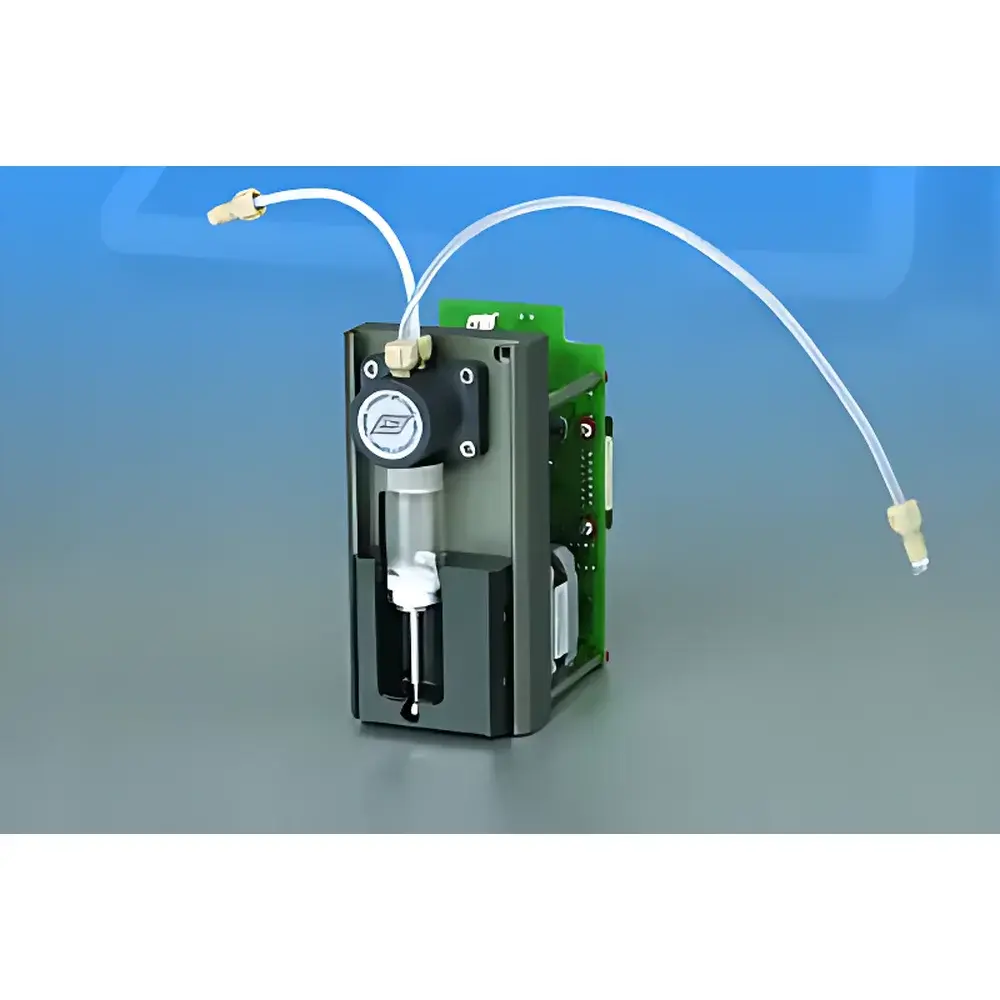
LongerPump MSP1-E1 Industrial Syringe Pump
| Brand | LongerPump |
|---|---|
| Origin | Hebei, China |
| Manufacturer Type | Direct Manufacturer |
| Product Category | Domestic |
| Model | MSP1-E1 |
| Instrument Type | Industrial Syringe Pump |
| Flow Rate | 0.5–150 mL/min |
| Accuracy | ≤1% (at rated stroke) |
| Repeatability | ≤0.5% (at rated stroke) |
| Rated Stroke | 30 mm (1000 steps) |
| Linear Speed Range | 0.5–15 mm/s |
| Stroke Execution Time | 2–60 s |
| Control Resolution | 0.03 mm/step |
| Drive Mechanism | Rack-and-pinion gear train |
| Max Piston Force | ≥68 N |
| Compatible Syringes | 500 µL, 1 mL, 2.5 mL, 5 mL |
| Valve Type | 2-Position, 3-Way Solenoid Valve |
| Valve Switching Time | ≤100 ms |
| Fluidic Path Materials | Borosilicate Glass, PTFE, PEEK |
| Max Fluidic Pressure Rating | 0.1 MPa |
| Tubing Port | 1/4"-28 internal thread |
| Syringe Mount Port | 1/4"-28 internal thread |
| TTL Input | 1 channel (≥16 mA drive current, for resume-after-hold command) |
| Open-Collector Output | 1 channel (status indication) |
| Communication Interface | RS485 / RS232 (configurable) |
| Baud Rate | 9600 or 38400 bps (selectable) |
| Device Address | BCD DIP switch (hex 0–E → decimal address 1–15) |
| Parameter Configuration | 6-position DIP switch (interface mode, baud rate, etc.) |
| Dimensions (L×W×H) | 100 × 65 × 127 mm |
| Power Supply | DC 24 V / 1.5 A |
| Operating Temperature | 15–40 °C |
| Operating Relative Humidity | <80% RH |
| Weight | 0.9 kg |
Overview
The LongerPump MSP1-E1 is an industrial-grade syringe pump engineered for high-precision fluid delivery in automated laboratory and process instrumentation environments. Based on a rack-and-pinion linear actuation architecture, it converts rotational motor motion into highly controlled, repeatable piston displacement—enabling accurate volumetric dosing over extended operational cycles. Unlike benchtop models designed for manual protocols, the MSP1-E1 is purpose-built for integration into OEM analytical systems, continuous-flow reactors, chromatographic sample introduction modules, and inline reagent dispensing platforms. Its deterministic mechanical design ensures minimal hysteresis and low thermal drift, supporting consistent performance across ambient temperature ranges (15–40 °C), constrained primarily by the thermal limits of its PTFE sealing components. The pump operates exclusively with standard Luer-lock syringes (500 µL to 5 mL), and its fluid path—comprising borosilicate glass barrels, PTFE plungers, and PEEK manifolds—is chemically inert and compatible with aqueous, organic, and mildly corrosive solutions up to 0.1 MPa pressure.
Key Features
- Precision linear actuation with rack-and-pinion transmission delivers ≤0.5% repeatability and ≤1% volumetric accuracy at full stroke—validated under ISO 8536-4 and ASTM D3418 calibration conditions.
- Configurable communication interface (RS485 or RS232) supports Modbus RTU protocol for seamless integration into SCADA, PLC, and LabVIEW-controlled automation frameworks.
- Dual-mode control architecture: local operation via front-panel DIP switches and remote command via serial interface; device addressing managed via BCD-coded hardware switch (1–15 addresses).
- Integrated 2-position, 3-way solenoid valve with ≤100 ms switching latency enables bidirectional flow routing without external manifolds—critical for sequential injection, purge-and-fill, and multi-syringe synchronization tasks.
- Real-time status monitoring via open-collector output and programmable TTL input for external pause/resume coordination—facilitating synchronized operation with spectrometers, detectors, or peristaltic pumps.
- Compact footprint (100 × 65 × 127 mm) and low mass (0.9 kg) allow panel-mounting in space-constrained enclosures while maintaining structural rigidity under continuous duty cycles.
Sample Compatibility & Compliance
The MSP1-E1 accommodates commercially available glass or plastic syringes with standardized Luer-lock fittings (500 µL, 1 mL, 2.5 mL, and 5 mL volumes). All wetted materials—including borosilicate glass barrels, PTFE piston seals, and PEEK valve bodies—meet USP Class VI biocompatibility requirements and exhibit resistance to hydrolysis, oxidation, and common organic solvents. The fluidic path is rated for continuous operation at ≤0.1 MPa (1 bar), making it suitable for gravity-fed or low-backpressure applications such as HPLC sample loops, microfluidic chip priming, and environmental sensor calibration. While not certified for medical device use per ISO 13485, its construction aligns with GLP-compliant instrument qualification practices when deployed in regulated QC/QA laboratories. Traceability of operational parameters (flow rate, stroke count, valve state) is supported through serial logging—enabling audit-ready data capture under FDA 21 CFR Part 11 when paired with compliant host software.
Software & Data Management
The MSP1-E1 does not include embedded firmware-based user interfaces or proprietary GUI software. Instead, it relies on industry-standard serial communication protocols to enable interoperability with third-party control environments. Configuration parameters—including interface selection (RS232/RS485), baud rate (9600 or 38400 bps), and device address—are set via physical DIP switches, ensuring deterministic startup behavior without firmware dependencies. Host-side implementation can be achieved using Python (pySerial), MATLAB Instrument Control Toolbox, or LabVIEW VISA drivers. Command sets follow ASCII-based command-response syntax with checksum validation, supporting real-time flow rate adjustment, stroke initiation/termination, valve actuation, and status polling. For GxP-aligned deployments, timestamped command logs and response acknowledgments may be archived externally to satisfy ALCOA+ data integrity principles.
Applications
- Automated sample introduction in UV-Vis, fluorescence, and ICP-OES analyzers requiring precise, pulse-free delivery at sub-mL/min rates.
- Controlled reagent addition in continuous-flow synthesis reactors where stoichiometric accuracy directly impacts yield and selectivity.
- Calibration fluid dispensing for gas sensors, pH probes, and conductivity meters in environmental monitoring stations.
- OEM integration into portable diagnostic platforms—leveraging its low power draw (24 V/1.5 A), compact form factor, and TTL-triggered resume functionality.
- Time-resolved kinetic studies involving sequential reagent mixing, enabled by coordinated valve switching and dual-syringe synchronization via daisy-chained RS485 networks.
FAQ
What syringe sizes are supported?
The MSP1-E1 is mechanically calibrated for 500 µL, 1 mL, 2.5 mL, and 5 mL Luer-lock syringes. Use outside this range may compromise accuracy and repeatability.
Is the pump compatible with Modbus RTU?
Yes—when configured for RS485 mode, the device implements a subset of Modbus RTU function codes (03h Read Holding Registers, 06h Write Single Register) for parameter read/write operations.
Can multiple MSP1-E1 units operate on a single RS485 bus?
Yes—up to 15 units may share one RS485 network using unique BCD-assigned addresses (1–15), enabling centralized orchestration of multi-channel fluid handling.
What is the minimum controllable step resolution?
The drive system resolves motion in 0.03 mm increments (1 step), corresponding to ~0.15 µL displacement when used with a 1 mL syringe (20 mm stroke length).
Does the pump support analog voltage or current input for flow control?
No—the MSP1-E1 accepts only digital commands via TTL or serial interface. Analog control requires external signal conditioning and microcontroller-based translation.



