
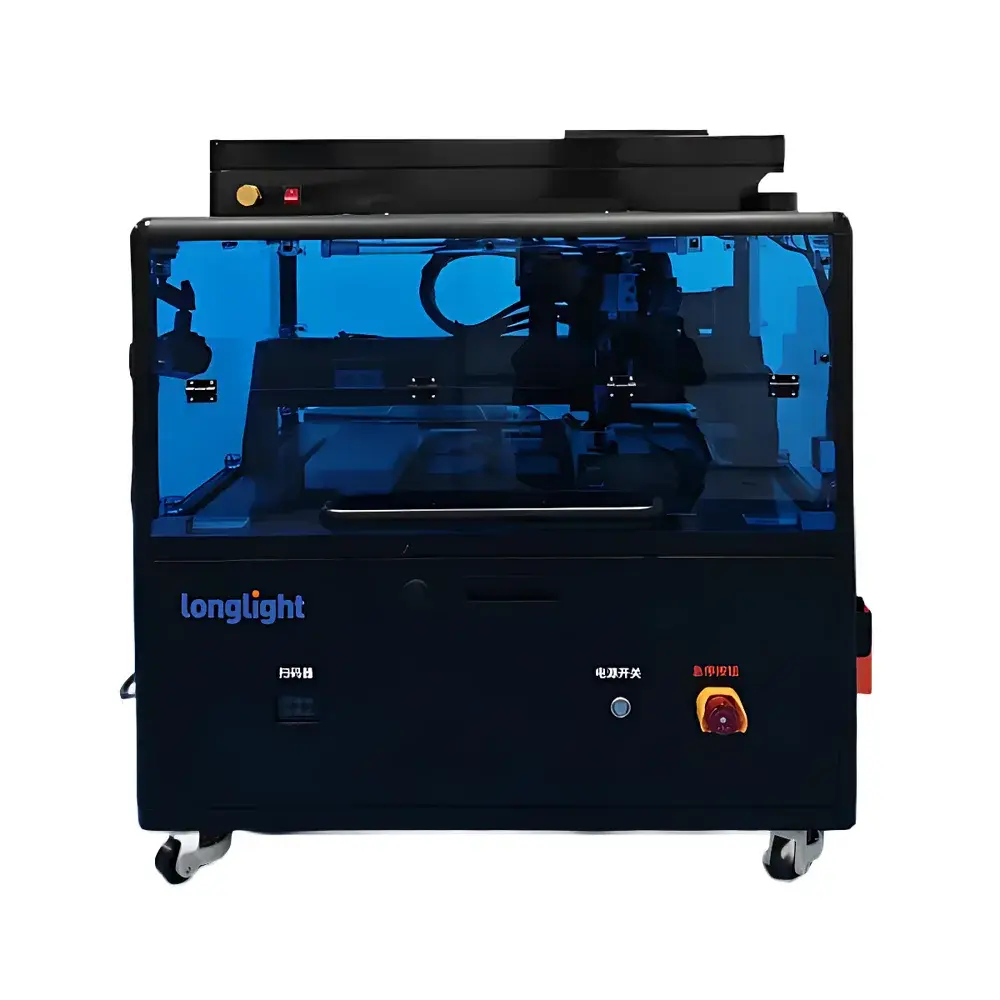
Longlight AccurPi-960 Automated Colony Picking Workstation
| Brand | Longlight |
|---|---|
| Origin | Guangdong, China |
| Manufacturer Type | OEM Manufacturer |
| Region Category | Domestic (China) |
| Model | AccurPi-960 |
| Instrument Type | Multi-pin High-Throughput Colony Picking Workstation |
| Compatible Microbial Types | Bacterial colonies (Gram-positive/negative), yeast, fungal colonies |
| Inoculation Mode | Solid-to-Liquid Transfer |
| Picking Throughput | ≥800 clones/h |
| Picking Accuracy | 99% |
| Positioning Precision | ±0.4 mm |
| Target Plate Formats | 96-well plates, 96-deep-well plates, 384-well plates |
| Source Plate Formats | Rectangular 8-channel plates, 120 mm rectangular agar plates, 120 mm multi-well agar plates, circular agar plates (60–90 mm diameter) |
| Dimensions (L×W×H) | 900 mm × 750 mm × 850 mm |
| Imaging Resolution | Micron-level pixel resolution |
| Sterile Tip Handling | Disposable sterile pipette tips per pick |
| Arm Resolution | Sub-micron positioning capability in 1/8-channel mode |
| Substrate Thickness Detection | Ultrasonic sensing module |
| Environmental Control | Integrated UV-C germicidal irradiation + HEPA H14 filtration (≥99.995% @ 0.3 µm) |
| Software Engine | AI-powered colony segmentation and classification algorithm (morphology, size, intensity, color channel analysis) |
| Data Traceability | Audit-trail-enabled logging, barcode scanning & thermal label printing support |
Overview
The Longlight AccurPi-960 Automated Colony Picking Workstation is an engineered solution for medium-to-high-throughput microbial strain isolation, designed to replace manual colony picking in academic, biotech, and pharmaceutical R&D laboratories. It operates on a vision-guided robotic platform integrating high-resolution monochrome imaging, ultrasonic substrate thickness measurement, and precision XYZ robotic motion control. The system identifies viable microbial colonies—whether unmarked, chromogenic, or fluorescence-labeled—based on morphological features (e.g., circularity, edge gradient, optical density) and spectral signatures (RGB or optional narrowband filter inputs). Each pick is executed via disposable sterile tips mounted on a multi-pin (up to 8-channel) actuator, enabling parallel transfer from source agar plates to destination microtiter plates in solid-to-liquid format. Its architecture supports reproducible, GLP-aligned workflows where traceability, contamination control, and positional fidelity are critical—particularly in CRISPR library screening, recombinant protein expression strain development, and industrial fermentation starter culture qualification.
Key Features
- High-fidelity imaging subsystem with micron-level pixel resolution and adjustable LED illumination (white + optional 365 nm UV excitation), optimized for low-contrast colony detection on opaque or semi-transparent agar media.
- Ultrasonic substrate thickness sensor dynamically calibrates Z-axis probe depth prior to each pick, compensating for batch-to-batch variations in agar pour height (range: 2–8 mm).
- Robotic arm with <0.4 mm repeatability and 1/8-channel modular pin configuration, supporting both single-colony and multi-colony parallel picking strategies without tip cross-contamination.
- Integrated biosafety enclosure featuring UV-C (254 nm) irradiation cycle (programmable pre/post-run duration) and HEPA H14 filtration (tested per EN 1822-1), maintaining ISO Class 5 (Class 100) air quality inside the working chamber.
- AI-driven image analysis engine trained on >12,000 annotated colony images; supports custom classifier training via user-uploaded ground-truth datasets (TIFF/PNG input, ROI annotation via GUI).
- Fully traceable digital logbook compliant with ALCOA+ principles: timestamps, operator ID, plate barcodes, pick coordinates, tip lot numbers, and environmental sensor readouts (UV dose, HEPA pressure drop) are embedded in each exportable .csv/.xlsx report.
Sample Compatibility & Compliance
The AccurPi-960 accommodates standard microbiological growth substrates including LB, TB, SOC, YPD, and selective media (e.g., X-Gal/IPTG, antibiotic-supplemented agars). It accepts source plates ranging from 60 mm Petri dishes to 120 mm rectangular formats, and targets 96-/384-well plates conforming to ANSI/SLAS standards. All fluidic pathways are autoclavable or disposable; no wetted metal surfaces contact samples. The system meets IEC 61000-6-2 (EMC immunity) and IEC 61000-6-3 (EMC emission) requirements. While not FDA-cleared, its audit trail, electronic signature support (via optional LDAP/Active Directory integration), and 21 CFR Part 11–ready software architecture align with GxP environments requiring validated colony isolation processes under ISO 13485 or ISO/IEC 17025 frameworks.
Software & Data Management
The workstation runs on Longlight’s proprietary ColonyTrack™ v3.2 software, built on a Qt-based cross-platform framework with SQLite backend. Core modules include: (1) Acquisition Suite (real-time focus stacking, background subtraction, dynamic thresholding); (2) Classifier Studio (drag-and-drop training interface with confusion matrix visualization); (3) Protocol Manager (modular SOP templates for streak-to-plate, replica plating, or fluorescence-gated sorting); (4) Export Hub (CSV, PDF, and LIMS-compatible XML exports with configurable metadata fields). Raw images and processed masks are stored with SHA-256 checksums; database backups support incremental encryption (AES-256). Optional API access enables integration with LabVantage, STARLIMS, or custom Python-based pipeline orchestrators.
Applications
- CRISPR-Cas9 and base-editing clone validation: isolating monoclonal populations post-transfection followed by Sanger sequencing prep.
- Directed evolution campaigns: recovering variants from mutagenesis libraries plated on selective media, with morphology-based pre-screening prior to DNA extraction.
- Recombinant expression host screening: picking colonies from autoinduction plates for microscale expression testing in 96-deep-well blocks.
- Antibiotic resistance profiling: quantifying colony count reduction across gradient plates and correlating morphology shifts with MIC values.
- Yeast two-hybrid interaction mapping: automated replica plating from master arrays onto selective dropout media with integrated β-galactosidase activity scoring.
FAQ
What types of agar plates are supported as source plates?
Standard circular Petri dishes (60–90 mm), rectangular 120 mm plates, and custom 8-channel agar strips—all compatible with standard lab-grade agar formulations.
Does the system require calibration before daily use?
Yes: a 5-minute automated calibration routine verifies tip alignment, Z-axis zero point, and illumination uniformity; results are logged and alert thresholds configurable.
Can the software distinguish between satellite colonies and true monoclonals?
Yes: the AI model incorporates proximity-based suppression logic and edge-intensity gradient analysis to suppress false positives within 1.2 mm of dominant colonies.
Is remote monitoring or troubleshooting supported?
Yes: secure HTTPS web interface provides real-time status dashboard, live camera feed (with optional RTSP streaming), and diagnostic logs accessible via corporate VPN.
How is sterility maintained during high-throughput operation?
Each pick uses a new sterile tip; UV/HEPA cycles run automatically between batches; all internal surfaces are stainless steel 316L with IP54-rated seals against aerosol ingress.
Related Products




