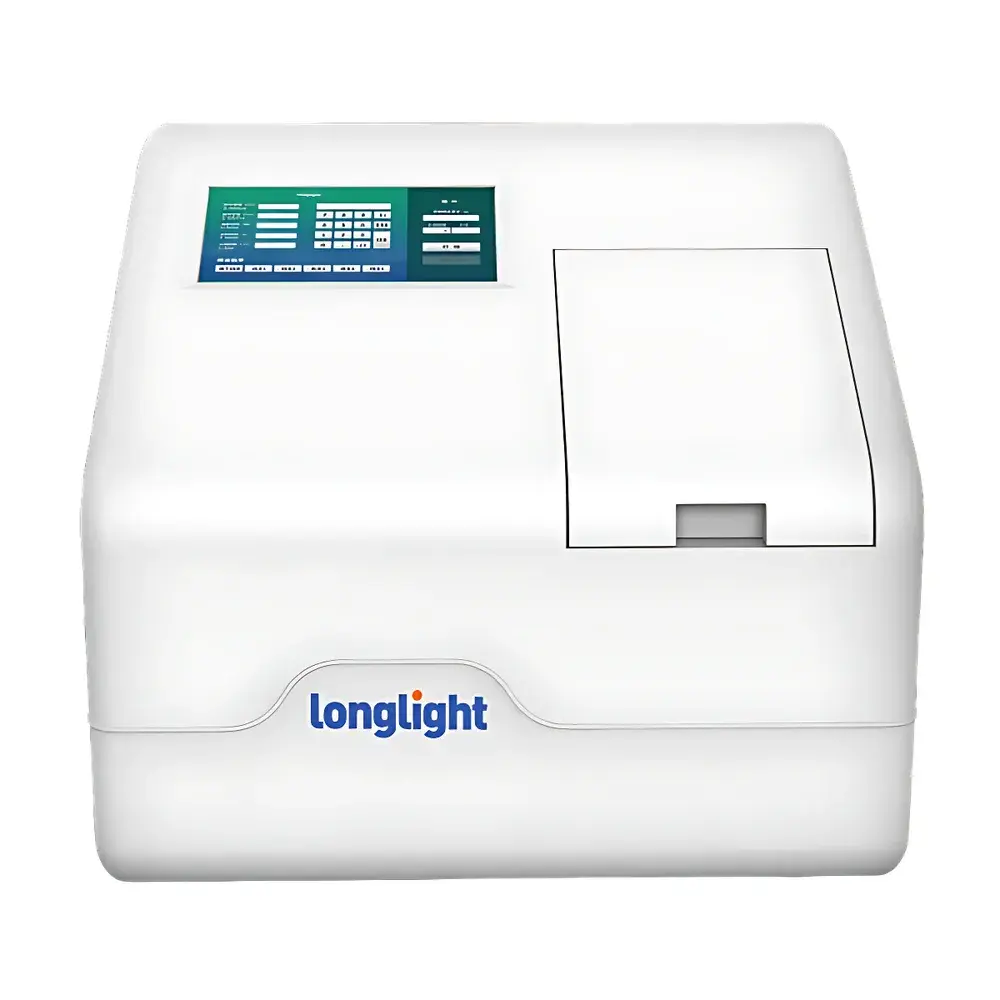
Longlight BoFU-100 Focused Ultrasonic DNA Shearer
| Brand | Longlight |
|---|---|
| Origin | Guangdong, China |
| Manufacturer Type | Direct Manufacturer |
| Origin Category | Domestic (China) |
| Model | BoFU-100 |
| Quotation | Upon Request |
| Nucleic Acid Fragment Size Range | 100–5000 bp |
| Sample Throughput | 1 |
| Cooling Temperature Range | 0–25 °C |
| Power Adjustment Range | 0–100 % |
Overview
The Longlight BoFU-100 Focused Ultrasonic DNA Shearer is an engineered solution for precise, reproducible nucleic acid fragmentation based on high-frequency, short-wavelength acoustic energy delivered via confocal ultrasonic focusing. Unlike conventional bath or probe-based sonicators that rely on bulk cavitation and uncontrolled energy dispersion, the BoFU-100 employs a tightly focused acoustic beam—generated by a piezoelectric transducer array and acoustically coupled through a liquid medium—to deliver spatially confined mechanical shear forces directly within the sample volume. This principle enables deterministic control over fragment size distribution without physical probe contact, minimizing thermal load, cross-contamination risk, and sample degradation. Designed specifically for next-generation sequencing (NGS) library preparation, chromatin immunoprecipitation (ChIP), ATAC-seq, and other epigenomic workflows, the system operates within a thermally regulated environment to preserve nucleic acid integrity and enzymatic activity during shearing.
Key Features
- Confocal ultrasonic focusing technology ensures sub-millimeter spatial precision and energy localization, enabling consistent fragment size distributions across replicates.
- Non-contact sample processing eliminates probe-mediated contamination and mechanical shear artifacts associated with tip-based sonication.
- Integrated Peltier-based cooling system maintains sample temperature between 0 °C and 25 °C with ±0.5 °C stability; real-time feedback from embedded high-sensitivity thermistors enables dynamic power modulation to suppress localized heating.
- Single-sample chamber design accommodates standard 1.5 mL microcentrifuge tubes and compatible low-binding PCR strips, supporting volumes from 20 µL to 300 µL.
- Intuitive touchscreen interface allows parameter entry—including amplitude (0–100 %), duration, and pulse mode—with preconfigured protocols for common applications (e.g., “ChIP-seq DNA”, “ATAC-seq nuclei”, “RNA shearing”).
- Compact all-in-one architecture requires no external chiller, PC, or auxiliary hardware—reducing footprint and simplifying validation in GLP/GMP-compliant environments.
Sample Compatibility & Compliance
The BoFU-100 is validated for use with genomic DNA, fragmented chromatin, isolated nuclei, total RNA, and protein–nucleic acid complexes. Its non-contact operation supports sensitive samples including FFPE-derived nucleic acids, low-input clinical specimens (<10 ng), and enzymatically active complexes requiring strict thermal management. The system complies with IEC 61000-6-3 (EMC emissions) and IEC 61000-6-2 (immunity). While not certified to ISO/IEC 17025, its operational repeatability (CV < 5% for fragment size distribution at 300 bp target) meets internal QC requirements aligned with ISO 20387 (biobanking) and ASTM E2912-22 (standard guide for nucleic acid fragmentation verification). Data audit trails and user-access logs support adherence to FDA 21 CFR Part 11 when integrated into validated laboratory information management systems (LIMS).
Software & Data Management
The embedded firmware supports protocol storage (up to 50 user-defined methods), timestamped run logs (including power profile, temperature history, and cycle count), and USB export of CSV-formatted metadata. No proprietary software installation is required; exported logs are compatible with common bioinformatics pipelines (e.g., FastQC, Picard Tools) and LIMS interfaces via standard RESTful API extensions (available upon request). All parameter changes are recorded with operator ID and timestamp, fulfilling basic electronic record requirements under GLP and internal SOP frameworks.
Applications
- Preparation of sequencing libraries for Illumina, PacBio, and Oxford Nanopore platforms.
- Chromatin fragmentation in ChIP-seq, CUT&RUN, and CUT&Tag assays.
- Nucleosome positioning studies requiring narrow fragment size windows (e.g., 147 ± 10 bp).
- Controlled RNA shearing for RNA-seq and ribosome profiling.
- Cell lysis and nuclear isolation from primary tissues and suspension cultures without chemical or enzymatic treatment.
- Homogenization of viscous biological matrices (e.g., sputum, biofilm lysates) prior to nucleic acid extraction.
FAQ
What fragment size distribution can be achieved with the BoFU-100?
Typical D50 values range from 100 bp to 5000 bp, controllable via amplitude, duration, and pulse duty cycle; narrow distributions (D90/D10 < 2.5) are routinely obtained for 150–800 bp targets.
Is the system compatible with automated liquid handlers?
Yes—the sample chamber accepts standard ANSI/SLAS-format tube racks; integration with robotic arms is supported via optional trigger I/O port (TTL-compatible).
How is temperature uniformity verified across the sample volume?
Calibration uses NIST-traceable microprobe thermometry at three axial positions within a representative 100 µL aqueous phantom; thermal homogeneity is maintained within ±0.8 °C over the full 0–25 °C setpoint range.
Can the BoFU-100 be used for protein shearing or nanoparticle dispersion?
While optimized for nucleic acids, empirical validation has demonstrated efficacy in controlled protein complex dissociation and lipid nanoparticle size reduction—application-specific protocols require internal qualification per ISO 13485 Annex A guidelines.