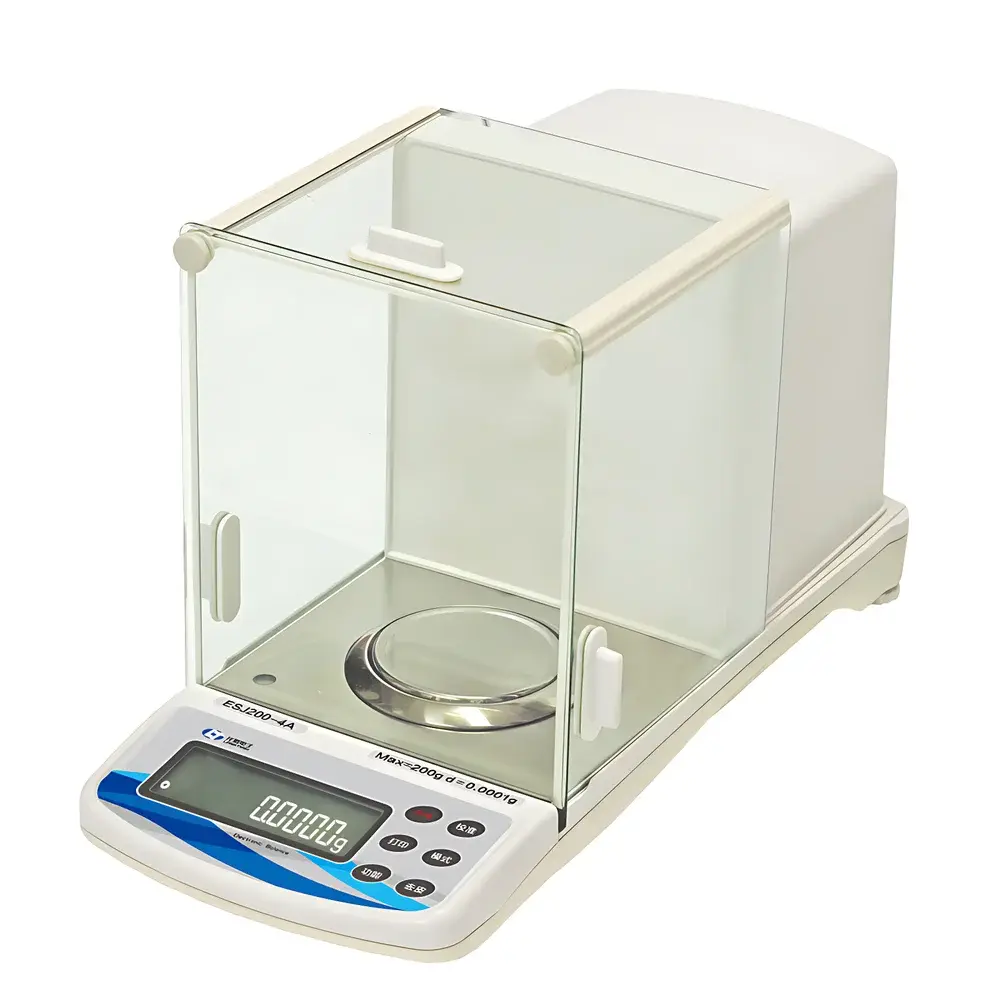
Longteng ESJ110-4A Advanced Analytical Balance with Automatic Internal Calibration
| Brand | Longteng |
|---|---|
| Origin | Liaoning, China |
| Manufacturer Type | Authorized Distributor |
| Country of Origin | China |
| Model | ESJ110-4A |
| Instrument Type | Analytical Balance |
| Maximum Capacity | 110 g |
| Readability | 0.1 mg |
| Repeatability | ±0.0001 g |
| Calibration | Fully Automatic Internal Calibration |
| Pan Diameter | Ø90 mm |
| Interface | RS232 |
| Compliance | Designed for GLP/GMP-compliant environments |
| Optional Accessories | Density determination kit (with software), below-balance weighing hook |
Overview
The Longteng ESJ110-4A is a high-precision analytical balance engineered for routine and regulated laboratory applications requiring consistent 0.1 mg readability and metrological reliability. Based on electromagnetic force compensation (EMFC) technology, it employs a rear-mounted, high-stability load cell architecture—widely adopted in ISO/IEC 17025-accredited laboratories for its low drift, minimal hysteresis, and immunity to mechanical wear. The balance operates within a triple-door draft shield enclosure, ensuring stable environmental isolation during critical mass determinations. Its design conforms to fundamental principles outlined in OIML R76 and ASTM E898–22 for analytical weighing instruments, supporting traceable measurements under variable ambient conditions—including temperature fluctuations between 10 °C and 30 °C.
Key Features
- Rear-mounted electromagnetic force sensor delivering high linearity and long-term stability across the full 110 g capacity range.
- Triple-door acrylic draft shield with optimized airflow geometry—minimizes convective interference while enabling unobstructed access to the Ø90 mm stainless-steel weighing pan.
- Automatic internal calibration system featuring built-in stainless-steel reference weights; initiates calibration automatically upon power-up, at user-defined time intervals, or in response to detected temperature shifts ≥1 °C.
- Backlit LCD display with adjustable contrast—ensures legibility under both low-light benchtop conditions and bright ambient lighting, reducing operator visual fatigue during extended QC workflows.
- Integrated temperature compensation algorithm that dynamically adjusts zero and span offsets based on real-time thermal profiling of the sensor housing.
- Comprehensive overload/underload protection with audible and visual alerts, plus automatic tare reset upon overrange recovery.
Sample Compatibility & Compliance
The ESJ110-4A accommodates standard laboratory vessels—including volumetric flasks, crucibles, and sample boats—within its spacious weighing chamber. Its Ø90 mm stainless-steel pan supports containers up to 120 mm in height when used with optional below-balance weighing hooks (sold separately). The balance meets functional requirements for ISO 9001 quality control labs and supports audit-ready documentation when paired with compliant data capture systems. While not pre-certified to FDA 21 CFR Part 11, its RS232 interface enables integration with validated third-party software platforms that provide electronic signatures, audit trails, and user access controls required for GxP environments.
Software & Data Management
Data output is supported via standard RS232 serial protocol (no USB or Ethernet), compatible with legacy lab information systems (LIS), statistical process control (SPC) software, and thermal label printers. Output formats include ASCII text with configurable delimiters and prefix/suffix identifiers. Optional density determination functionality requires installation of dedicated firmware and external density kit hardware—including immersion basket, sinker, and temperature-compensated liquid density module—enabling solid density calculations per ASTM D792 and ISO 1183-1. All calibration events—including date, time, ambient temperature, and deviation values—are logged internally and retrievable via serial query commands.
Applications
This balance serves as a foundational instrument in pharmaceutical formulation labs (e.g., active pharmaceutical ingredient [API] dispensing), academic research settings (gravimetric analysis, stoichiometric reagent preparation), and industrial QA/QC departments performing raw material verification, tablet weight variation testing (per USP ), and moisture content validation. Its repeatability of ±0.0001 g ensures compliance with pharmacopeial requirements for Class I and II analytical procedures. The unit also supports counting mode for uniform-part inventory management and percentage weighing for formulation scaling—functions routinely employed in food safety testing and polymer additive blending.
FAQ
What is the recommended calibration frequency for GLP-compliant use?
For continuous operation in regulated environments, internal calibration should be performed at startup, after every 2-hour interval, and following any significant ambient temperature change (>1 °C). External verification using certified Class E2 or better weights is advised daily.
Does the balance support direct connection to modern LIMS platforms?
Yes—via RS232-to-USB adapters or industrial serial servers—but requires middleware configuration to map output strings to LIMS field identifiers. No native TCP/IP or OPC UA support is provided.
Is the internal calibration weight traceable to national standards?
The integrated stainless-steel calibration mass is factory-adjusted against NIM (National Institute of Metrology, China)-certified references; full traceability documentation is available upon request with purchase order confirmation.
Can the ESJ110-4A perform dynamic weighing (e.g., filling or dosing monitoring)?
No—it lacks real-time streaming mode or analog output; all readings are stabilized point measurements. For continuous mass monitoring, a dedicated dynamic balance or load-cell-based system is recommended.
What maintenance is required to sustain 0.1 mg performance?
Bi-weekly cleaning of the draft shield and pan with lint-free ethanol wipes; annual sensor diagnostic verification by authorized service technician; avoidance of corrosive vapors and particulate-laden air streams.