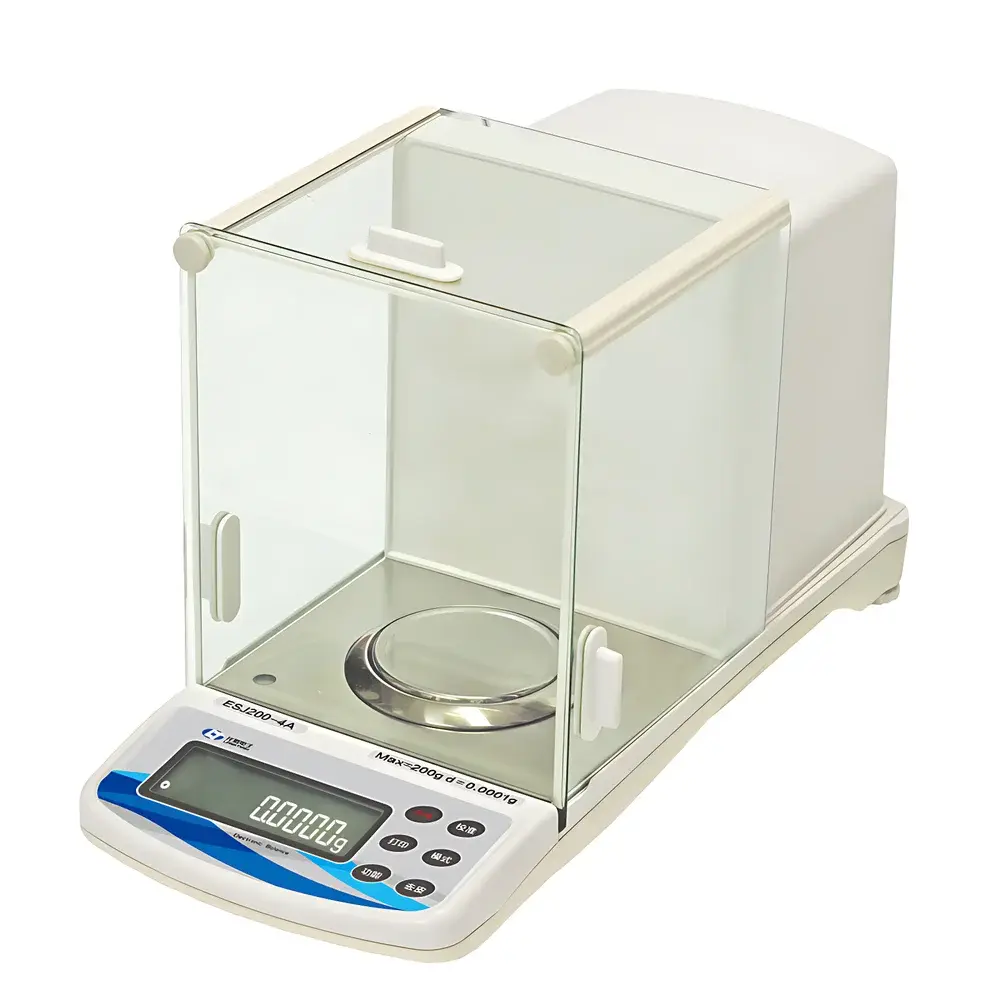
Longteng ESJ120-4A Advanced Analytical Balance with Internal Calibration
| Brand | Longteng |
|---|---|
| Origin | Liaoning, China |
| Manufacturer Type | Authorized Distributor |
| Product Category | Domestic |
| Model | ESJ120-4A |
| Instrument Type | Analytical Balance |
| Maximum Capacity | 120 g |
| Readability | 0.1 mg |
| Repeatability | ±0.1 mg |
| Calibration | Fully Automatic Internal Calibration |
| Pan Diameter | Φ90 mm |
| Dimensions (W×D×H) | 460 × 205 × 280 mm |
| Net Weight | 9.1 kg |
| Compliance | ISO/IEC 17025-compatible operation environment, GLP/GMP-ready data handling |
Overview
The Longteng ESJ120-4A is a high-precision analytical balance engineered for routine and regulated laboratory applications requiring reproducible mass measurements at the 0.1 mg readability level. Utilizing a rear-mounted electromagnetic force compensation sensor architecture — a globally recognized design principle for stability and thermal resilience — the instrument delivers consistent performance under variable ambient conditions. Its 120 g maximum capacity and Φ90 mm stainless-steel weighing pan accommodate standard volumetric flasks, crucibles, and sample containers commonly used in pharmaceutical QC, academic research, and materials testing labs. The balance operates on the fundamental principle of electromagnetic force restoration: when mass is placed on the pan, the system generates a counteracting electromagnetic current proportional to the gravitational load; this current is digitally converted into a stable, drift-compensated mass reading. Designed for integration into quality-controlled workflows, the ESJ120-4A supports audit-ready operation through automatic internal calibration routines and environmental drift mitigation logic.
Key Features
- Rear-mounted electromagnetic force sensor with optimized thermal mass distribution for minimized drift during extended measurement sessions.
- Triple-door draft shield with wide access aperture and ergonomic height clearance, facilitating safe handling of tall or bulky vessels without compromising air turbulence control.
- Automatic internal calibration system using built-in stainless-steel reference weights; initiates calibration upon power-up, user command, scheduled intervals, or detected temperature fluctuations ≥0.5 °C.
- Backlit LCD display with adjustable contrast and brightness — compliant with ISO 9241-307 for visual ergonomics in both low-light and high-ambient-light environments.
- Full-range tare, accumulation, subtraction, piece counting, and percentage weighing modes — all accessible via intuitive soft-key navigation.
- RS232 serial interface (standard) supporting bi-directional communication with LIMS, ELN, or statistical process control software; compatible with common printer drivers and PC-based data logging tools.
- Optional density determination kit (including sinker, thermometer input, and dedicated firmware module) enables solid and liquid density calculations per ASTM D792 and ISO 1183 standards.
Sample Compatibility & Compliance
The ESJ120-4A accommodates samples up to 120 g across diverse physical forms — powders, granules, liquids in open or capped containers, and small solid components — provided they fit within the draft shield’s internal volume (approx. 190 × 155 × 210 mm). Its stainless-steel pan and corrosion-resistant housing meet basic requirements for non-hazardous chemical exposure in ISO 15195-accredited calibration laboratories. While not certified to OIML R76 or NIST Handbook 44 out-of-the-box, the balance’s metrological behavior aligns with ISO/IEC 17025 clause 6.4.3 for equipment suitability verification. Internal calibration traceability is maintained through documented weight values stored in non-volatile memory, enabling retrospective verification during internal audits. Temperature compensation algorithms operate continuously across 10–30 °C ambient range, reducing long-term drift to ≤±0.1 mg over 8-hour continuous use (per manufacturer validation protocol).
Software & Data Management
Data output conforms to standard ASCII RS232 framing (9600 baud, 8N1), permitting direct ingestion into spreadsheet applications or validated laboratory informatics systems. Each transmitted record includes timestamp (system-generated), net weight, unit identifier, and status flags (e.g., “CAL”, “OVER”, “UNSTABLE”). Optional firmware upgrades support GLP-compliant audit trails: enabling operator ID entry, reason-for-calibration tagging, and electronic signature prompts where integrated with external authentication servers. All calibration events — including time/date stamp, pre- and post-calibration deviation, and ambient temperature at initiation — are retained in onboard memory for ≥1,000 entries. Exportable logs comply with FDA 21 CFR Part 11 foundational expectations for electronic records, though full Part 11 compliance requires supplementary IT infrastructure controls.
Applications
- Pharmaceutical formulation: active pharmaceutical ingredient (API) dispensing, excipient ratio verification, and tablet weight uniformity testing per USP .
- Academic chemistry labs: stoichiometric reagent preparation, gravimetric analysis, and molar mass determination.
- Materials science: catalyst loading quantification, thin-film deposition mass gain tracking, and powder blend homogeneity assessment.
- Food & beverage QA: moisture content determination via loss-on-drying protocols (paired with compatible drying oven), and nutritional label mass verification.
- Environmental testing labs: filter paper mass differential for particulate matter (PM₂.₅/PM₁₀) analysis per EPA Method IO-3.2.
FAQ
What is the calibration traceability path for the internal weights?
The embedded stainless-steel calibration masses are factory-adjusted against NIM (National Institute of Metrology, China)-certified standards; certificate of conformance is supplied with each unit.
Does the balance support external calibration with Class E2 or F1 weights?
Yes — the external calibration mode accepts manual intervention using certified weights; calibration data is logged separately from internal routines.
Can the RS232 interface be configured for USB or Ethernet connectivity?
No — native interface is RS232 only; USB-to-serial adapters or network-enabled serial servers may be deployed externally per IT policy.
Is density measurement functionality included by default?
No — density determination requires optional hardware (density kit) and firmware activation; sold separately.
How does the balance handle electrostatic interference during microgram-level weighing?
The draft shield features conductive acrylic panels grounded via the chassis; users are advised to employ ionizers and anti-static labware for optimal sub-milligram repeatability.