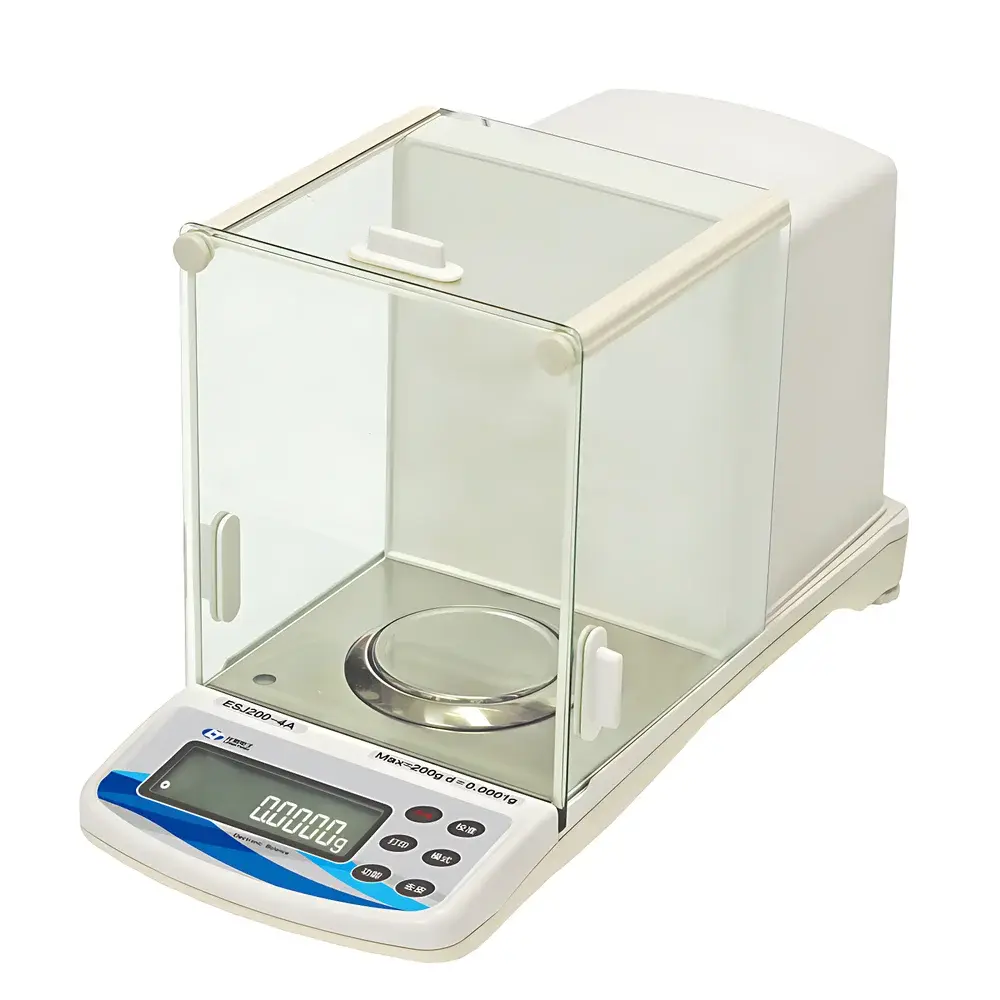
Longteng ESJ200-4A Advanced Analytical Balance with Automatic Internal Calibration
| Brand | Longteng |
|---|---|
| Origin | Liaoning, China |
| Manufacturer Type | Authorized Distributor |
| Country of Origin | China |
| Model | ESJ200-4A |
| Instrument Type | Analytical Balance |
| Maximum Capacity | 200 g |
| Readability | 0.1 mg (0.0001 g) |
| Repeatability | ≤ ±0.0001 g |
| Calibration | Fully Automatic Internal Calibration |
| Pan Diameter | Φ90 mm |
| Interface | RS232 |
| Compliance | ISO/IEC 17025–compatible operation, GLP/GMP-ready audit trail support |
Overview
The Longteng ESJ200-4A is a high-precision analytical balance engineered for routine and regulated laboratory environments requiring reliable mass measurement at the 0.1 mg readability level. It operates on the principle of electromagnetic force compensation (EMFC), where the downward gravitational force exerted by the sample is precisely counterbalanced by an upward electromagnetic force generated within a closed-loop feedback system. This architecture ensures exceptional stability, minimal drift, and long-term repeatability—critical attributes for quantitative analysis in pharmaceutical QC, academic research, materials science, and quality assurance workflows. Designed with a rear-mounted EMFC sensor and triple-door draft shield, the ESJ200-4A delivers optimized airflow control and mechanical isolation from ambient disturbances. Its robust aluminum alloy housing and stainless-steel weighing pan (Φ90 mm) provide corrosion resistance and thermal inertia, supporting consistent performance across variable lab conditions.
Key Features
- Rear-mounted high-stability electromagnetic force compensation sensor for superior linearity and low noise floor
- Triple-door acrylic draft shield with ergonomic access and wide internal chamber (≥120 mm H × Φ140 mm) for large containers or volumetric glassware
- Automatic internal calibration system with built-in stainless-steel reference weights; supports scheduled, temperature-triggered, and manual recalibration
- Backlit LCD display with adjustable brightness—optimized for both low-light and high-ambient-light environments to reduce operator eye strain
- Integrated temperature compensation algorithm that continuously monitors internal thermal gradients and adjusts gain parameters in real time
- Overload/underload protection with audible and visual alerts, full-range tare, cumulative addition/subtraction, and dynamic zero tracking
- Multi-unit weighing capability: g, mg, ct (carat), oz, lb, and % mode; configurable decimal places (1–4 digits)
Sample Compatibility & Compliance
The ESJ200-4A accommodates a broad range of sample forms—including powders, granules, liquids in beakers or vials, and small solid components—thanks to its spacious weighing chamber and removable pan support. The Φ90 mm stainless-steel pan allows compatibility with standard laboratory vessels (e.g., 100 mL beakers, crucibles, and density kits). Optional accessories include a density determination kit (with sinker, thermometer, and dedicated software module) and an under-hook assembly for suspended weighing of irregular solids or magnetic samples. From a regulatory standpoint, the balance supports GLP and GMP documentation requirements via timestamped calibration logs, user-accessible audit trails, and RS232 data export compliant with 21 CFR Part 11–aligned systems when paired with validated third-party data acquisition software. While not certified to ISO 9001 or ISO/IEC 17025 out-of-the-box, its metrological performance aligns with the uncertainty budgets defined in OIML R76 and ASTM E898–22 for Class I analytical balances.
Software & Data Management
Data output is facilitated through a standard RS232 serial interface (no USB or Ethernet), enabling direct connection to PCs, label printers, or LIMS terminals. The balance transmits stable, ASCII-formatted weight readings with optional prefixes (e.g., “W:” for weight, “T:” for tare), timestamps, and unit identifiers. When integrated into validated environments, users may employ compliant terminal emulation software (e.g., Tera Term with logging enabled) to capture traceable records meeting ALCOA+ principles (Attributable, Legible, Contemporaneous, Original, Accurate, Complete, Consistent, Enduring, Available). Firmware supports user-defined auto-print intervals and configurable data formatting, reducing post-acquisition manipulation. No proprietary software is bundled; however, the device responds to standard SCPI-like commands for remote control in automated workflows.
Applications
This balance serves as a foundational instrument in multiple technical domains: formulation and assay validation in pharmaceutical development; gravimetric preparation of standard solutions per USP ; residue-on-ignition (ROI) and loss-on-drying (LOD) testing per ASTM E1868; powder flow characterization via tapped density measurements; and stoichiometric reagent dispensing in synthetic chemistry labs. Its repeatability of ≤ ±0.0001 g enables confident detection of sub-milligram mass changes during desiccation studies or catalyst loading verification. In teaching laboratories, the intuitive interface and multi-function modes (counting, percentage, density) support pedagogical objectives without compromising metrological integrity.
FAQ
What calibration standards does the ESJ200-4A use internally?
It employs a factory-installed, traceable stainless-steel reference mass conforming to OIML R111–1 class M1 tolerances. Internal calibration is performed against this artifact without external intervention.
Is external calibration required after installation?
Yes—initial external verification using NIST-traceable weights is mandatory before first use and recommended following relocation, significant ambient temperature shifts (>5 °C), or after any mechanical shock.
Can the balance meet ISO/IEC 17025 accreditation requirements?
It provides the metrological foundation (repeatability, linearity, sensitivity) expected of Class I analytical balances; however, full accreditation requires documented uncertainty budgets, environmental monitoring, and procedural controls implemented by the end-user laboratory.
Does it support density measurement natively?
Density functionality is available only with the optional density kit (sold separately), which includes immersion accessories, temperature probe, and calculation firmware extension.
What is the warm-up time before achieving rated repeatability?
Minimum 30 minutes at stable ambient temperature (20 ±2 °C); extended stabilization (60 min) is advised for applications demanding ≤0.00005 g variation.