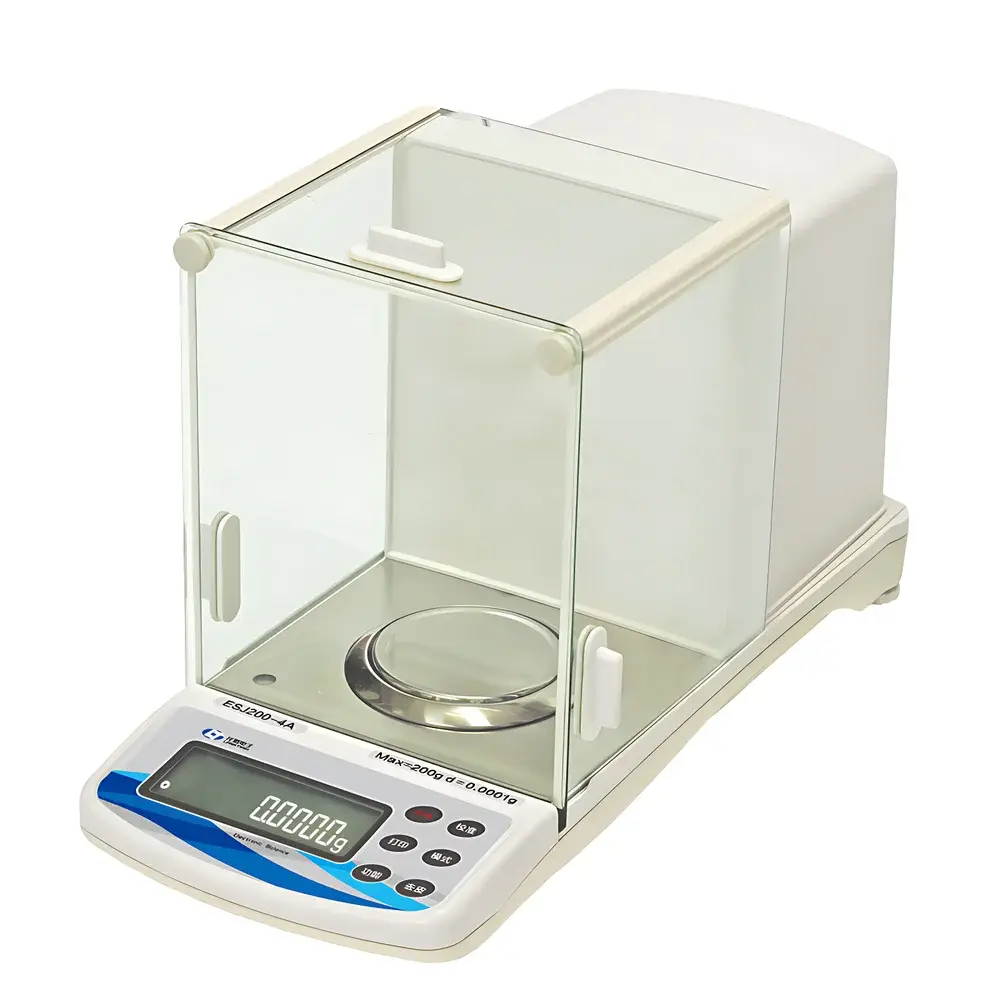
Longteng ESJ210-4A Advanced Analytical Balance with Automatic Internal Calibration
| Brand | Longteng |
|---|---|
| Origin | Liaoning, China |
| Model | ESJ210-4A |
| Type | Analytical Balance |
| Maximum Capacity | 210 g |
| Readability | 0.1 mg |
| Repeatability | ±0.1 mg |
| Calibration | Fully Automatic Internal Calibration |
| Pan Diameter | Φ90 mm |
| Display | Backlit LCD |
| Interface | RS232 |
| Compliance | ISO/IEC 17025-aligned operation, GLP/GMP-ready data traceability |
Overview
The Longteng ESJ210-4A is a high-precision analytical balance engineered for routine and regulated laboratory environments requiring consistent 0.1 mg readability and metrological reliability. It operates on the principle of electromagnetic force compensation (EMFC), where sample mass is determined by the current required to restore equilibrium in a precision coil-suspended beam system. This architecture delivers inherent linearity, minimal hysteresis, and long-term stability—critical attributes for quantitative gravimetric analysis in pharmaceutical QC, academic research, and materials testing. With a maximum capacity of 210 g and a stainless-steel Φ90 mm weighing pan, the ESJ210-4A accommodates standard volumetric flasks, crucibles, and multi-well plates without compromising draft protection or measurement integrity. Its rear-mounted EMFC sensor design enhances mechanical rigidity and reduces susceptibility to lateral load-induced drift—a known contributor to repeatability loss in high-resolution balances.
Key Features
- Rear-mounted electromagnetic force compensation (EMFC) sensor for enhanced stability, reduced thermal drift, and improved shock resistance.
- Triple-door acrylic draft shield with optimized airflow geometry—minimizes convection currents while enabling unobstructed access during multi-step weighing protocols.
- Automatic internal calibration system featuring built-in stainless-steel reference weights; supports scheduled, temperature-triggered, and manual recalibration modes per ISO 17025 Clause 6.5.2.
- Backlit monochrome LCD display with adjustable brightness—ensures legibility under variable ambient lighting conditions (e.g., fume hood interiors or low-illumination cleanrooms).
- Full-range tare, cumulative weighing, net/gross switching, and percentage weighing functions—supporting SOP-driven workflows in quality control laboratories.
- RS232 serial interface compliant with standard ASCII command protocol (e.g., “S” for stable weight output), enabling seamless integration with LIMS, ELN, or statistical process control software.
- Overload/underload detection with audible and visual alerts—prevents sensor damage and maintains calibration validity across operational cycles.
Sample Compatibility & Compliance
The ESJ210-4A is validated for use with non-corrosive, non-magnetic, and low-volatility samples typical of pharmaceutical active ingredients, reference standards, catalysts, and polymer powders. Its Φ90 mm stainless-steel pan permits direct placement of 100 mL volumetric flasks and ASTM E2234-compliant sampling containers. While not certified to OIML R76 or NIST Handbook 44 for legal-for-trade applications, the balance meets functional requirements outlined in USP “Balances” and EP 2.1.6 for analytical weighing in GxP environments. All calibration events—including time-stamped internal calibrations—are recordable via RS232 and support audit trails aligned with FDA 21 CFR Part 11 principles when paired with compliant data acquisition software.
Software & Data Management
Data output follows standard ASCII format via RS232 at 9600 baud, 8N1 configuration. Each stable reading includes timestamp (if enabled externally), unit identifier (e.g., “g”), and status flag (e.g., “S” = stable). No proprietary drivers are required; compatibility extends to generic terminal emulators (e.g., Tera Term), Excel-based macros, and validated third-party platforms such as LabWare LIMS or Thermo Fisher SampleManager. Optional density determination functionality requires external density kit (not included) and is implemented per Archimedes’ principle using air buoyancy correction algorithms compliant with ISO 1183-1. All firmware operations—including calibration logs and error codes—are stored in non-volatile memory and retrievable upon request.
Applications
- Pharmaceutical: Quantitative assay preparation, reference standard weighing, excipient blending verification per ICH Q5C.
- Academic Research: Stoichiometric reagent dispensing, catalyst loading in heterogeneous catalysis studies, and gravimetric moisture content determination (ASTM D2231).
- Materials Science: Powder density profiling, additive manufacturing feedstock characterization, and thin-film deposition mass monitoring.
- Environmental Testing: Filter weighing for total suspended solids (TSS) analysis per EPA Method 160.1.
- Food & Agriculture: Nutrient fortification verification, pesticide residue standard preparation, and mycotoxin reference material dilution.
FAQ
What calibration standards does the ESJ210-4A use internally?
It employs factory-traceable stainless-steel reference masses calibrated against national metrology institute standards (e.g., NIM China), with full calibration history documented in the device’s internal log.
Is the balance compatible with GLP-compliant electronic lab notebooks?
Yes—when connected via RS232 to validated data capture software, it supports ALCOA+ data integrity principles including attributable, legible, contemporaneous, original, accurate, complete, consistent, enduring, and available records.
Can the ESJ210-4A perform dynamic weighing or motion compensation?
No—it is designed for static, stabilized measurements only. Dynamic or vibration-prone environments require external anti-vibration tables per ISO 14644-1 Class 7 or better.
Does the unit support user-defined calibration intervals?
Yes—calibration scheduling can be configured via front-panel menu to trigger at user-specified time intervals (e.g., every 2 hours) or temperature deltas (e.g., ±1.0 °C from last calibration baseline).
What environmental conditions are recommended for optimal performance?
Operating temperature: 10–30 °C; relative humidity: ≤80 % RH non-condensing; ambient air velocity: 10 A/m), acoustic noise (>70 dB), and floor vibrations exceeding 0.5 µm peak-to-peak at 10 Hz.