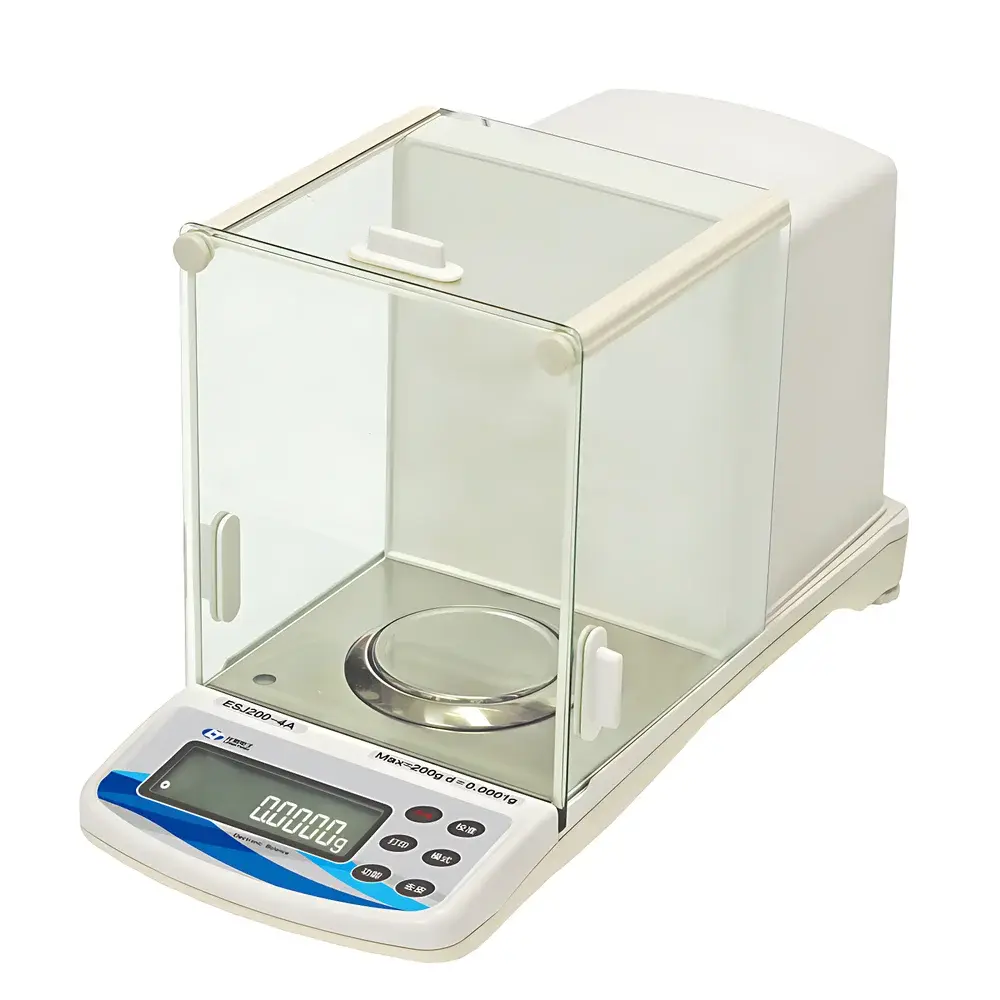
Longteng ESJ220-4A Advanced Analytical Balance with Automatic Internal Calibration
| Brand | Longteng |
|---|---|
| Origin | Liaoning, China |
| Manufacturer Type | Authorized Distributor |
| Country of Origin | China |
| Model | ESJ220-4A |
| Instrument Type | Analytical Balance |
| Maximum Capacity | 220 g |
| Readability | 0.1 mg |
| Repeatability | ±0.1 mg |
| Linearity Error | ±0.2 mg |
| Pan Diameter | Φ90 mm |
| Dimensions (W×D×H) | 460 × 205 × 280 mm |
| Net Weight | 9.1 kg |
| Calibration | Fully Automatic Internal Calibration with Temperature Compensation and Scheduled Recalibration |
Overview
The Longteng ESJ220-4A is a high-precision analytical balance engineered for routine and regulated laboratory environments requiring consistent 0.1 mg readability and long-term measurement stability. It operates on the principle of electromagnetic force compensation (EMFC), where sample mass is determined by the precisely controlled current required to restore equilibrium in a magnetic field after load application. This method ensures high reproducibility, minimal drift, and immunity to mechanical wear—critical attributes for quality control (QC), pharmaceutical formulation, chemical synthesis, and academic research workflows. Designed to meet foundational metrological requirements for Class I analytical balances per OIML R76 and ISO 9001-compliant processes, the ESJ220-4A integrates thermal compensation algorithms and automatic internal calibration routines to mitigate environmental influence—including ambient temperature fluctuations (±0.5 °C sensitivity threshold) and time-dependent sensor drift—without manual intervention.
Key Features
- Electromagnetic force compensation (EMFC) sensor with rear-mounted configuration for enhanced stability and reduced air-current interference
- Triple-door draft shield with spacious 90 mm diameter stainless-steel weighing pan—optimized for volumetric containers and multi-step gravimetric procedures
- Full internal calibration system featuring built-in stainless-steel reference weights; supports automatic recalibration triggered by time intervals, temperature shifts (>0.5 °C change), or user command
- Backlit LCD display with adjustable brightness—ensures legibility under variable lighting conditions while minimizing eye fatigue during extended operation
- Comprehensive error management: overload/underload detection, auto-zero tracking, full-range tare, accumulation and subtraction functions
- Multi-unit support: g, mg, ct (carat), oz, lb, and %—configurable via front-panel interface
- RS232 serial interface compliant with standard ASCII protocol for direct connection to PCs, label printers, or LIMS systems
Sample Compatibility & Compliance
The ESJ220-4A accommodates samples up to 220 g with dimensions compatible with standard laboratory glassware (e.g., 100 mL beakers, crucibles, and volumetric flasks). Its sealed EMFC mechanism and corrosion-resistant stainless-steel pan ensure compatibility with mildly aggressive solvents and powders. While not certified to GLP/GMP or FDA 21 CFR Part 11 out-of-the-box, the balance supports audit-ready operation when paired with compliant data capture software: all calibration events, tare actions, and weight records are timestamped and stored locally. The device conforms to general-purpose safety standards IEC 61010-1 (electrical safety) and EMC Directive 2014/30/EU. For ISO/IEC 17025-accredited labs, periodic external verification using traceable NIST- or BIPM-traceable weights (Class E2 or better) is recommended every 3–6 months depending on usage intensity.
Software & Data Management
Data export is facilitated through the RS232 port using standard asynchronous serial communication (9600 baud, 8N1). No proprietary driver is required; output follows fixed-format ASCII strings (e.g., “+000.1234 g”) compatible with Excel, LabArchives, or custom Python/Node.js ingestion scripts. Optional PC software (sold separately) enables real-time graphing, statistical reporting (mean, SD, CV%), and CSV export with metadata tagging (operator ID, location, project code). Audit trail functionality—including calibration history, firmware version, and last maintenance date—is accessible via service menu and printable upon request.
Applications
- Pharmaceutical QC: active ingredient assay, excipient blending verification, and USP repeatability testing
- Materials science: density determination (with optional density kit), powder flow characterization via loss-on-drying gravimetry
- Environmental testing: filter weighing for particulate matter (PM2.5/PM10) analysis per EPA Method 201A
- Academic teaching labs: stoichiometric reaction setup, molar mass determination, and calibration of volumetric glassware
- Food & beverage: moisture content analysis, additive dosage verification, and net weight compliance checks
FAQ
Does the ESJ220-4A support external calibration with user-provided weights?
Yes—the balance includes an external calibration mode accessible via service menu; however, internal calibration remains the default and recommended method for daily use.
Is the RS232 interface compatible with modern Windows/macOS systems?
Yes, using a USB-to-RS232 adapter (FTDI chipset recommended); no additional drivers needed for basic ASCII streaming.
What is the warm-up time required before first use?
Minimum 30 minutes at stable ambient temperature (20–25 °C); full metrological stability achieved after 60 minutes.
Can the balance perform dynamic weighing (e.g., filling control)?
No—it lacks real-time analog output or programmable relay triggers; it is optimized for static, discrete measurements.
Is the internal calibration weight traceable to national standards?
The built-in weight is factory-adjusted against certified reference masses; full traceability documentation is available upon request for accredited calibration services.