
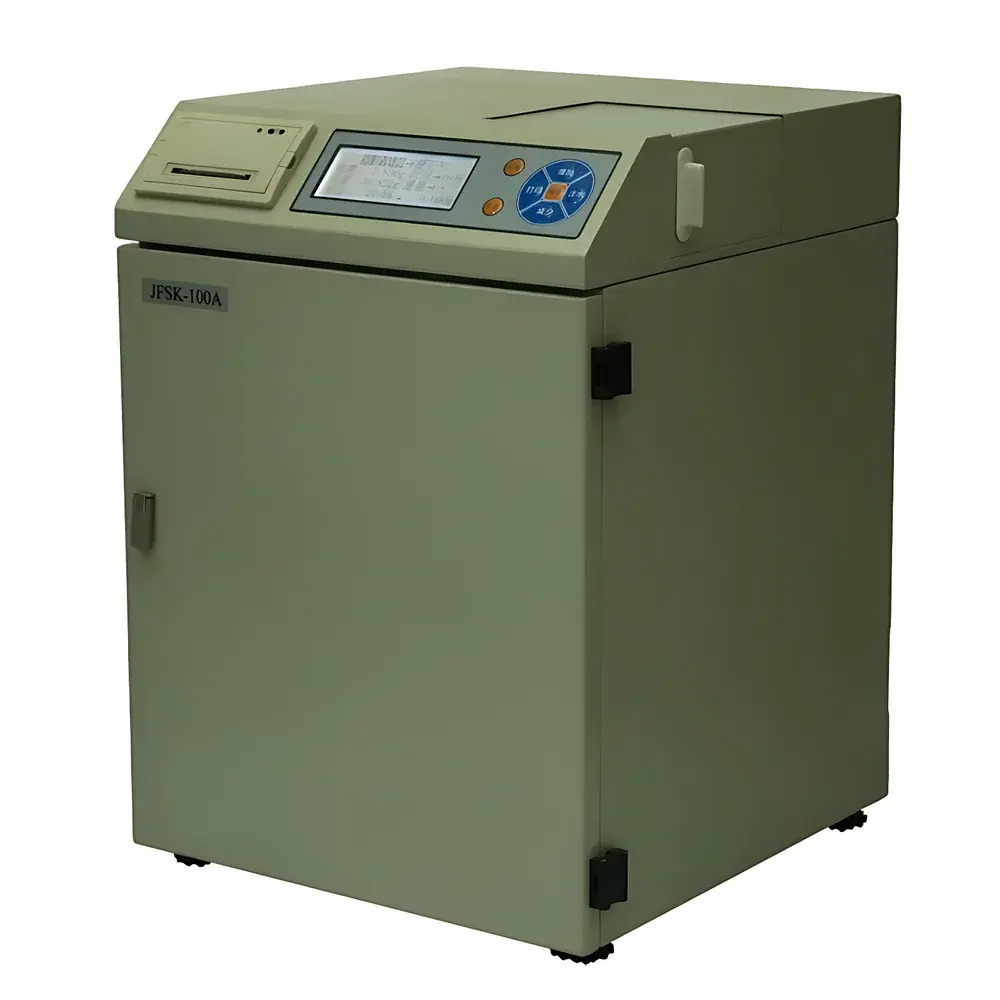
Longteng JFSK-100A Coulometric Moisture Tester for Cereals
| Brand | Longteng |
|---|---|
| Origin | Liaoning, China |
| Manufacturer Type | Authorized Distributor |
| Country of Origin | China |
| Model | JFSK-100A |
| Price | Upon Request |
| Weighing Accuracy | 1 mg |
| Weighing Range | 0–100 g |
| Moisture Measurement Error | ≤0.5% |
| Repeatability | ±0.2% |
| Sample Temperature Range | −30 to 40 °C |
| Moisture Range | 1–99% w/w |
| Measurement Time | 3–5 min |
| Recommended Sample Mass | ~9.0 g |
| Instrument Weight | 20 kg |
| Operating Voltage | 220 V ±10% |
| Dimensions (W×D×H) | 360 × 370 × 500 mm |
| Ambient Operating Temperature | 5–40 °C |
Overview
The Longteng JFSK-100A Coulometric Moisture Tester for Cereals is a dedicated, standards-compliant instrument engineered for rapid and precise determination of moisture content in non-oily cereal grains—including wheat, rice, corn, barley, oats, and sorghum. Unlike volumetric Karl Fischer titration or oven-drying methods, the JFSK-100A implements the water immersion suspension principle (also referenced as the “immersion suspension method” in Chinese national standards), a gravimetric-electrochemical hybrid technique standardized under LS/T 6103–2010 (“Grain and Oil Testing—Moisture Determination in Cereals—Water Immersion Suspension Method”). This method relies on controlled water extraction via immersion in a calibrated electrolyte solution, followed by coulometric quantification of liberated iodine during electrochemical titration at a platinum working electrode. The system integrates high-resolution microbalance functionality (1 mg readability) with real-time current integration to deliver trace-level moisture quantification across the full 1–99% w/w range. Designed for routine QC laboratories in grain elevators, feed mills, and national grain inspection agencies, the JFSK-100A operates without volatile solvents or manual endpoint detection—reducing operator dependency and improving inter-laboratory reproducibility.
Key Features
- Compliance with LS/T 6103–2010 and LS/T 3705–2010: Fully aligned with China’s national standard methodology for cereal moisture analysis, supporting regulatory reporting and inter-agency data equivalence.
- Integrated High-Precision Microbalance: 0–100 g capacity with 1 mg resolution ensures accurate sample mass input critical for gravimetric normalization in coulometric calculations.
- Optimized Electrochemical Cell Architecture: Dual-platinum electrode configuration with temperature-stabilized electrolyte chamber minimizes drift and supports stable current integration over 3–5 minute measurement cycles.
- Controlled Sample Thermal Environment: Built-in ambient temperature compensation (−30 to +40 °C sample range) mitigates thermal expansion artifacts in low-moisture grains (15%).
- Robust Mechanical Design: 20 kg cast-alloy chassis and vibration-dampened base enhance stability during weighing and electrochemical measurement phases.
- Fixed-Protocol Operation Mode: Preconfigured assay parameters (e.g., 9.0 g nominal sample mass, default electrolyte volume, fixed current threshold) reduce method validation burden for GLP-compliant environments.
Sample Compatibility & Compliance
The JFSK-100A is validated exclusively for non-oily, solid granular cereals—excluding oilseeds (e.g., soybean, rapeseed), milled flours with high surface-area-to-volume ratios, and fermented or mold-damaged grains that may interfere with immersion kinetics or generate interfering redox species. It meets the physical and metrological requirements defined in LS/T 3705–2010, including mechanical durability testing, electromagnetic compatibility (EMC) under industrial power conditions (220 V ±10%), and repeatability verification per ISO 5725-2. While not certified to ASTM E203 or AOAC 992.13, its performance profile aligns with the precision expectations for primary moisture screening in national grain procurement and storage systems. Documentation packages include calibration certificates traceable to NIM (National Institute of Metrology, China) mass standards and factory verification reports per LS/T 3705–2010 Annex B.
Software & Data Management
The JFSK-100A operates in embedded firmware mode with no external PC dependency. All measurement data—including sample ID, timestamp, mass reading, integrated charge (C), calculated moisture %, and operator ID—are stored internally in non-volatile memory (≥1,000 test records). Data export is supported via RS-232 serial interface to laboratory information management systems (LIMS) or Excel-compatible CSV files using vendor-provided terminal software. Audit trails record instrument startup/shutdown events, calibration status changes, and parameter modifications—supporting basic GLP documentation requirements. Though not compliant with FDA 21 CFR Part 11 (lacking electronic signatures and role-based access control), the device satisfies minimum data integrity criteria for internal QA audits where raw data printouts and manual logbook cross-referencing are accepted practice.
Applications
- Pre-harvest moisture screening at grain collection centers to enforce contractual moisture limits (e.g., ≤13.5% for wheat, ≤14.0% for paddy rice).
- In-process monitoring during drying operations in batch or continuous dryers, enabling real-time feedback control loops.
- Storage stability assessment: periodic moisture trending to detect condensation or localized hot-spot development in silos.
- Regulatory compliance testing for national grain reserves under State Grain Administration directives.
- Method correlation studies against reference methods (e.g., ISO 712, ICC 110/1) in accredited laboratories seeking supplementary rapid-screening capability.
FAQ
What types of grains can be analyzed with the JFSK-100A?
Non-oily cereals only—such as wheat, rice, maize, barley, rye, and millet. Oilseeds, ground flour, and processed products are excluded due to differential water release kinetics and potential electrode fouling.
Does the instrument require daily recalibration?
No. The coulometric cell is factory-calibrated using certified water standards (1000 ppm KHP in methanol). Routine verification uses 10 mg distilled water spikes; recalibration is recommended only after electrode replacement or ≥500 tests.
Can results be exported to LIMS?
Yes—via RS-232 serial output using ASCII protocol. Vendor-supplied Windows utility enables batch export to CSV; custom API integration requires third-party middleware.
Is the JFSK-100A suitable for ISO/IEC 17025-accredited labs?
It may serve as a secondary screening tool within an accredited scope, provided method validation per ISO/IEC 17025 Clause 7.2.2 is performed, including uncertainty budgeting for balance contribution, temperature effects, and electrolyte aging.
What maintenance is required beyond electrode cleaning?
Annual verification of balance linearity (using NIST-traceable weights), electrolyte replacement every 6 months (or after 200 tests), and inspection of immersion chamber seals for microleakage.




