
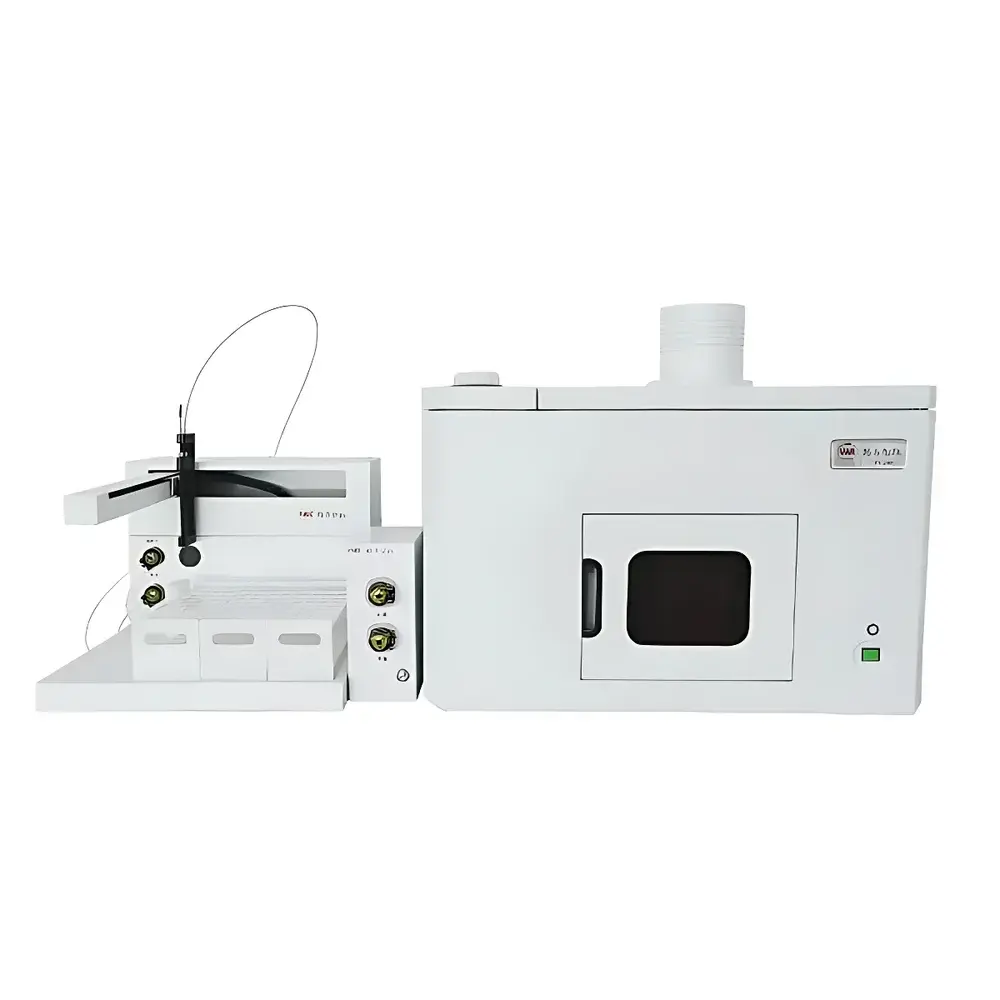
Louyi FL-200 Atomic Fluorescence Spectrometer
| Brand | Louyi SmartLink (LWL) |
|---|---|
| Origin | Fujian, China |
| Model | FL-200 |
| Instrument Type | Dual-Channel Hydride Generation Atomic Fluorescence Spectrometer (HG-AFS) |
| Sample Introduction | Peristaltic Pump |
| Waste Disposal | Peristaltic Pump Extraction |
| Sample Introduction Mode | Vapor Generation / Hydride Generation |
| Detectable Elements | Hg, As, Se, Sb, Bi, Pb, Cd, Ge, Sn, Te, Zn, Au |
| Relative Standard Deviation (RSD) | < 0.6% |
| Linear Dynamic Range | > 3 orders of magnitude |
| Detection Limits | Hg ≤ 0.001 µg/L |
| Photomultiplier Tube Wavelength Range | 160–320 nm |
Overview
The Louyi FL-200 Atomic Fluorescence Spectrometer is a dual-channel hydride generation atomic fluorescence spectrometer engineered for high-sensitivity, trace-level quantification of hydride-forming and cold-vapor elements in environmental, food, pharmaceutical, and geological matrices. Based on fourth-generation atomic fluorescence spectroscopy (AFS) architecture, the FL-200 employs vapor generation coupled with quartz-trap atomization and pulsed continuum excitation to achieve sub-ppt detection capabilities. Its measurement principle relies on the selective formation of volatile hydride species (e.g., AsH₃, SbH₃, SeH₂) or cold-vapor Hg⁰ from acid-reduced analyte solutions, followed by transport into a high-temperature quartz cell where ground-state atoms are excited by a high-intensity, microsecond-pulsed hollow cathode lamp (HCL). The resulting atomic fluorescence emission—collected at 90° to the excitation axis—is detected by a low-noise photomultiplier tube (PMT) operating within the 160–320 nm spectral window. This configuration ensures minimal spectral interference, high signal-to-noise ratio, and exceptional selectivity for target elements without requiring high-resolution monochromators.
Key Features
- Fourth-generation AFS architecture with integrated solid-state hydrogen generator—eliminates external gas cylinders and reduces reagent consumption by up to 40% compared to conventional KBH₄-based systems.
- Dual-channel simultaneous measurement capability with independent optical paths and real-time background correction, enabling concurrent analysis of paired elements (e.g., As/Hg or Sb/Bi) without cross-talk.
- Microsecond-scale pulsed HCL driver with high-duty-cycle current modulation—enhances radiant intensity by 3× while extending lamp lifetime beyond 5,000 hours and minimizing thermal drift.
- FPGA-based digital signal processing platform with time-division multiplexing (TDM), supporting 50 MHz sampling frequency and dynamic baseline correction to suppress source flicker and lamp aging effects.
- Proprietary integrated two-stage gas–liquid separator—optimized for rapid phase separation, reduced memory effect (< 0.8% carryover for 10 µg/L As), and improved response linearity at sub-ppb concentrations.
- Custom-designed short-residence quartz atomizer with thermally stabilized ignition zone and auto-monitoring piezoelectric spark igniter (rated for >1 million cycles), ensuring flame stability and immediate relight upon extinction.
- Electronic flow controller (EFC)-regulated carrier and shielding gas delivery—maintains ±0.5% flow accuracy across 0–1.2 L/min range, critical for reproducible atomization efficiency and long-term baseline stability (drift < 1.5% over 8 h).
Sample Compatibility & Compliance
The FL-200 is validated for direct analysis of aqueous digests and extracts prepared via EPA Method 200.8, ISO 17294-2:2016, and GB/T standards including GB/T 22105-2008 (soil), HJ 694-2014 (water), HJ 702-2014 (solid waste), and HJ 1133-2020 (airborne particulates). It supports sample introduction from standard 15-mL polypropylene vials and integrates seamlessly with microwave-assisted digestion systems (e.g., CEM MARS 6, Anton Paar Multiwave PRO). All analytical protocols comply with GLP requirements for audit trail generation, electronic signature support, and data integrity per FDA 21 CFR Part 11 when used with certified software modules. Instrument performance meets or exceeds detection limit specifications outlined in USP <232>, ICH Q3D, and EU Commission Regulation (EU) 2023/2006 for elemental impurities in pharmaceuticals.
Software & Data Management
The FL-200 operates under Louyi AFS Control Suite v4.2—a Windows-based application compliant with ISO/IEC 17025:2017 data handling requirements. The software provides full method development tools, including multi-point calibration with forced zero, internal standard correction (e.g., Co or Ni), spike recovery calculation, and QC charting (X-bar/R, Levey-Jennings). Raw spectral data, lamp energy logs, gas flow records, and system diagnostics are stored in encrypted SQLite databases with immutable timestamps. Audit trails capture all user actions—including method edits, result overrides, and calibration events—with role-based access control (admin/operator/analyst tiers). Export formats include CSV, PDF analytical reports, and ASTM E1382-compliant .dxp files for third-party statistical review.
Applications
The FL-200 delivers robust performance in regulated testing laboratories performing routine monitoring of toxic elements in drinking water (GB 5749-2022), rice and infant formula (GB 5009.11-2024, GB 5009.17-2021), seafood (GB 5009.93-2017), soil remediation samples (HJ 494-2019), and industrial effluents (GB/T 31962-2015). Its low detection limits and high RSD repeatability make it suitable for reference material certification (e.g., CRM 82a, GBW(E)080392), method validation studies, and interlaboratory comparison programs. The instrument is routinely deployed in national CDC laboratories, provincial environmental monitoring centers, and contract testing facilities accredited to CNAS CL01:2018 (equivalent to ISO/IEC 17025).
FAQ
What hydride-forming elements can the FL-200 quantify with certified detection limits?
Hg, As, Se, Sb, Bi, Pb, Cd, Ge, Sn, Te, Zn, and Au—all validated against national and international reference materials with documented LODs per GB/T 27404-2008.
Does the FL-200 support automated calibration and QC checks?
Yes—fully programmable calibration sequences with bracketing standards, continuing calibration verification (CCV), and automatic recalibration triggers based on signal deviation thresholds.
Is the system compatible with existing laboratory information management systems (LIMS)?
It supports ASTM E1382 and HL7 v2.5 interfaces for bidirectional data exchange, including sample ID, result values, metadata, and QC flags.
How is system performance verified during routine operation?
Built-in performance verification includes daily sensitivity checks using 1 µg/L As standard, lamp energy monitoring, gas flow calibration, and optional NIST-traceable drift correction kits.
Can the FL-200 be operated unattended overnight?
Yes—designed for 24/7 operation with hardware-level flame-out detection, automatic shutdown on error, and resume-on-restart functionality after power interruption.






