
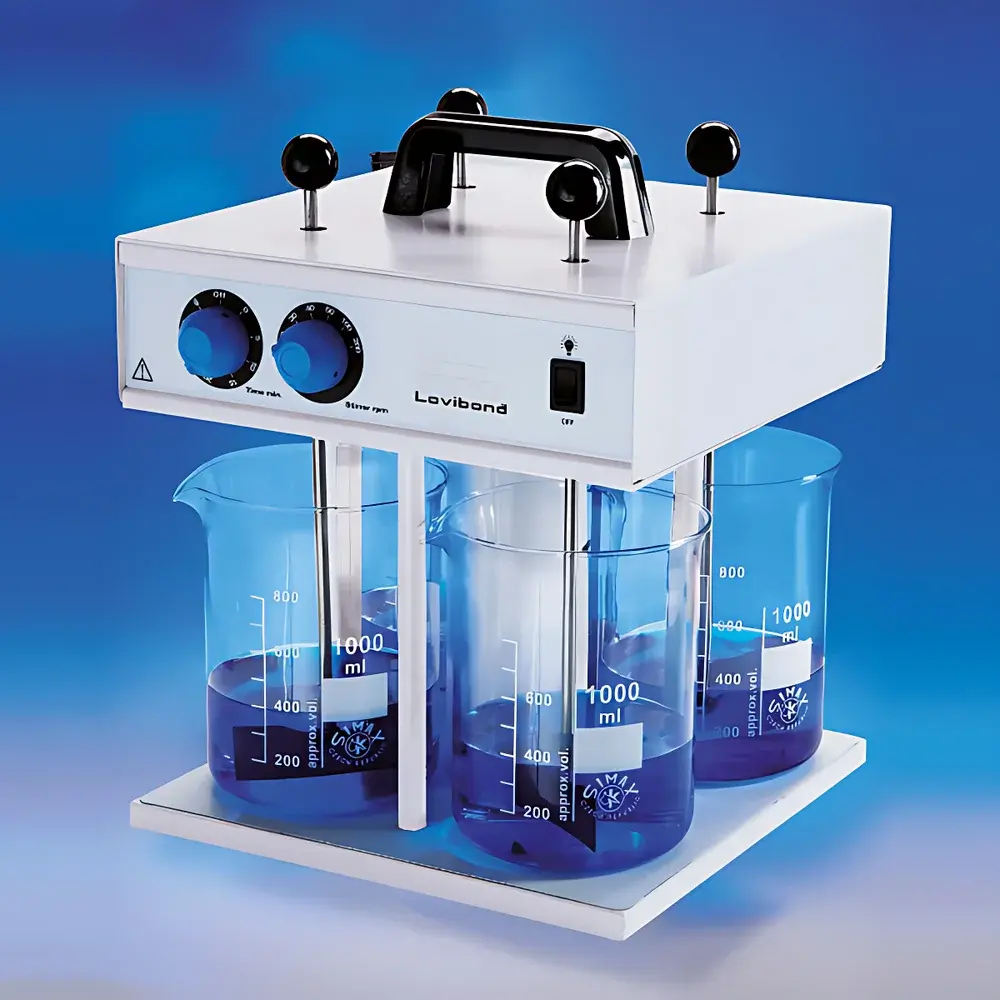
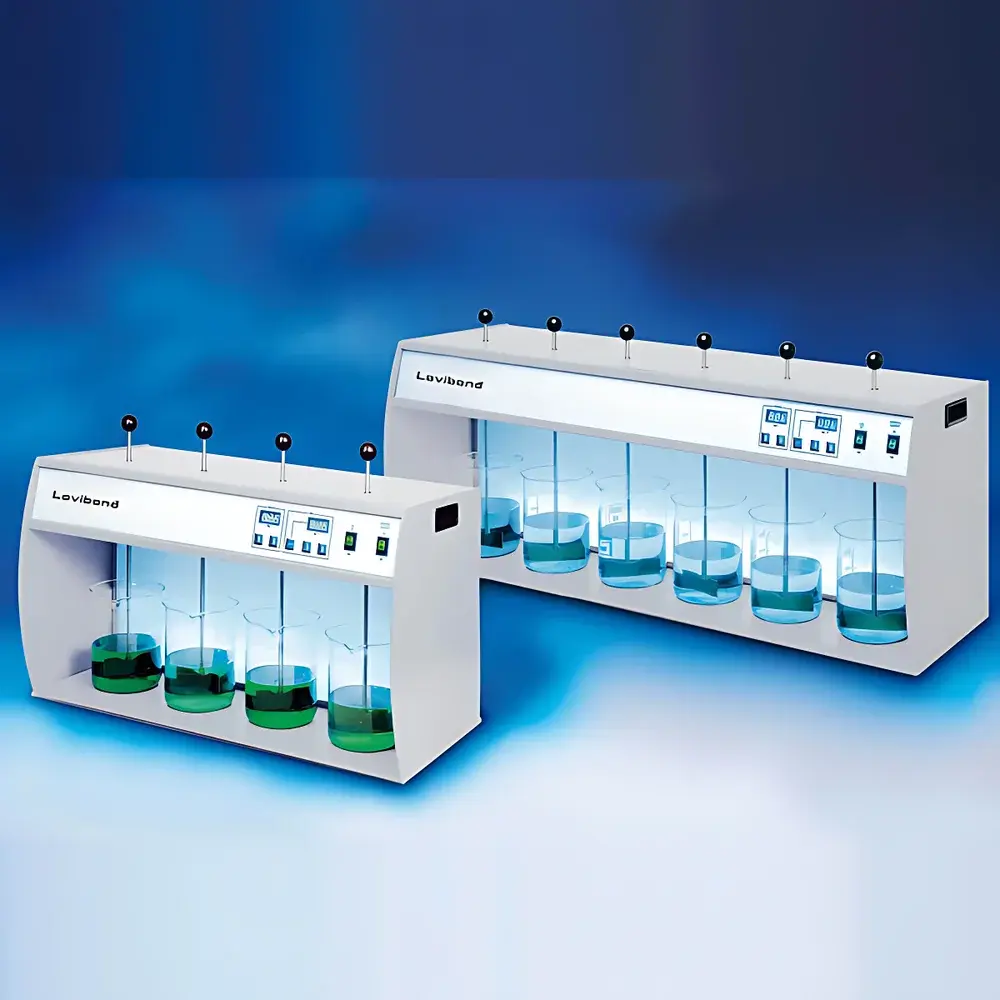
Lovibond Floc-tester Sedimentation Analyzer
| Brand | Lovibond (Tintometer) |
|---|---|
| Origin | Germany |
| Manufacturer Type | Original Equipment Manufacturer (OEM) |
| Import Status | Imported |
| Model | Floc-tester ET 730 / ET 740 / ET 750 |
| Stirring Positions | 4 (ET 730, ET 740) or 6 (ET 750) |
| Stirring Speed Range | 10–300 rpm |
| Timer Range | 0–999 min or 0–99 h (continuous) |
| Power Supply | 100–240 V AC, 50–60 Hz |
| Sample Vessel Compatibility | 1000–1500 mL beakers (ET 740/ET 750) |
| Illuminated Rear Panel | Yes |
| Application Environment | Laboratory (ET 740/ET 750) and Field-Deployable (ET 730) |
Overview
The Lovibond Floc-tester Sedimentation Analyzer is a precision-engineered benchtop instrument designed for quantitative evaluation of flocculation and sedimentation behavior in aqueous suspensions. Based on standardized jar test methodology—widely adopted in water and wastewater treatment research—the system enables controlled, reproducible simulation of coagulation-flocculation-sedimentation sequences under variable hydrodynamic conditions. Unlike optical particle counters or laser diffraction systems, the Floc-tester operates via real-time visual assessment of floc formation, settling velocity, and clarity development, making it particularly suited for process optimization of polymeric or inorganic coagulants (e.g., aluminum sulfate, ferric chloride, polyacrylamides) and for comparative screening of flocculant dosing strategies. Its modular design supports both laboratory-based method development and field-deployable validation, aligning with ASTM D2035, ISO 5667-12, and USEPA Method 100.1 guidelines for suspended solids and turbidity-related performance testing.
Key Features
- Multi-position programmable stirrer platform: 4-position (ET 730, ET 740) or 6-position (ET 750) independent stirring stations with synchronized speed control
- Digital RPM display and continuous speed adjustment from 10 to 300 rpm, enabling precise shear history replication per ASTM D3978
- Integrated high-contrast illuminated rear panel with uniform backlighting, optimized for visual observation of floc size distribution, settling front progression, and supernatant clarity
- Adjustable stirrer height mechanism—allows vertical positioning of impellers to accommodate varying beaker geometries (1000 mL to 1500 mL standard; compatible with lower or taller vessels)
- Extended-range digital timer supporting dual modes: 0–999 minutes or 0–99 hours (continuous operation), essential for long-duration settling studies and aging experiments
- Universal power input (100–240 V AC, 50–60 Hz) ensures global compatibility without external transformers
- Robust polymer housing and corrosion-resistant shafts engineered for repeated exposure to aggressive chemical environments including chlorine, alum, and iron-based coagulants
Sample Compatibility & Compliance
The Floc-tester accommodates standard borosilicate glass beakers (1000 mL for ET 730; 1000–1500 mL for ET 740/ET 750), though custom vessel integration is supported via height-adjustable clamping. It is validated for use with potable water, surface water, wastewater influent/effluent, slurry suspensions, and industrial process liquors containing particulates ranging from colloidal clay (<1 µm) to macroflocs (>1 mm). Instrument operation conforms to GLP-aligned documentation practices, with manual log entries supporting traceability for ISO/IEC 17025-accredited laboratories. While the system itself does not generate electronic audit trails, its operational parameters (speed, time, position) are directly observable and recordable—facilitating alignment with FDA 21 CFR Part 11 requirements when integrated into validated SOP workflows.
Software & Data Management
The Floc-tester operates as a standalone hardware platform with no embedded microprocessor or proprietary software. All operational parameters—including stirring speed, elapsed time, and station assignment—are set manually and monitored visually or recorded externally. This architecture eliminates firmware dependencies, reduces calibration overhead, and ensures long-term functional consistency across instrument lifecycles. Users typically document results using standardized jar test datasheets, digital photography (with scale reference), or third-party image analysis tools (e.g., ImageJ with sedimentation front tracking plugins). For regulated environments, laboratories integrate the Floc-tester into LIMS or ELN platforms via manual entry or barcode-scanned test protocols, maintaining full compliance with data integrity principles outlined in ALCOA+ (Attributable, Legible, Contemporaneous, Original, Accurate, Complete, Consistent, Enduring, Available).
Applications
- Optimization of coagulant/flocculant type and dosage in municipal drinking water treatment plants
- Evaluation of floc strength and settleability in activated sludge and anaerobic digester supernatants
- Comparative assessment of synthetic vs. natural polymer flocculants under varying pH and ionic strength conditions
- Validation of pretreatment efficiency prior to membrane filtration or dissolved air flotation (DAF)
- Research on sedimentation kinetics in reservoir management and stormwater runoff characterization
- Teaching laboratory implementation for environmental engineering curricula covering physical-chemical water treatment principles
FAQ
What standards does the Floc-tester support?
It is designed to facilitate testing in accordance with ASTM D2035 (Standard Practice for Coagulation-Flocculation Jar Tests), ISO 5667-12 (Water quality — Sampling — Part 12: Guidance on sampling of wastewater), and USEPA Method 100.1 (Turbidity).
Can the Floc-tester be used for non-aqueous suspensions?
While primarily validated for aqueous systems, limited use with low-viscosity organic solvents (e.g., ethanol/water mixtures) is possible if material compatibility of stirrer shafts and seals is confirmed—consult technical documentation before deployment.
Is calibration required?
No routine calibration is specified; however, periodic verification of stirring speed accuracy using a handheld tachometer and timer accuracy using a certified stopwatch is recommended per ISO/IEC 17025 Clause 6.5.
How is data exported or archived?
Data capture is manual: users record observations in lab notebooks, spreadsheets, or LIMS. No native digital export interface exists, ensuring simplicity and eliminating cybersecurity or software obsolescence risks.
What maintenance is necessary?
The system requires only periodic cleaning of stirrer blades and beaker holders; no lubrication, sensor recalibration, or firmware updates are needed—consistent with its “near-zero maintenance” design philosophy.



